
 Summer Camp
 Reading Writing
 Book Club
 Calligraphy
 Creative Writing
 English Speaking
 Handwriting
 Library
 Phonics
 Story Telling
 Art and Craft
 Clay Moulding
 Drawing
 Painting
 Pottery
 Sketching
 Drama Theatre
 Personality Development
 Public Speaking
 Languages
 Arabic
 Chinese
 French
 German
 Hindi
Hindi Italian
 Japanese
 Korean
 Persian
 Portuguese
 Russian
 Spanish
 Turkish
 Uzbek
Uzbek Sports and Fitness
 Aerobics
 Athletics
 Badminton
 Basket Ball
 Chess
Chess Cricket
 Football
 Golf
Golf Gymnastics
 Hulahoop
 Karate
 Martial Arts
 Pickleball
 Rugby
Rugby Skating
 Swimming
 Taekwondo
 Tennis
 Volleyball
 Yoga
Yoga Zumba
Zumba Tuition Classes
 Accounts
 Biology
 Business Studies
 CBSE
CBSE Chemistry
 Commerce
 Economics
 Homework Classes
 IB Board
 IGCSE
IGCSE Mathematics
 Physics
 Psychology
 Science
 Social Studies
 Vedic Maths
 Dance and Music
 Ballet
 Bhangra
 Bharatnatyam
 Bollywood Dance
 Casio
Casio Dandiya and Garba
 Drums
Drums Flute
Flute Guitar
 Harmonium
 Hip Hop
 Jazz
Jazz Kathak
 Keyboard
 Piano
Piano Salsa
Salsa Shlokas
 Sitar
Sitar Tabla
Tabla Ukulele
 Violin
 Vocal
Vocal PlaySchools
 Preschool
 STEM
STEM
 Abacus
 App Development
 Artificial intelligence
 Basic Computer Courses
 Canva
Canva Coding
 Graphic Design
 Lego
Lego Python
 Robotics
 Rubiks Cube
 Scrabble
 Scratch
 Website Development
 Winter Camp
 Workshops
 Diwali Workshop
 Easter
 Ganesh Mahotsav
 Guru Nanak Jayanti Workshop
 Holi
Holi Independence day workshop
 Janmashtami Workshop
 Mothers day
 Navratri Workshops
 Raksha Bandhan workshop
 Ramayana Workshop
 Spring Camp
 Valentines Day Workshops
 Festive
 Daycare
 Cooking and Food
 Spring Camp
 Contests and Competitions
 Special abled
 Republic Day Workshops
 Mela
Mela
 Mela
Mela Cognitive Development
 Mother-Toddler Program
-Jul-03-2026-06-59-25-1926-AM.webp?width=30&height=30&name=Smart_20Skills_20(2)-Jul-03-2026-06-59-25-1926-AM.webp) Smart Skills
Smart Skills
 Financial Literacy





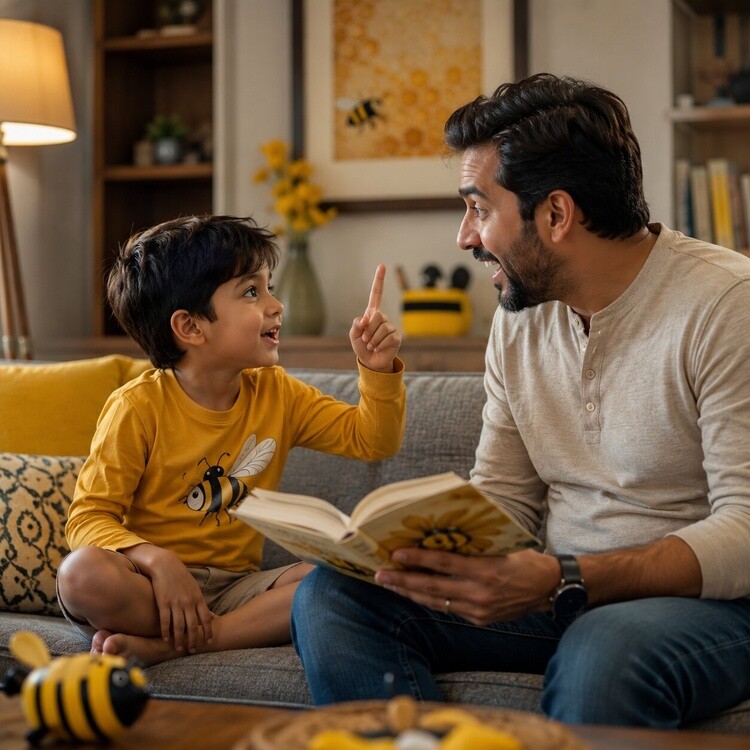
Reading aloud to a child, even after they can read independently, builds vocabulary, listening comprehension, and connection in ways independent reading alone doesn't achieve. Fifteen minutes a day is a genuinely realistic, high-value habit for even the busiest households.
Of everything covered across this reading series, reading aloud to your child may be the single highest-value, lowest-effort habit available — genuinely well-supported by research, requiring no special materials, and fitting into even the most time-constrained evening routine.
Why reading aloud matters even after independent reading develops
A child's listening comprehension level typically exceeds their independent reading level for several years — meaning a child can understand and enjoy books read aloud that are meaningfully more complex than what they could read alone, exposing them to richer vocabulary and more sophisticated storytelling earlier than independent reading would allow.
The vocabulary benefit specifically
Books, even simple ones, typically contain significantly richer vocabulary than everyday spoken conversation. Regular read-aloud sessions expose children to this richer language repeatedly, in a context (an engaging story) that makes new words stick far better than isolated vocabulary drilling.
Building genuine connection alongside literacy
Beyond the measurable academic benefits, the fifteen minutes of focused, close attention that reading aloud requires — no phones, no multitasking, just shared attention on a story — is itself valuable in a way that's easy to overlook amid busier daily demands.

Making it realistic for working parents
Fifteen minutes before bedtime is genuinely achievable for most households, even with demanding work schedules — the key is consistency of the ritual (same time, same low-key setup) rather than duration. Some families find success with a rotating arrangement, where different family members (including grandparents, in joint family settings) take turns on different nights.
What to read aloud, and how long to continue the habit
There's no fixed age to stop — many families continue reading aloud well into the early teenage years, simply shifting to more complex, chapter-length material as the child grows. The habit's value doesn't diminish once a child becomes an independent reader; it simply evolves.
Making read-aloud time genuinely engaging, not just routine
Using different voices for characters, pausing to ask what might happen next, and letting your child interrupt with questions or comments all keep read-aloud sessions feeling alive rather than mechanical.

Addressing the common worry: "isn't this making them lazy readers?"
Some parents worry reading aloud might reduce motivation for independent reading. In practice, the opposite is typically true — children who are read to regularly tend to develop stronger, more enthusiastic independent reading habits themselves, since the read-aloud experience builds genuine love for stories that then transfers to independent reading time.
A closing thought on this entire series
Everything covered across these reading and language posts — phonics, comprehension, vocabulary, storytelling, libraries — ultimately points toward the same underlying goal: a child who genuinely enjoys reading, not just one who's technically proficient at it. Of all the specific activities and strategies, reading aloud together remains one of the simplest, most enjoyable ways to build toward that goal, night after night, for years.