
 Reading Writing
 Book Club
 Calligraphy
 Creative Writing
 English Speaking
 Handwriting
 Library
 Phonics
 Story Telling
 Art and Craft
 Clay Moulding
 Drawing
 Painting
 Pottery
 Sketching
 Drama Theatre
 Personality Development
 Public Speaking
 Languages
 Arabic
 Chinese
 French
 German
 Hindi
Hindi Italian
 Japanese
 Korean
 Persian
 Portuguese
 Russian
 Spanish
 Turkish
 Uzbek
Uzbek Sports and Fitness
 Aerobics
 Athletics
 Badminton
 Basket Ball
 Chess
Chess Cricket
 Football
 Golf
Golf Gymnastics
 Hulahoop
 Karate
 Martial Arts
 Pickleball
 Rugby
Rugby Skating
 Swimming
 Taekwondo
 Tennis
 Volleyball
 Yoga
Yoga Zumba
Zumba Tuition Classes
 Accounts
 Biology
 Business Studies
 CBSE
CBSE Chemistry
 Commerce
 Economics
 Homework Classes
 IB Board
 IGCSE
IGCSE Mathematics
 Physics
 Psychology
 Science
 Social Studies
 Vedic Maths
 Dance and Music
 Ballet
 Bhangra
 Bharatnatyam
 Bollywood Dance
 Casio
Casio Dandiya and Garba
 Drums
Drums Flute
Flute Guitar
 Harmonium
 Hip Hop
 Jazz
Jazz Kathak
 Keyboard
 Piano
Piano Salsa
Salsa Shlokas
 Sitar
Sitar Tabla
Tabla Ukulele
 Violin
 Vocal
Vocal Play School
 STEM
STEM
 Abacus
 App Development
 Artificial intelligence
 Basic Computer Courses
 Canva
Canva Coding
 Graphic Design
 Lego
Lego Python
 Robotics
 Rubiks Cube
 Scrabble
 Scratch
 Website Development
 Workshops
 Diwali Workshops
 Guru Nanak Jayanti Workshop
 Halloween
 Independence day workshop
 Navratri Workshops
 Raksha Bandhan workshop
 Ramayana Workshop
 Spring Camp
 Valentines Day Workshops
 Festive
 Daycare
 Cooking and Food
 Spring Camp
 Contests and Competitions
 Special abled
 Republic Day Workshops
 Mela
Mela
 Mela
Mela Cognitive Development
 Mother-Toddler Program
 Music
Music
 Dance
Dance
-Jul-03-2026-06-59-25-1926-AM.webp?width=30&height=30&name=Smart_20Skills_20(2)-Jul-03-2026-06-59-25-1926-AM.webp) Smart Skills
Smart Skills
 Financial Literacy
 Mental Wellbeing
 Meditation
 Reiki
Reiki



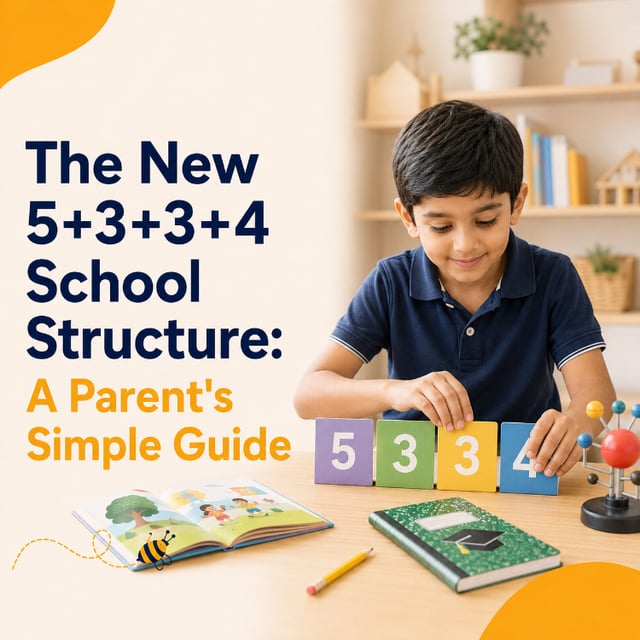
The 5+3+3+4 structure replaces India's old 10+2 schooling model with four developmentally-grounded stages. Here's what each stage actually covers and why the grouping matters more than it first appears.
The 5+3+3+4 structure sounds like education-department jargon, but the grouping logic behind it — organising school years around developmental stages rather than arbitrary grade numbers — is worth understanding, since it explains many of the smaller changes parents encounter without context.
Stage one: Foundational (ages 3-8)
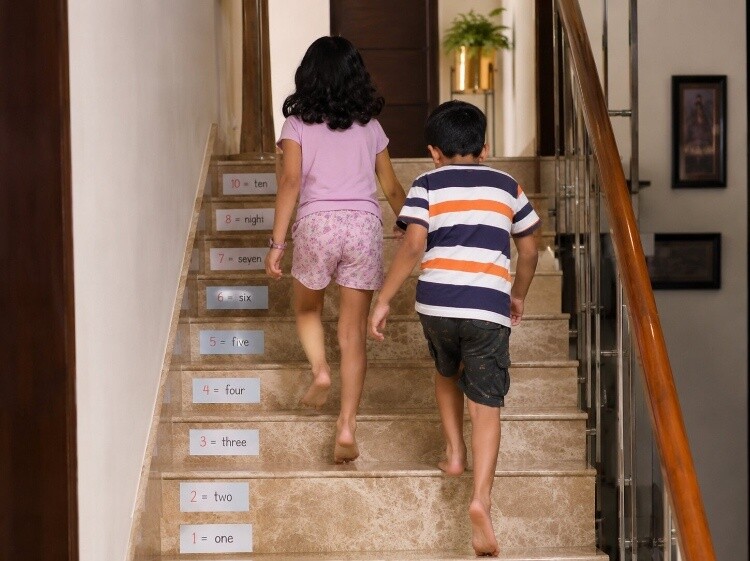
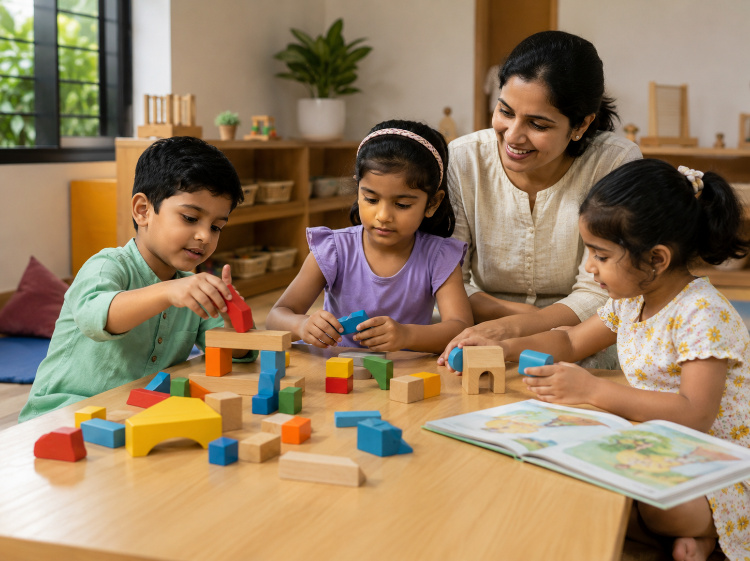
Covers three years of pre-primary (often anganwadi, nursery, and LKG/UKG-equivalent years) plus Classes 1 and 2 — five years total, treated as one continuous developmental phase. The unifying idea: children in this age range learn best through play, exploration, and activity-based engagement, regardless of whether they're technically in "pre-school" or "formal school." This is why Classes 1-2 increasingly look and feel different from how many parents remember their own early schooling — less worksheet-heavy, more activity-based, explicitly by design.

Stage two: Preparatory (ages 8-11)
Classes 3, 4, and 5 — a bridge phase introducing more formal, subject-based learning (distinct subjects like science and social studies emerging more clearly) while still emphasising discovery-based and interactive teaching methods over pure lecture-and-test formats.
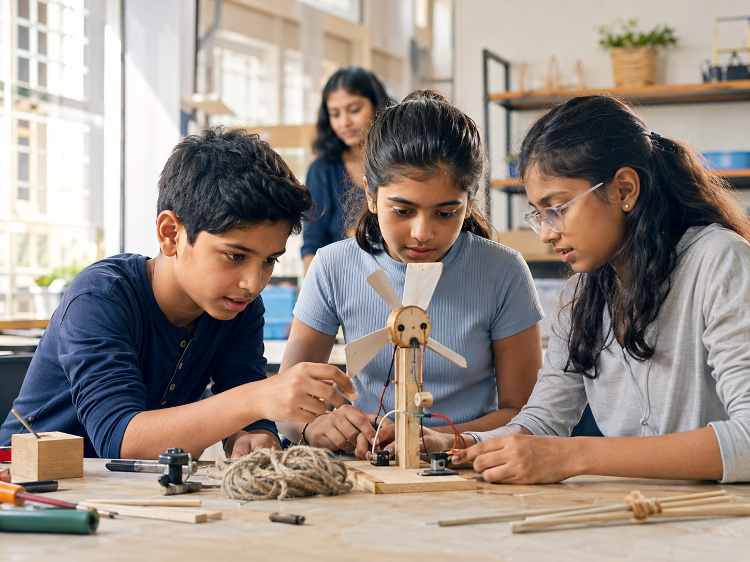
Stage three: Middle (ages 11-14)
Classes 6, 7, and 8 — introducing more abstract, critical, and experiential learning across subjects, with an increased emphasis on vocational exposure (NEP explicitly recommends vocational education familiarity beginning at this stage, a notable shift).
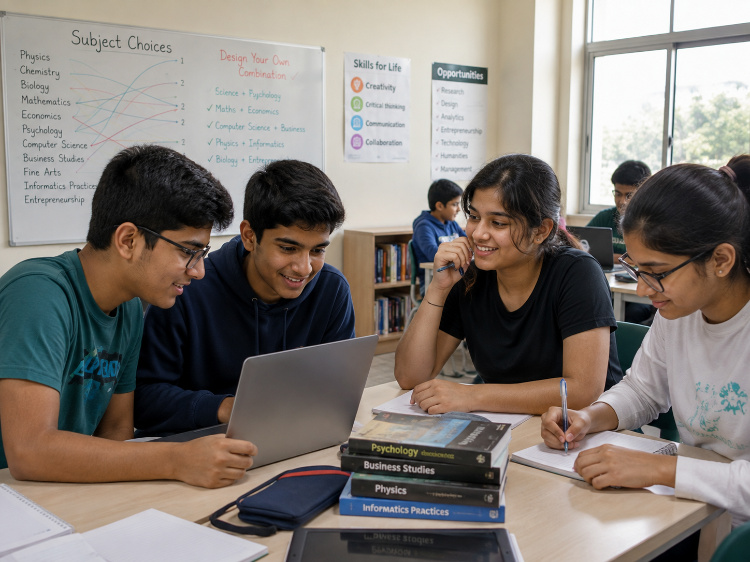
Stage four: Secondary (ages 14-18)
Classes 9 through 12, restructured internally with more flexibility in subject choice than the traditional streams (Science/Commerce/Arts) previously enforced — students can increasingly mix subjects across traditional stream boundaries.
Why the grouping logic matters for primary-level parents specifically
Understanding that Classes 1-2 are officially grouped with pre-primary (not with Classes 3-5) helps explain why NEP-aligned schools resist introducing formal exams or heavy academic pressure in these grades — it's not an isolated soft-pedagogy choice, but a structural policy position that these years are still fundamentally developmental, not yet "real school" in the exam-driven sense many parents grew up with.
What to look for as evidence a school has genuinely adopted this thinking
Beyond report card language, genuine foundational-stage alignment shows up in classroom observation: significant unstructured or activity-based time in Classes 1-2, minimal or no formal written examinations before Class 3, and teacher language focused on developmental progress rather than comparative ranking.
The transition friction worth expecting
Since implementation varies significantly by school, don't be surprised if your child's school uses some NEP language (foundational stage, holistic development) while retaining older practices in other areas (formal exams starting earlier than the framework suggests, for instance) — genuine full transition takes years across a system this large, and asking direct, specific questions about your child's actual classroom experience remains more useful than assuming policy-level change has fully arrived everywhere at once.