
 Summer Camp
 Reading Writing
 Book Club
 Calligraphy
 Creative Writing
 English Speaking
 Handwriting
 Library
 Phonics
 Story Telling
 Art and Craft
 Clay Moulding
 Drawing
 Painting
 Pottery
 Sketching
 Drama Theatre
 Personality Development
 Public Speaking
 Languages
 Arabic
 Chinese
 French
 German
 Hindi
Hindi Italian
 Japanese
 Korean
 Persian
 Portuguese
 Russian
 Spanish
 Turkish
 Uzbek
Uzbek Sports and Fitness
 Aerobics
 Athletics
 Badminton
 Basket Ball
 Chess
Chess Cricket
 Football
 Golf
Golf Gymnastics
 Hulahoop
 Karate
 Martial Arts
 Pickleball
 Rugby
Rugby Skating
 Swimming
 Taekwondo
 Tennis
 Volleyball
 Yoga
Yoga Zumba
Zumba Tuition Classes
 Accounts
 Biology
 Business Studies
 CBSE
CBSE Chemistry
 Commerce
 Economics
 Homework Classes
 IB Board
 IGCSE
IGCSE Mathematics
 Physics
 Psychology
 Science
 Social Studies
 Vedic Maths
 Dance and Music
 Ballet
 Bhangra
 Bharatnatyam
 Bollywood Dance
 Casio
Casio Dandiya and Garba
 Drums
Drums Flute
Flute Guitar
 Harmonium
 Hip Hop
 Jazz
Jazz Kathak
 Keyboard
 Piano
Piano Salsa
Salsa Shlokas
 Sitar
Sitar Tabla
Tabla Ukulele
 Violin
 Vocal
Vocal Play School
 STEM
STEM
 Abacus
 App Development
 Artificial intelligence
 Basic Computer Courses
 Canva
Canva Coding
 Graphic Design
 Lego
Lego Python
 Robotics
 Rubiks Cube
 Scrabble
 Scratch
 Website Development
 Winter Camp
 Workshops
 Diwali Workshop
 Easter
 Ganesh Mahotsav
 Guru Nanak Jayanti Workshop
 Holi
Holi Independence day workshop
 Janmashtami Workshop
 Mothers day
 Navratri Workshops
 Raksha Bandhan workshop
 Ramayana Workshop
 Spring Camp
 Valentines Day Workshops
 Festive
 Daycare
 Cooking and Food
 Spring Camp
 Contests and Competitions
 Special abled
 Republic Day Workshops
 Mela
Mela
 Mela
Mela Cognitive Development
 Mother-Toddler Program
-Jul-03-2026-06-59-25-1926-AM.webp?width=30&height=30&name=Smart_20Skills_20(2)-Jul-03-2026-06-59-25-1926-AM.webp) Smart Skills
Smart Skills
 Financial Literacy
 Mental Wellbeing
 Meditation
 Reiki
Reiki




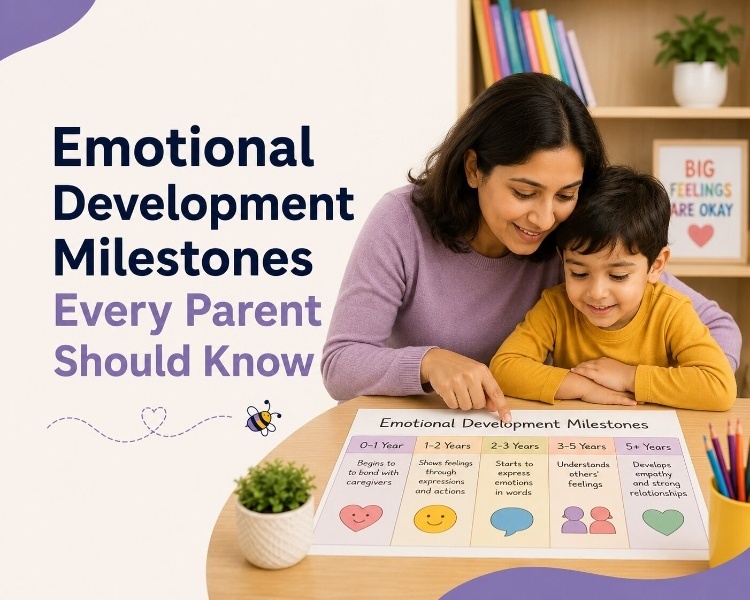
Emotional development follows its own trajectory alongside physical and cognitive growth — understanding what's typical by age helps parents respond supportively rather than worrying unnecessarily about normal emotional expression.
Emotional development is sometimes overshadowed by more visible physical or academic milestones, but it's equally important — and equally subject to a wide range of normal variation by age. Understanding general patterns helps parents respond with appropriate support rather than unnecessary concern.
Why emotional milestones vary so significantly by temperament
Beyond age-related development, individual temperament plays a significant role in emotional expression and regulation — some children are naturally more intensely emotional or more reserved than others, and this variation is a genuine, lasting personality trait rather than something to be "fixed" toward a specific expected pattern.
Supporting emotional development at each stage
Consistently naming emotions for younger children ("I can see you're feeling frustrated") builds emotional vocabulary that supports later self-regulation. Modelling healthy emotional expression as a parent (rather than suppressing or over-dramatising emotions yourself) provides a genuinely powerful example. Avoiding dismissing a child's emotional experience ("don't cry, it's not a big deal") even when the trigger seems minor from an adult perspective, since validation supports healthy emotional development even when the specific reaction seems disproportionate.
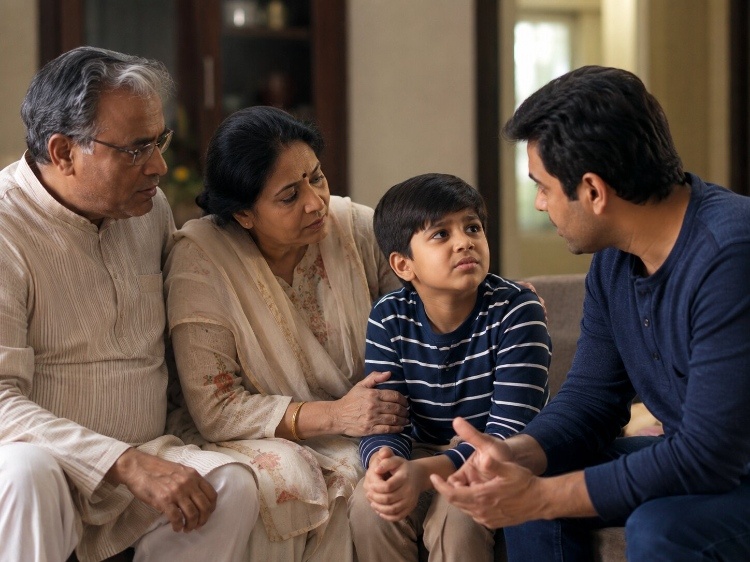
A note on emotional expression within Indian family culture
Many Indian households, particularly joint families, have strong cultural norms around emotional expression and respect toward elders — navigating this alongside supporting a child's genuine emotional development sometimes requires thoughtful balance, acknowledging cultural context while still validating a child's authentic emotional experience.

When to seek additional support
Persistent, intense emotional dysregulation well beyond what's typical for a child's age, significant difficulty forming any peer relationships, or emotional withdrawal that seems to be worsening over time are worth discussing with a paediatrician or child psychologist — not as an alarm, but as a genuinely useful step toward appropriate support if needed.