
 Summer Camp
 Reading Writing
 Book Club
 Calligraphy
 Creative Writing
 English Speaking
 Handwriting
 Library
 Phonics
 Story Telling
 Art and Craft
 Clay Moulding
 Drawing
 Painting
 Pottery
 Sketching
 Drama Theatre
 Personality Development
 Public Speaking
 Languages
 Arabic
 Chinese
 French
 German
 Hindi
Hindi Italian
 Japanese
 Korean
 Persian
 Portuguese
 Russian
 Spanish
 Turkish
 Uzbek
Uzbek Sports and Fitness
 Aerobics
 Athletics
 Badminton
 Basket Ball
 Chess
Chess Cricket
 Football
 Golf
Golf Gymnastics
 Hulahoop
 Karate
 Martial Arts
 Pickleball
 Rugby
Rugby Skating
 Swimming
 Taekwondo
 Tennis
 Volleyball
 Yoga
Yoga Zumba
Zumba Tuition Classes
 Accounts
 Biology
 Business Studies
 CBSE
CBSE Chemistry
 Commerce
 Economics
 Homework Classes
 IB Board
 IGCSE
IGCSE Mathematics
 Physics
 Psychology
 Science
 Social Studies
 Vedic Maths
 Dance and Music
 Ballet
 Bhangra
 Bharatnatyam
 Bollywood Dance
 Casio
Casio Dandiya and Garba
 Drums
Drums Flute
Flute Guitar
 Harmonium
 Hip Hop
 Jazz
Jazz Kathak
 Keyboard
 Piano
Piano Salsa
Salsa Shlokas
 Sitar
Sitar Tabla
Tabla Ukulele
 Violin
 Vocal
Vocal PlaySchools
 Preschool
 STEM
STEM
 Abacus
 App Development
 Artificial intelligence
 Basic Computer Courses
 Canva
Canva Coding
 Graphic Design
 Lego
Lego Python
 Robotics
 Rubiks Cube
 Scrabble
 Scratch
 Website Development
 Winter Camp
 Workshops
 Diwali Workshop
 Easter
 Ganesh Mahotsav
 Guru Nanak Jayanti Workshop
 Holi
Holi Independence day workshop
 Janmashtami Workshop
 Mothers day
 Navratri Workshops
 Raksha Bandhan workshop
 Ramayana Workshop
 Spring Camp
 Valentines Day Workshops
 Festive
 Daycare
 Cooking and Food
 Spring Camp
 Contests and Competitions
 Special abled
 Republic Day Workshops
 Mela
Mela
 Mela
Mela Cognitive Development
 Mother-Toddler Program
-Jul-03-2026-06-59-25-1926-AM.webp?width=30&height=30&name=Smart_20Skills_20(2)-Jul-03-2026-06-59-25-1926-AM.webp) Smart Skills
Smart Skills
 Financial Literacy




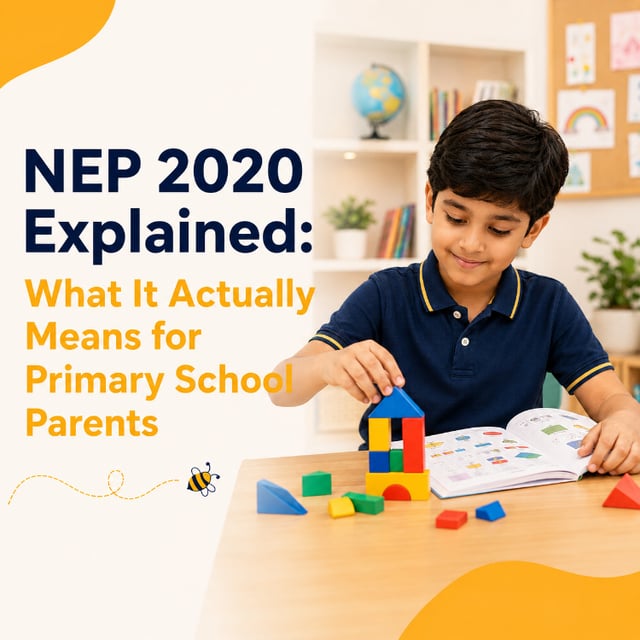
NEP 2020 is India's biggest education policy overhaul in decades, but most parents only hear fragments through WhatsApp forwards. Here's what actually changed for primary school specifically, stripped of policy jargon.
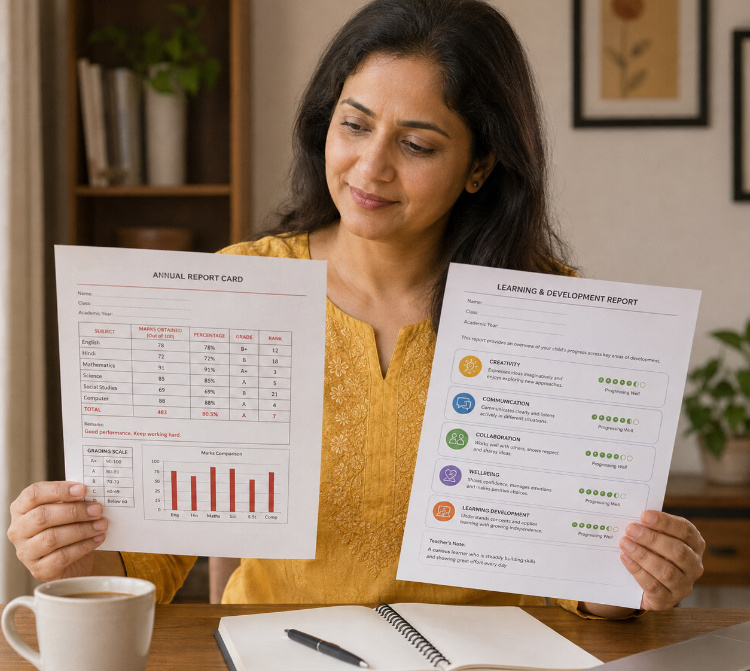
If your child started school in the last few years, you've probably encountered NEP-related changes without a clear explanation of what NEP actually is — a new report card format, a changed admission age cutoff, a teacher mentioning "foundational stage" instead of "nursery." The policy itself is genuinely large; here's the part that touches your child's early years.

What NEP 2020 actually is
The National Education Policy 2020 is India's first major education policy update since 1986 — a broad framework covering everything from early childhood care to higher education and vocational training. For primary-level parents, the relevant pieces are narrower than the policy's full scope.
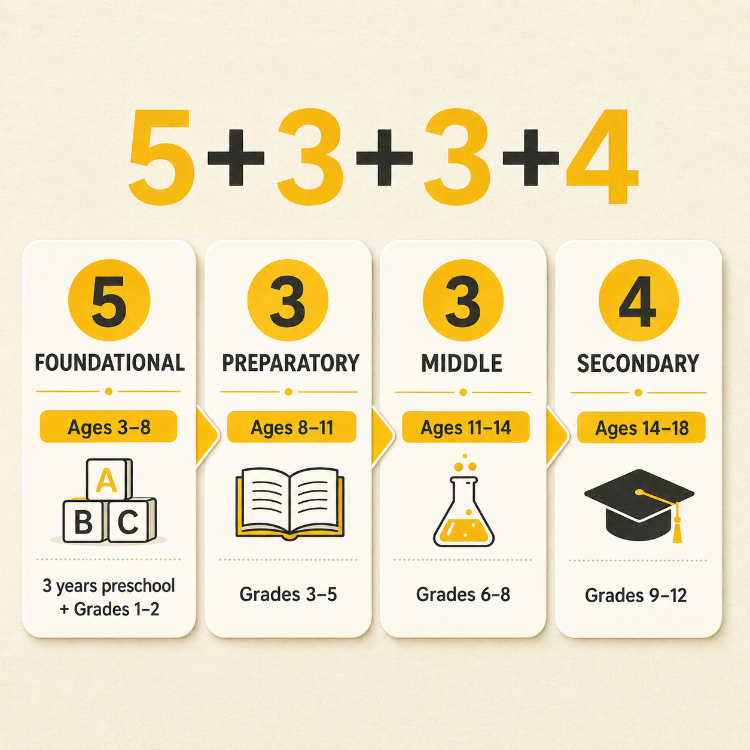
The structural change that matters most: 5+3+3+4
NEP replaces the old 10+2 schooling structure with a 5+3+3+4 model: a Foundational Stage (ages 3-8, covering three years of pre-primary plus Classes 1-2), a Preparatory Stage (ages 8-11, Classes 3-5), a Middle Stage (ages 11-14, Classes 6-8), and a Secondary Stage (ages 14-18). This means Classes 1-2 are now formally grouped with pre-primary years as one continuous "foundational" phase, not the start of formal schooling — a genuine shift in philosophy, not just naming.

What this means practically for a nursery-to-Class-2 parent
The foundational stage emphasises play-based and activity-based learning explicitly, formal reading and writing introduced gradually rather than pushed early, and significantly, no formal examination-style assessment in these years — report cards are meant to reflect development, not rank.
The admission age standardisation
NEP recommends a minimum age of 6 for Class 1 admission nationally — a change that has created genuine confusion and, in some states, admission-year gaps for children born in certain months. This is covered in detail in the next post in this series specifically for Delhi NCR and Chandigarh timelines.
What genuinely hasn't changed yet, despite the policy
NEP is a policy framework, not a single law implemented uniformly overnight — actual implementation varies by state, and by individual school, sometimes significantly. Many Delhi NCR and Chandigarh schools are mid-transition, meaning your child's specific school may reflect NEP language without having fully changed underlying practices, or vice versa. Reading policy summaries online can create expectations your specific school isn't yet meeting — the more useful move is asking your child's school directly what's actually changed in their classroom.
The genuine reassurance in the policy's own language
Whatever the implementation gaps, NEP's stated direction for early years is toward less rote learning, less rigid assessment, and more play — a direction most child development research supports, and one worth citing (gently) if your child's school still seems to be running an exam-heavy, rote-driven primary program despite claiming NEP alignment.