

 Summer Camp
 Reading Writing
 Book Club
 Calligraphy
 Creative Writing
 English Speaking
 Handwriting
 Library
 Phonics
 Story Telling
 Art and Craft
 Clay Moulding
 Drawing
 Painting
 Pottery
 Sketching
 Drama Theatre
 Personality Development
 Public Speaking
 Languages
 Arabic
 Chinese
 French
 German
 Hindi
Hindi Italian
 Japanese
 Korean
 Persian
 Portuguese
 Russian
 Spanish
 Turkish
 Uzbek
Uzbek Sports and Fitness
 Aerobics
 Athletics
 Badminton
 Basket Ball
 Chess
Chess Cricket
 Football
 Golf
Golf Gymnastics
 Hulahoop
 Karate
 Martial Arts
 Pickleball
 Rugby
Rugby Skating
 Swimming
 Taekwondo
 Tennis
 Volleyball
 Yoga
Yoga Zumba
Zumba Tuition Classes
 Accounts
 Biology
 Business Studies
 CBSE
CBSE Chemistry
 Commerce
 Economics
 Homework Classes
 IB Board
 IGCSE
IGCSE Mathematics
 Physics
 Psychology
 Science
 Social Studies
 Vedic Maths
 Dance and Music
 Ballet
 Bhangra
 Bharatnatyam
 Bollywood Dance
 Casio
Casio Dandiya and Garba
 Drums
Drums Flute
Flute Guitar
 Harmonium
 Hip Hop
 Jazz
Jazz Kathak
 Keyboard
 Piano
Piano Salsa
Salsa Shlokas
 Sitar
Sitar Tabla
Tabla Ukulele
 Violin
 Vocal
Vocal Play School
 STEM
STEM
 Abacus
 App Development
 Artificial intelligence
 Basic Computer Courses
 Canva
Canva Coding
 Graphic Design
 Lego
Lego Python
 Robotics
 Rubiks Cube
 Scrabble
 Scratch
 Website Development
 Winter Camp
 Workshops
 Diwali Workshop
 Easter
 Ganesh Mahotsav
 Guru Nanak Jayanti Workshop
 Holi
Holi Independence day workshop
 Janmashtami Workshop
 Mothers day
 Navratri Workshops
 Raksha Bandhan workshop
 Ramayana Workshop
 Spring Camp
 Valentines Day Workshops
 Festive
 Daycare
 Cooking and Food
 Spring Camp
 Contests and Competitions
 Special abled
 Republic Day Workshops
 Mela
Mela
 Mela
Mela Cognitive Development
 Mother-Toddler Program
-Jul-03-2026-06-59-25-1926-AM.webp?width=30&height=30&name=Smart_20Skills_20(2)-Jul-03-2026-06-59-25-1926-AM.webp) Smart Skills
Smart Skills
 Financial Literacy
 Mental Wellbeing
 Meditation
 Reiki
Reiki




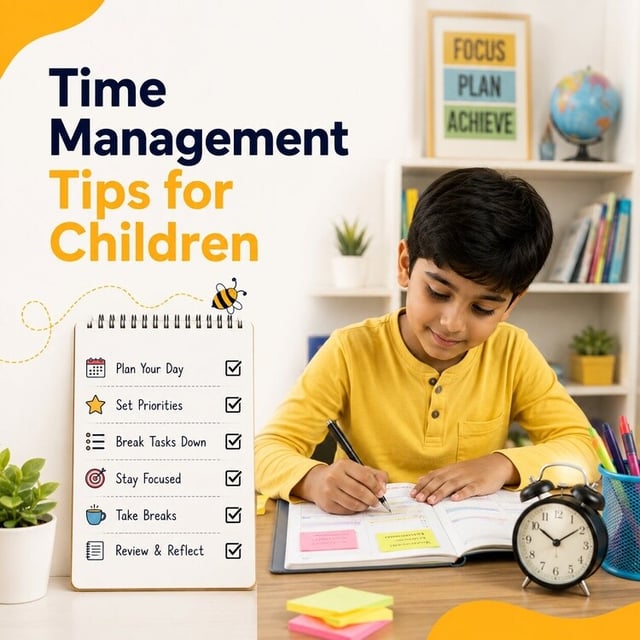
Time management for children is built through concrete tools and practice, not abstract advice — visual schedules, estimation practice, and gradually increasing self-management responsibility.
Time management is abstract for developing minds — children genuinely struggle to estimate duration and plan backward from deadlines until specifically practiced, making concrete tools far more effective than verbal instruction alone.
Time management for children is built through concrete tools and practice, not abstract advice — visual schedules, estimation practice, and gradually increasing self-management responsibility.
Time management is abstract for developing minds — children genuinely struggle to estimate duration and plan backward from deadlines until specifically practiced, making concrete tools far more effective than verbal instruction alone.
Age-appropriate approaches
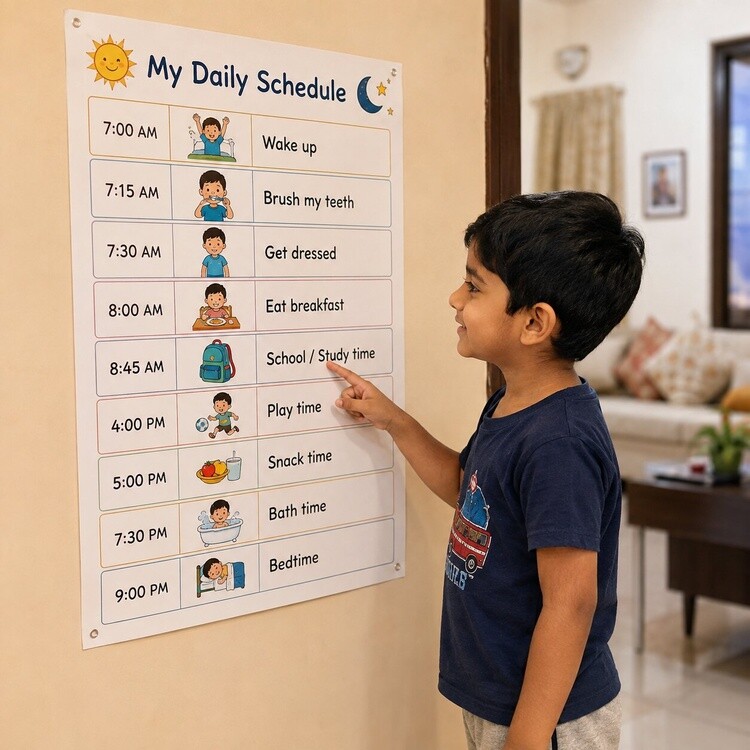
Ages 5-7 — visual daily schedules with pictures (not just words), simple timers for tasks ("finish dressing before this timer ends"), and basic sequence understanding (first this, then this).
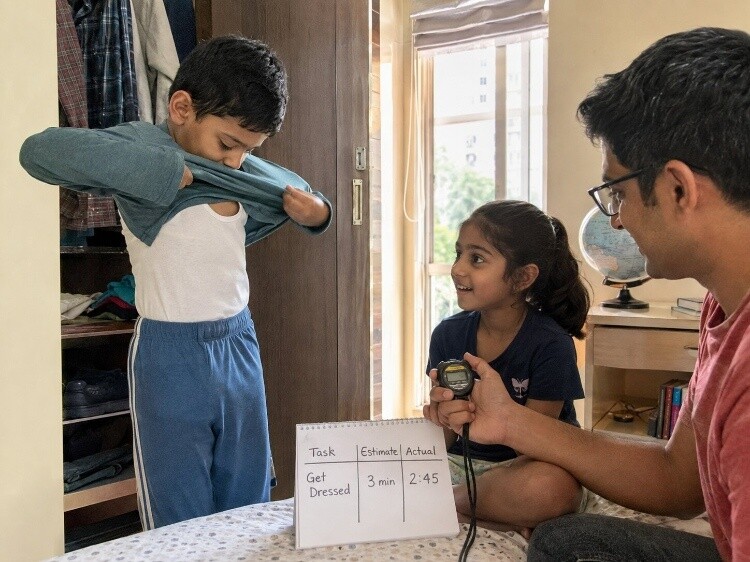
Ages 8-10 — introduction to actual clock-reading tied to real schedule management, simple planners or checklists for daily tasks, and estimation practice ("how long do you think this will take? let's check").
Ages 10-12 — managing their own homework and activity schedule with periodic check-ins rather than constant oversight, understanding and using a weekly planner or calendar, and backward-planning practice for longer-term tasks (a school project due in two weeks).
Building estimation skill specifically
Children are often wildly inaccurate estimating how long tasks take — a deliberate practice of guessing then timing actual tasks ("how long do you think getting dressed will take? let's see") builds this specific skill through repeated calibration.
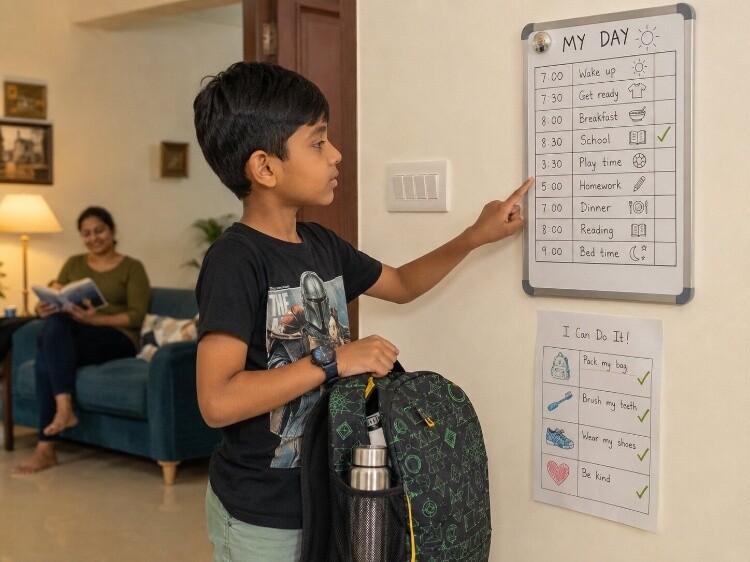
The visual schedule tool, genuinely effective
A physical, visible schedule (a chart, a whiteboard, even a simple list) that a child can reference independently reduces the constant verbal reminders that often characterise time-management struggles, and builds independent time-awareness rather than externally-prompted awareness.

Backward planning as a specific teachable skill
For older children facing longer-term tasks (school projects, extended assignments), explicitly teaching backward planning — "it's due in two weeks, so what needs to happen by next week, and what by today?" — builds a genuinely transferable planning skill that many adults never explicitly learned either.
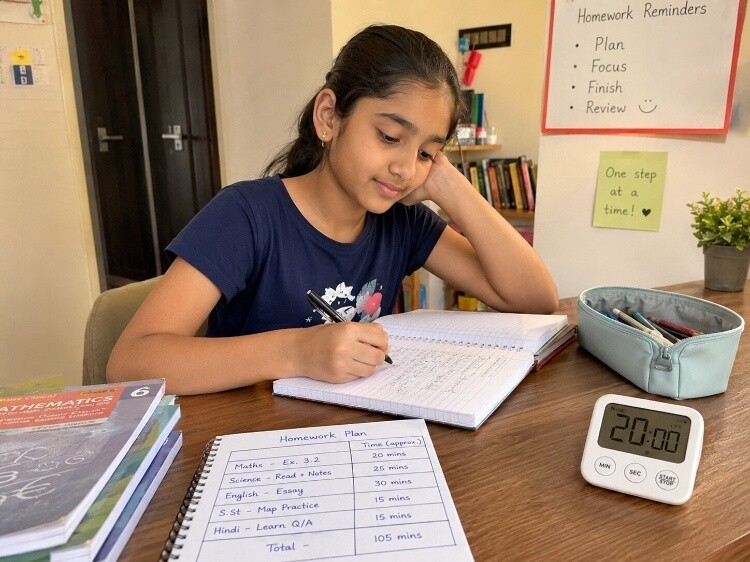
The homework-time-management connection
Much of the homework battle covered elsewhere in this content relates directly to time management — a child who's practiced estimating and planning handles the "how long will this take" anxiety that often triggers homework resistance considerably better than one for whom every task feels like an unbounded, potentially endless demand.

Balancing structure with flexibility
Rigid time management taught too early or too strictly can create anxiety rather than skill — the goal is building genuine internal time-awareness gradually, with reasonable flexibility, rather than producing a child anxious about strict schedule adherence.
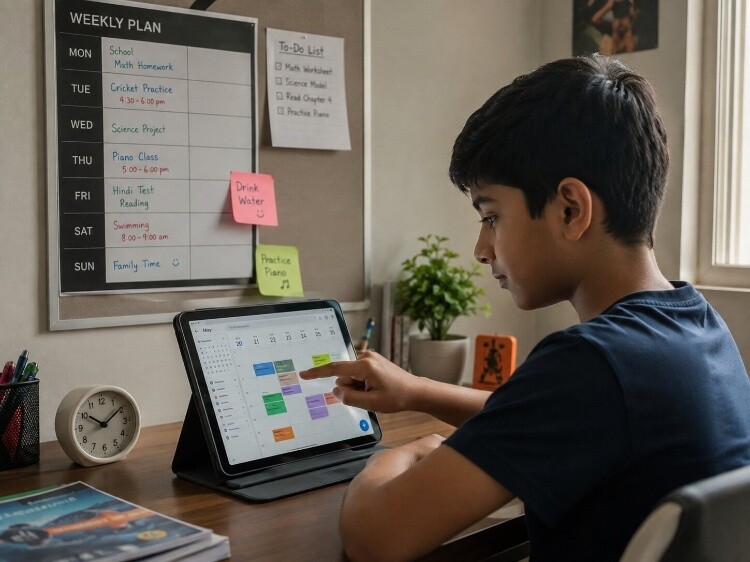
The digital tool question
Digital calendar and reminder apps can genuinely help older children (10+) manage increasingly complex schedules, though starting with physical, visual tools for younger children tends to build the underlying skill more concretely before digital abstraction.