
 Summer Camp
 Reading Writing
 Book Club
 Calligraphy
 Creative Writing
 English Speaking
 Handwriting
 Library
 Phonics
 Story Telling
 Art and Craft
 Clay Moulding
 Drawing
 Painting
 Pottery
 Sketching
 Drama Theatre
 Personality Development
 Public Speaking
 Languages
 Arabic
 Chinese
 French
 German
 Hindi
Hindi Italian
 Japanese
 Korean
 Persian
 Portuguese
 Russian
 Spanish
 Turkish
 Uzbek
Uzbek Sports and Fitness
 Aerobics
 Athletics
 Badminton
 Basket Ball
 Chess
Chess Cricket
 Football
 Golf
Golf Gymnastics
 Hulahoop
 Karate
 Martial Arts
 Pickleball
 Rugby
Rugby Skating
 Swimming
 Taekwondo
 Tennis
 Volleyball
 Yoga
Yoga Zumba
Zumba Tuition Classes
 Accounts
 Biology
 Business Studies
 CBSE
CBSE Chemistry
 Commerce
 Economics
 Homework Classes
 IB Board
 IGCSE
IGCSE Mathematics
 Physics
 Psychology
 Science
 Social Studies
 Vedic Maths
 Dance and Music
 Ballet
 Bhangra
 Bharatnatyam
 Bollywood Dance
 Casio
Casio Dandiya and Garba
 Drums
Drums Flute
Flute Guitar
 Harmonium
 Hip Hop
 Jazz
Jazz Kathak
 Keyboard
 Piano
Piano Salsa
Salsa Shlokas
 Sitar
Sitar Tabla
Tabla Ukulele
 Violin
 Vocal
Vocal Play School
 STEM
STEM
 Abacus
 App Development
 Artificial intelligence
 Basic Computer Courses
 Canva
Canva Coding
 Graphic Design
 Lego
Lego Python
 Robotics
 Rubiks Cube
 Scrabble
 Scratch
 Website Development
 Winter Camp
 Workshops
 Diwali Workshop
 Easter
 Ganesh Mahotsav
 Guru Nanak Jayanti Workshop
 Holi
Holi Independence day workshop
 Janmashtami Workshop
 Mothers day
 Navratri Workshops
 Raksha Bandhan workshop
 Ramayana Workshop
 Spring Camp
 Valentines Day Workshops
 Festive
 Daycare
 Cooking and Food
 Spring Camp
 Contests and Competitions
 Special abled
 Republic Day Workshops
 Mela
Mela
 Mela
Mela Cognitive Development
 Mother-Toddler Program
-Jul-03-2026-06-59-25-1926-AM.webp?width=30&height=30&name=Smart_20Skills_20(2)-Jul-03-2026-06-59-25-1926-AM.webp) Smart Skills
Smart Skills
 Financial Literacy
 Mental Wellbeing
 Meditation
 Reiki
Reiki




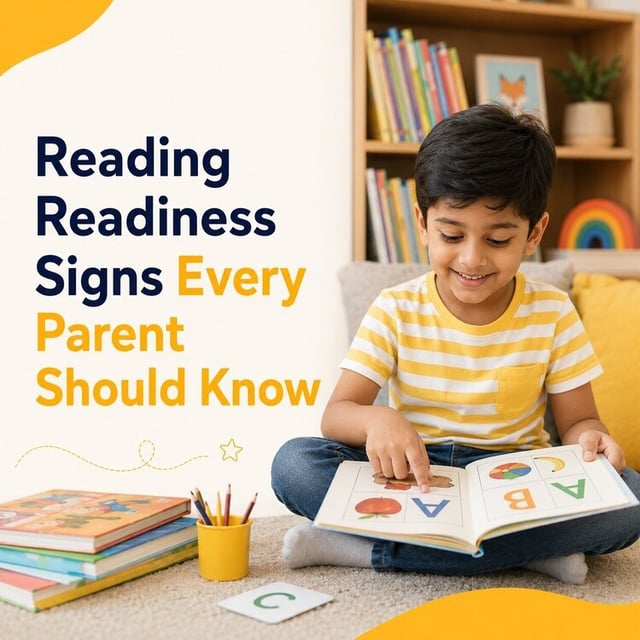
Reading readiness is a cluster of signs — sound awareness, print interest, letter knowledge, story comprehension — not an age. Recognising the cluster prevents both premature pushing and missed momentum.
"When should my child start reading?" has no calendar answer — it has a signs answer. The readiness cluster, once visible, makes learning fast and joyful; pushed before it, the same content produces struggle and aversion.
The signs that matter
Phonological awareness — hearing rhymes, catching initial sounds, clapping syllables — the strongest single predictor of reading ease.
Print motivation — reaching for books, requesting reads, pretend-reading to toys — wanting it.
Print awareness — knowing text runs left-to-right, that words (not pictures) carry the story, where a book starts.
Letter familiarity — recognising some letters, especially their name's — interest, not mastery, is the sign.
Narrative comprehension — following and retelling simple stories, predicting endings — understanding language at story scale.
Name recognition and writing attempts — the first word nearly every child reads and writes is their own name.
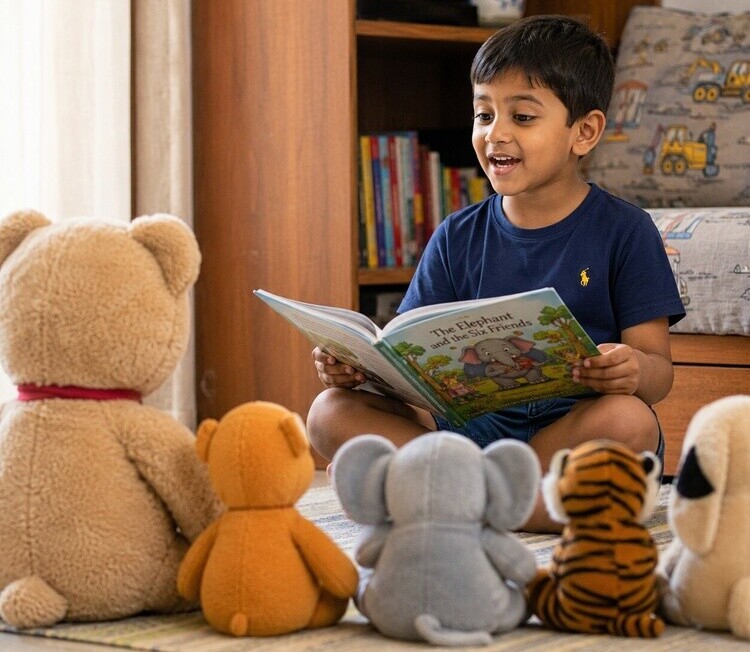
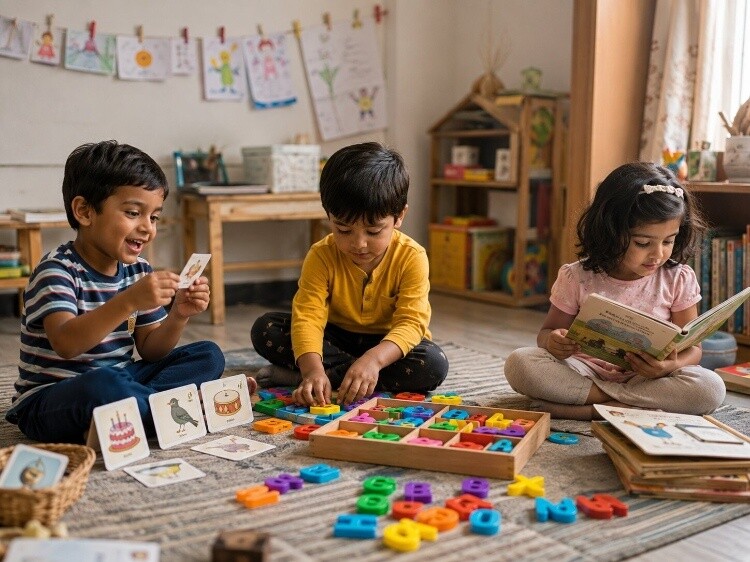
What the cluster looks like arriving
Typically these accumulate across ages 4-6, unevenly and in varying order — strong sound-players with zero letter interest, letter-obsessives who can't yet rhyme. The cluster completing, whenever it completes, is the green light; most children complete it between five and six-and-a-half, and late completion within this range predicts nothing negative.
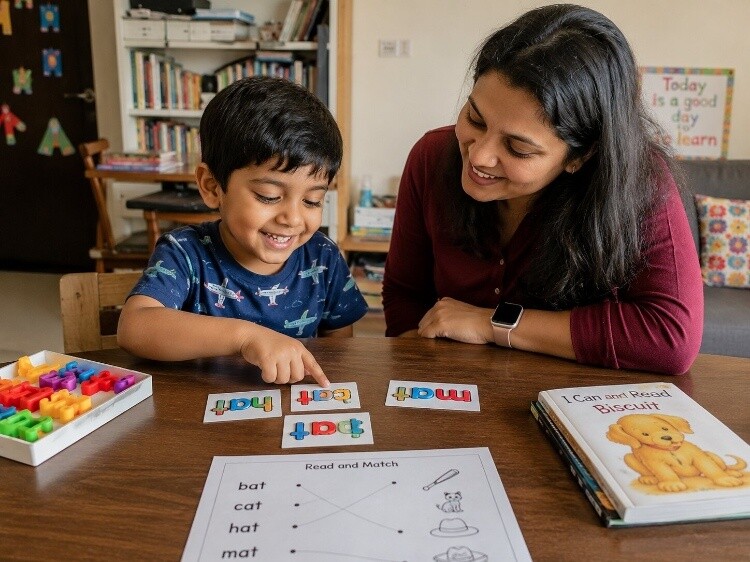
Responding to readiness (and its absence)
Signs present: follow with light structure — the phonics games, shared reading with their participation growing, celebrating every decoded word. Signs sparse at five: feed the foundations (rhyme play, read-alouds, sound games) rather than pushing letters harder — the foundation-feeding IS the acceleration.
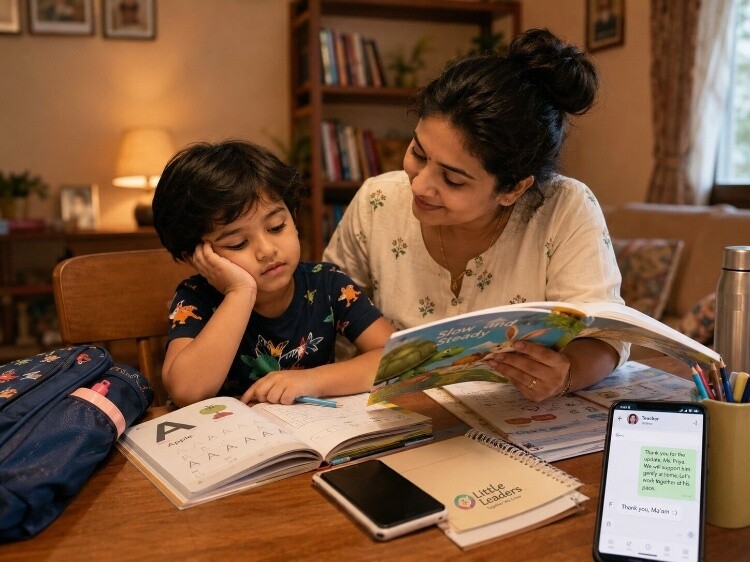
School pressure versus child pace
Indian schools often expect reading motion in kindergarten regardless of individual readiness — where school pace outruns the child's, home's job flips to pressure-absorption: keeping home reading warm and success-rich while the readiness completes, and communicating with the teacher rather than doubling the drilling at home.
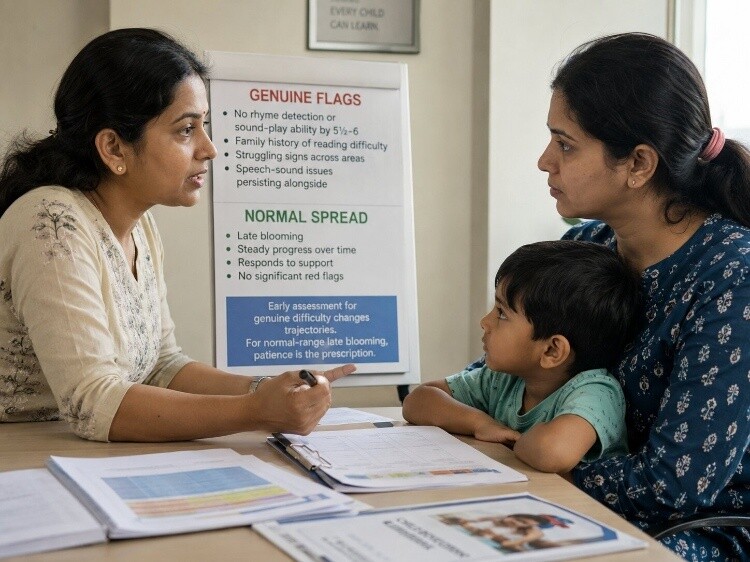
Genuine flags versus normal spread
Worth a professional conversation: no rhyme detection or sound-play ability by 5½-6 despite exposure, family history of reading difficulty plus struggling signs, or speech-sound issues persisting alongside. Early assessment for genuine difficulty changes trajectories; for normal-range late blooming, patience is the entire prescription — distinguishing which is which is the professional's job, not the WhatsApp group's.