
 Summer Camp
 Reading Writing
 Book Club
 Calligraphy
 Creative Writing
 English Speaking
 Handwriting
 Library
 Phonics
 Story Telling
 Art and Craft
 Clay Moulding
 Drawing
 Painting
 Pottery
 Sketching
 Drama Theatre
 Personality Development
 Public Speaking
 Languages
 Arabic
 Chinese
 French
 German
 Hindi
Hindi Italian
 Japanese
 Korean
 Persian
 Portuguese
 Russian
 Spanish
 Turkish
 Uzbek
Uzbek Sports and Fitness
 Aerobics
 Athletics
 Badminton
 Basket Ball
 Chess
Chess Cricket
 Football
 Golf
Golf Gymnastics
 Hulahoop
 Karate
 Martial Arts
 Pickleball
 Rugby
Rugby Skating
 Swimming
 Taekwondo
 Tennis
 Volleyball
 Yoga
Yoga Zumba
Zumba Tuition Classes
 Accounts
 Biology
 Business Studies
 CBSE
CBSE Chemistry
 Commerce
 Economics
 Homework Classes
 IB Board
 IGCSE
IGCSE Mathematics
 Physics
 Psychology
 Science
 Social Studies
 Vedic Maths
 Dance and Music
 Ballet
 Bhangra
 Bharatnatyam
 Bollywood Dance
 Casio
Casio Dandiya and Garba
 Drums
Drums Flute
Flute Guitar
 Harmonium
 Hip Hop
 Jazz
Jazz Kathak
 Keyboard
 Piano
Piano Salsa
Salsa Shlokas
 Sitar
Sitar Tabla
Tabla Ukulele
 Violin
 Vocal
Vocal Play School
 STEM
STEM
 Abacus
 App Development
 Artificial intelligence
 Basic Computer Courses
 Canva
Canva Coding
 Graphic Design
 Lego
Lego Python
 Robotics
 Rubiks Cube
 Scrabble
 Scratch
 Website Development
 Winter Camp
 Workshops
 Diwali Workshop
 Easter
 Ganesh Mahotsav
 Guru Nanak Jayanti Workshop
 Holi
Holi Independence day workshop
 Janmashtami Workshop
 Mothers day
 Navratri Workshops
 Raksha Bandhan workshop
 Ramayana Workshop
 Spring Camp
 Valentines Day Workshops
 Festive
 Daycare
 Cooking and Food
 Spring Camp
 Contests and Competitions
 Special abled
 Republic Day Workshops
 Mela
Mela
 Mela
Mela Cognitive Development
 Mother-Toddler Program
-Jul-03-2026-06-59-25-1926-AM.webp?width=30&height=30&name=Smart_20Skills_20(2)-Jul-03-2026-06-59-25-1926-AM.webp) Smart Skills
Smart Skills
 Financial Literacy
 Mental Wellbeing
 Meditation
 Reiki
Reiki




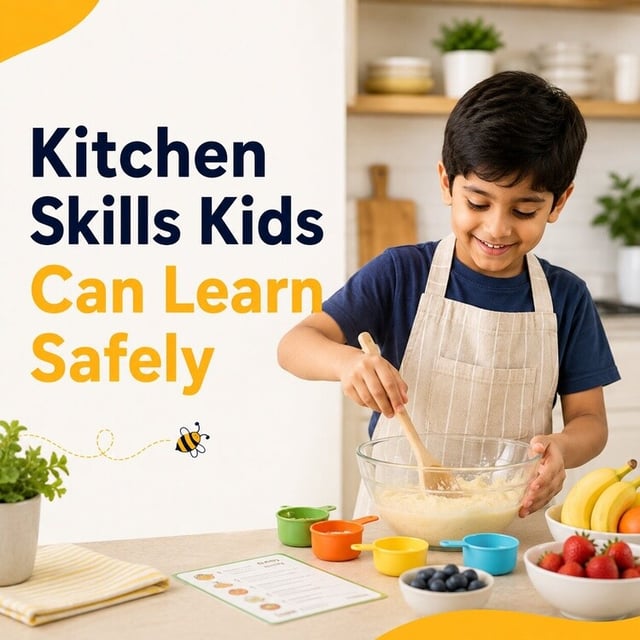
Kitchen involvement builds genuine life competence and often improves eating habits — with safety-first age-graded skill introduction. Here's what's appropriate at different stages, and how to manage the real risks.
The kitchen offers uniquely rich life-skill building — measurement, sequencing, safety awareness, and genuine competence — provided skills are introduced with real safety awareness matched to developmental stage.
Non-negotiable safety rules, regardless of age
Adult presence required for any heat source until genuine competence is demonstrated and explicitly approved, hair tied back and loose clothing managed, immediate correction (not delayed) for any unsafe practice observed, and a clear, practiced understanding of what to do if a burn or cut occurs.
Why kitchen skill-building often improves eating habits too
Children who help prepare food frequently show greater willingness to actually eat it — the ownership and familiarity built through preparation genuinely reduces resistance, particularly valuable for families managing picky eating.
Managing the real mess and time cost honestly
Cooking with children is measurably slower and messier than cooking without them — worth planning for on days with actual time buffer (weekends, rather than a rushed weeknight) rather than attempting it only when convenient, since the skill-building requires the investment of a slower process.
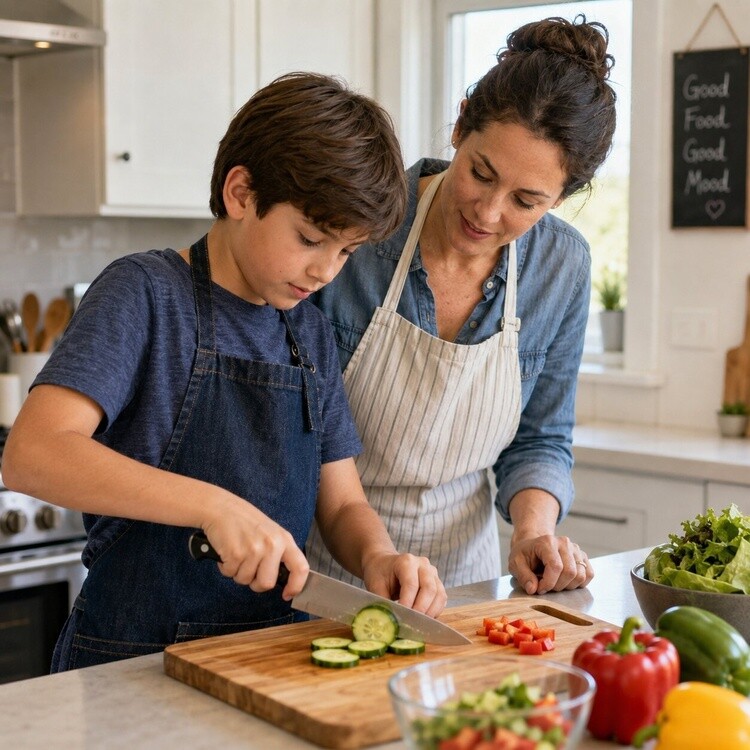
The joint-family kitchen dynamic
In households where a grandparent or domestic help primarily manages cooking, carving out specific child-inclusive cooking time (even just weekly) requires deliberate coordination — framing it explicitly as valuable skill-building helps navigate any resistance to "interference" in the established kitchen routine.