
 Summer Camp
 Reading Writing
 Book Club
 Calligraphy
 Creative Writing
 English Speaking
 Handwriting
 Library
 Phonics
 Story Telling
 Art and Craft
 Clay Moulding
 Drawing
 Painting
 Pottery
 Sketching
 Drama Theatre
 Personality Development
 Public Speaking
 Languages
 Arabic
 Chinese
 French
 German
 Hindi
Hindi Italian
 Japanese
 Korean
 Persian
 Portuguese
 Russian
 Spanish
 Turkish
 Uzbek
Uzbek Sports and Fitness
 Aerobics
 Athletics
 Badminton
 Basket Ball
 Chess
Chess Cricket
 Football
 Golf
Golf Gymnastics
 Hulahoop
 Karate
 Martial Arts
 Pickleball
 Rugby
Rugby Skating
 Swimming
 Taekwondo
 Tennis
 Volleyball
 Yoga
Yoga Zumba
Zumba Tuition Classes
 Accounts
 Biology
 Business Studies
 CBSE
CBSE Chemistry
 Commerce
 Economics
 Homework Classes
 IB Board
 IGCSE
IGCSE Mathematics
 Physics
 Psychology
 Science
 Social Studies
 Vedic Maths
 Dance and Music
 Ballet
 Bhangra
 Bharatnatyam
 Bollywood Dance
 Casio
Casio Dandiya and Garba
 Drums
Drums Flute
Flute Guitar
 Harmonium
 Hip Hop
 Jazz
Jazz Kathak
 Keyboard
 Piano
Piano Salsa
Salsa Shlokas
 Sitar
Sitar Tabla
Tabla Ukulele
 Violin
 Vocal
Vocal Play School
 STEM
STEM
 Abacus
 App Development
 Artificial intelligence
 Basic Computer Courses
 Canva
Canva Coding
 Graphic Design
 Lego
Lego Python
 Robotics
 Rubiks Cube
 Scrabble
 Scratch
 Website Development
 Winter Camp
 Workshops
 Diwali Workshop
 Easter
 Ganesh Mahotsav
 Guru Nanak Jayanti Workshop
 Holi
Holi Independence day workshop
 Janmashtami Workshop
 Mothers day
 Navratri Workshops
 Raksha Bandhan workshop
 Ramayana Workshop
 Spring Camp
 Valentines Day Workshops
 Festive
 Daycare
 Cooking and Food
 Spring Camp
 Contests and Competitions
 Special abled
 Republic Day Workshops
 Mela
Mela
 Mela
Mela Cognitive Development
 Mother-Toddler Program
-Jul-03-2026-06-59-25-1926-AM.webp?width=30&height=30&name=Smart_20Skills_20(2)-Jul-03-2026-06-59-25-1926-AM.webp) Smart Skills
Smart Skills
 Financial Literacy
 Mental Wellbeing
 Meditation
 Reiki
Reiki




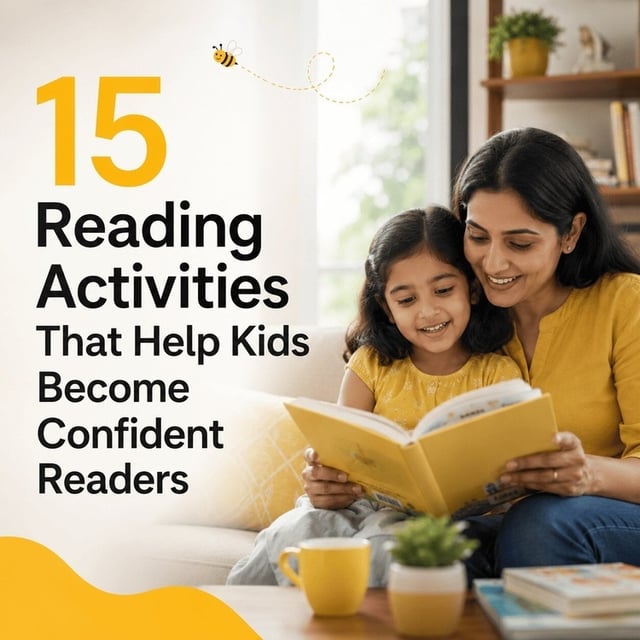
Confidence matters as much as skill when it comes to reading. These 15 activities focus on making reading feel enjoyable and low-pressure rather than another academic task to get right.
A child who can technically sound out words but feels anxious about reading aloud will avoid books every chance they get. A child who reads slightly below "grade level" but genuinely enjoys stories will usually catch up and surpass their more pressured peers within a year or two. These activities are built around that second outcome.

1. Let your child choose the books, even "easy" ones - Rereading familiar, easy books builds fluency and confidence — it's not wasted time, even if it feels repetitive to you as a parent.
2. Read together, not just to or by them - Alternate paragraphs or pages, so reading feels shared rather than a solo performance being evaluated.
3. Visit a library regularly, not just buy books - Several genuinely good family libraries exist across Delhi NCR — the freedom to choose and return books (without the pressure of a purchase) makes book selection feel lower-stakes for kids.
4. Create a cozy, dedicated reading spot - A cushion in a corner, a small light, nothing elaborate — a defined reading space signals that this is a pleasant activity, not homework.
5. Read books connected to what they already love - A child obsessed with cricket will engage more with a cricket-themed story than a beautifully written book about something they have zero interest in. Interest beats "quality" at the early stage.
6. Try graphic novels and comics without guilt - Comics build reading fluency and vocabulary just as effectively as prose books for many children — the "real books only" bias can actively discourage reluctant readers.
7. Record your child reading and play it back - Kids are often surprised and proud hearing themselves read fluently — a small confidence boost that costs nothing.
8. Use audiobooks alongside physical books - Following along with text while listening to a narrator builds fluency and pronunciation, especially useful during long car rides or before bed.
9. Make bedtime reading non-negotiable but low-pressure - Fifteen minutes before lights out, every night, with zero quizzing afterward — just enjoyment.
10. Let them read to a younger sibling or cousin - Reading aloud to someone younger builds confidence because the "audience" isn't evaluating them the way a parent or teacher might feel like they are.
11. Celebrate finishing books, not reading speed - A sticker chart or small tracker for books completed (regardless of how long each took) reinforces persistence over comparison.
12. Point out real-world reading throughout the day - Reading a menu, a recipe, or directions on a form shows reading as a genuinely useful life skill, not just a school subject.
13. Avoid correcting every single mistake - Let your child self-correct or finish the sentence first; constant interruption breaks flow and confidence more than it helps accuracy.
14. Rotate between reading levels intentionally - Mix a slightly challenging book with several easy, comfortable ones — an all-difficult diet burns kids out fast.
15. Model reading yourself, visibly - A child who regularly sees a parent reading (even a phone article, if explained) absorbs that reading is a normal adult habit, not just a school requirement.
Bringing structure without pressure
The common thread across all fifteen: reading works best as a genuinely enjoyable, pressure-free part of the day, not a performance to be evaluated. For families managing school, tuition, and after-school activities already, even 15-20 minutes of relaxed daily reading tends to build more lasting confidence than longer, tenser sessions.