
 Summer Camp
 Reading Writing
 Book Club
 Calligraphy
 Creative Writing
 English Speaking
 Handwriting
 Library
 Phonics
 Story Telling
 Art and Craft
 Clay Moulding
 Drawing
 Painting
 Pottery
 Sketching
 Drama Theatre
 Personality Development
 Public Speaking
 Languages
 Arabic
 Chinese
 French
 German
 Hindi
Hindi Italian
 Japanese
 Korean
 Persian
 Portuguese
 Russian
 Spanish
 Turkish
 Uzbek
Uzbek Sports and Fitness
 Aerobics
 Athletics
 Badminton
 Basket Ball
 Chess
Chess Cricket
 Football
 Golf
Golf Gymnastics
 Hulahoop
 Karate
 Martial Arts
 Pickleball
 Rugby
Rugby Skating
 Swimming
 Taekwondo
 Tennis
 Volleyball
 Yoga
Yoga Zumba
Zumba Tuition Classes
 Accounts
 Biology
 Business Studies
 CBSE
CBSE Chemistry
 Commerce
 Economics
 Homework Classes
 IB Board
 IGCSE
IGCSE Mathematics
 Physics
 Psychology
 Science
 Social Studies
 Vedic Maths
 Dance and Music
 Ballet
 Bhangra
 Bharatnatyam
 Bollywood Dance
 Casio
Casio Dandiya and Garba
 Drums
Drums Flute
Flute Guitar
 Harmonium
 Hip Hop
 Jazz
Jazz Kathak
 Keyboard
 Piano
Piano Salsa
Salsa Shlokas
 Sitar
Sitar Tabla
Tabla Ukulele
 Violin
 Vocal
Vocal Play School
 STEM
STEM
 Abacus
 App Development
 Artificial intelligence
 Basic Computer Courses
 Canva
Canva Coding
 Graphic Design
 Lego
Lego Python
 Robotics
 Rubiks Cube
 Scrabble
 Scratch
 Website Development
 Winter Camp
 Workshops
 Diwali Workshop
 Easter
 Ganesh Mahotsav
 Guru Nanak Jayanti Workshop
 Holi
Holi Independence day workshop
 Janmashtami Workshop
 Mothers day
 Navratri Workshops
 Raksha Bandhan workshop
 Ramayana Workshop
 Spring Camp
 Valentines Day Workshops
 Festive
 Daycare
 Cooking and Food
 Spring Camp
 Contests and Competitions
 Special abled
 Republic Day Workshops
 Mela
Mela
 Mela
Mela Cognitive Development
 Mother-Toddler Program
-Jul-03-2026-06-59-25-1926-AM.webp?width=30&height=30&name=Smart_20Skills_20(2)-Jul-03-2026-06-59-25-1926-AM.webp) Smart Skills
Smart Skills
 Financial Literacy
 Mental Wellbeing
 Meditation
 Reiki
Reiki




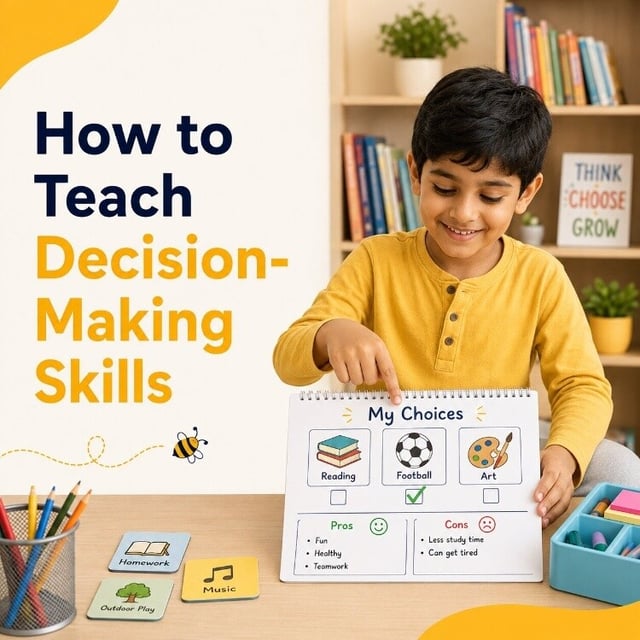
Decision-making skill builds through genuine practice with real (bounded) stakes and consequences — not through being told the "right" answer, but through structured opportunities to weigh options and live with outcomes.
Decision-making is a practiced skill, and children build it genuinely only through actual decisions with real (though bounded) consequences — not through being handed correct answers or having every choice pre-selected by well-meaning adults.
Building decision-making capacity by age
Ages 4-6 — simple binary choices with clearly bounded options ("red shirt or blue shirt"), building basic choice-making comfort.
Ages 7-9 — slightly more complex choices with real (small) trade-offs (spending pocket money now versus saving, choosing between two activities), introducing genuine consequence experience.
Ages 9-12 — more significant choices with real stakes (how to spend a free Saturday, how to handle a friend conflict, larger purchase decisions), and introduction to explicit decision-making frameworks (listing pros and cons, considering different perspectives).
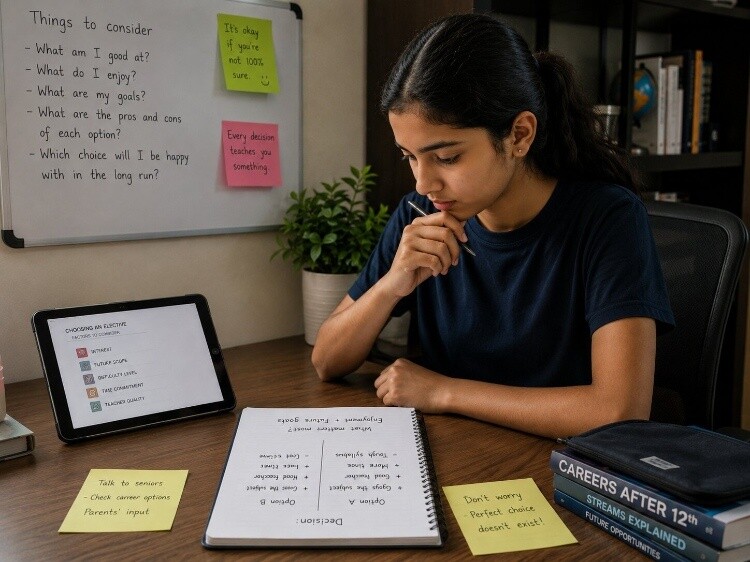
The framework worth teaching explicitly, simplified
What are the options? What might happen with each? What matters most to me here? What would I choose, and why? — walked through conversationally for real decisions the child faces, building a transferable mental structure over repeated practice.
Allowing genuine consequences, within safety bounds
A child who chooses to spend all their money immediately and then can't buy something they wanted later experiences a genuine, safe-stakes consequence that teaches more than any lecture about "thinking ahead." The parental discipline required here — resisting the urge to rescue every suboptimal choice — is often harder than the child's actual decision-making practice.
Distinguishing safety non-negotiables from genuine choice opportunities
Not every situation should be a child's decision — safety matters, values-based family rules, and genuinely high-stakes situations warrant parental decision-making, clearly and without extensive debate. The skill-building opportunity lies specifically in situations with genuine, bounded latitude for different reasonable choices.
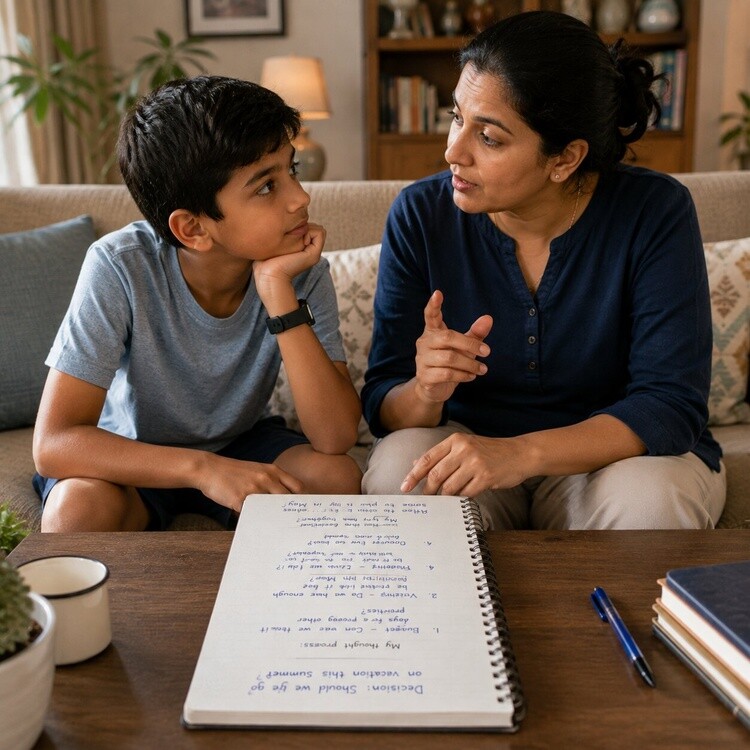
Teaching perspective-taking as part of decision-making
For decisions involving others (a friend conflict, a family choice), explicitly asking "how might this look from their side?" builds decision-making sophistication that considers more than just immediate personal preference.
The role of mistakes in building better decision-making
Children who never experience a poor decision's natural consequences (because parents consistently intervene to prevent any negative outcome) often struggle more with decision-making as the stakes rise in adolescence and adulthood — the practiced experience of "I chose X, it didn't work out ideally, here's what I'd do differently" is itself the core decision-making skill, built through repetition.
Modelling your own decision-making process aloud
Narrating your own reasoning through real decisions ("I'm choosing to leave early because traffic tends to be bad, even though it means less time at home") gives children a live model of the thinking process underlying good decision-making, beyond any formal teaching.