
 Summer Camp
 Reading Writing
 Book Club
 Calligraphy
 Creative Writing
 English Speaking
 Handwriting
 Library
 Phonics
 Story Telling
 Art and Craft
 Clay Moulding
 Drawing
 Painting
 Pottery
 Sketching
 Drama Theatre
 Personality Development
 Public Speaking
 Languages
 Arabic
 Chinese
 French
 German
 Hindi
Hindi Italian
 Japanese
 Korean
 Persian
 Portuguese
 Russian
 Spanish
 Turkish
 Uzbek
Uzbek Sports and Fitness
 Aerobics
 Athletics
 Badminton
 Basket Ball
 Chess
Chess Cricket
 Football
 Golf
Golf Gymnastics
 Hulahoop
 Karate
 Martial Arts
 Pickleball
 Rugby
Rugby Skating
 Swimming
 Taekwondo
 Tennis
 Volleyball
 Yoga
Yoga Zumba
Zumba Tuition Classes
 Accounts
 Biology
 Business Studies
 CBSE
CBSE Chemistry
 Commerce
 Economics
 Homework Classes
 IB Board
 IGCSE
IGCSE Mathematics
 Physics
 Psychology
 Science
 Social Studies
 Vedic Maths
 Dance and Music
 Ballet
 Bhangra
 Bharatnatyam
 Bollywood Dance
 Casio
Casio Dandiya and Garba
 Drums
Drums Flute
Flute Guitar
 Harmonium
 Hip Hop
 Jazz
Jazz Kathak
 Keyboard
 Piano
Piano Salsa
Salsa Shlokas
 Sitar
Sitar Tabla
Tabla Ukulele
 Violin
 Vocal
Vocal Play School
 STEM
STEM
 Abacus
 App Development
 Artificial intelligence
 Basic Computer Courses
 Canva
Canva Coding
 Graphic Design
 Lego
Lego Python
 Robotics
 Rubiks Cube
 Scrabble
 Scratch
 Website Development
 Winter Camp
 Workshops
 Diwali Workshop
 Easter
 Ganesh Mahotsav
 Guru Nanak Jayanti Workshop
 Holi
Holi Independence day workshop
 Janmashtami Workshop
 Mothers day
 Navratri Workshops
 Raksha Bandhan workshop
 Ramayana Workshop
 Spring Camp
 Valentines Day Workshops
 Festive
 Daycare
 Cooking and Food
 Spring Camp
 Contests and Competitions
 Special abled
 Republic Day Workshops
 Mela
Mela
 Mela
Mela Cognitive Development
 Mother-Toddler Program
-Jul-03-2026-06-59-25-1926-AM.webp?width=30&height=30&name=Smart_20Skills_20(2)-Jul-03-2026-06-59-25-1926-AM.webp) Smart Skills
Smart Skills
 Financial Literacy
 Mental Wellbeing
 Meditation
 Reiki
Reiki





Hindi grammar in CBSE and ICSE schools follows its own grade-wise progression, often taught alongside English grammar with different structural rules that can genuinely confuse young bilingual learners. Here's what's typically expected by grade, and how to support both languages without overwhelming your child.
Hindi grammar homework can feel harder to help with than English, especially for parents whose own Hindi reading and writing may be rustier than their spoken fluency. Knowing the general grade-wise expectations helps you support confidently, even if you're brushing up alongside your child.
Why Hindi grammar can feel harder to help with
Many urban Indian households, especially in English-medium school settings, use a mix of Hindi and English at home, with Hindi often spoken more than read or written. This means a child (and sometimes a parent) may be verbally fluent in Hindi but less confident with formal written Hindi grammar — this gap is extremely common and nothing to feel embarrassed about.
A specific challenge: script and matra confusion
Devanagari script has vowel signs (matras) that change a word's sound and meaning subtly — a common early mistake is confusing "की" and "कि," for instance. This typically resolves through consistent reading practice rather than rule memorisation alone.
How to support Hindi learning at home practically
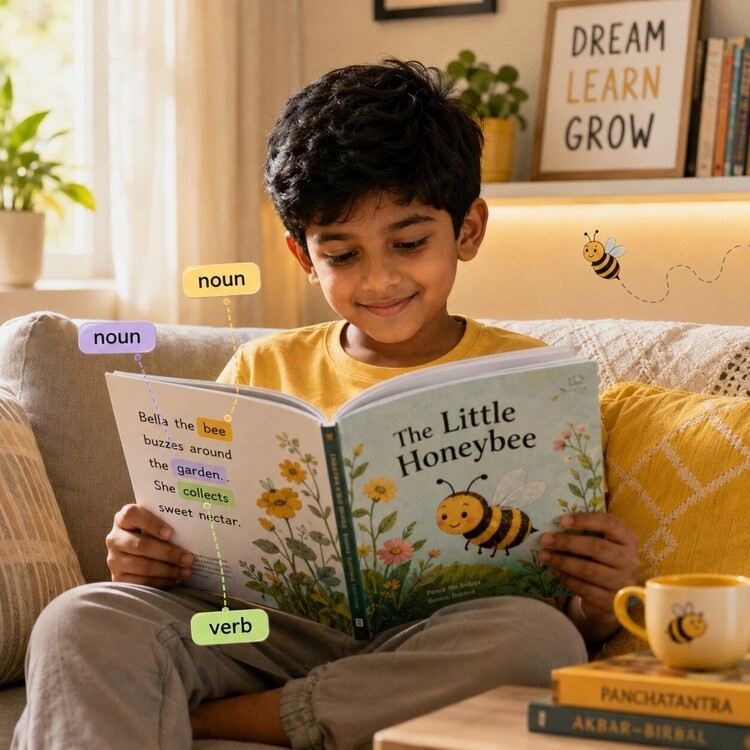
Read Hindi storybooks or comics together, even simple ones — genuine reading exposure matters more than grammar worksheets for building intuitive correctness. Watch Hindi content with subtitles occasionally, which quietly reinforces written-spoken connections. If Hindi isn't the primary home language, even 10-15 minutes of dedicated reading time a few times a week makes a meaningful difference over months.
Balancing two languages without overwhelming
Trying to push equally intensive grammar practice in both English and Hindi simultaneously can genuinely overwhelm a young child. Many families find it more effective to lean into whichever language the child is naturally more confident in first, using that confidence as a foundation, while keeping the second language exposure consistent but lower-pressure.
The genuine value beyond exam marks
Strong Hindi literacy connects children to a much broader world of literature, family communication (especially in joint family or extended family settings), and cultural connection that pure English fluency doesn't provide on its own — worth the investment even when English tends to dominate school life.