
 Summer Camp
 Reading Writing
 Book Club
 Calligraphy
 Creative Writing
 English Speaking
 Handwriting
 Library
 Phonics
 Story Telling
 Art and Craft
 Clay Moulding
 Drawing
 Painting
 Pottery
 Sketching
 Drama Theatre
 Personality Development
 Public Speaking
 Languages
 Arabic
 Chinese
 French
 German
 Hindi
Hindi Italian
 Japanese
 Korean
 Persian
 Portuguese
 Russian
 Spanish
 Turkish
 Uzbek
Uzbek Sports and Fitness
 Aerobics
 Athletics
 Badminton
 Basket Ball
 Chess
Chess Cricket
 Football
 Golf
Golf Gymnastics
 Hulahoop
 Karate
 Martial Arts
 Pickleball
 Rugby
Rugby Skating
 Swimming
 Taekwondo
 Tennis
 Volleyball
 Yoga
Yoga Zumba
Zumba Tuition Classes
 Accounts
 Biology
 Business Studies
 CBSE
CBSE Chemistry
 Commerce
 Economics
 Homework Classes
 IB Board
 IGCSE
IGCSE Mathematics
 Physics
 Psychology
 Science
 Social Studies
 Vedic Maths
 Dance and Music
 Ballet
 Bhangra
 Bharatnatyam
 Bollywood Dance
 Casio
Casio Dandiya and Garba
 Drums
Drums Flute
Flute Guitar
 Harmonium
 Hip Hop
 Jazz
Jazz Kathak
 Keyboard
 Piano
Piano Salsa
Salsa Shlokas
 Sitar
Sitar Tabla
Tabla Ukulele
 Violin
 Vocal
Vocal Play School
 STEM
STEM
 Abacus
 App Development
 Artificial intelligence
 Basic Computer Courses
 Canva
Canva Coding
 Graphic Design
 Lego
Lego Python
 Robotics
 Rubiks Cube
 Scrabble
 Scratch
 Website Development
 Winter Camp
 Workshops
 Diwali Workshop
 Easter
 Ganesh Mahotsav
 Guru Nanak Jayanti Workshop
 Holi
Holi Independence day workshop
 Janmashtami Workshop
 Mothers day
 Navratri Workshops
 Raksha Bandhan workshop
 Ramayana Workshop
 Spring Camp
 Valentines Day Workshops
 Festive
 Daycare
 Cooking and Food
 Spring Camp
 Contests and Competitions
 Special abled
 Republic Day Workshops
 Mela
Mela
 Mela
Mela Cognitive Development
 Mother-Toddler Program
-Jul-03-2026-06-59-25-1926-AM.webp?width=30&height=30&name=Smart_20Skills_20(2)-Jul-03-2026-06-59-25-1926-AM.webp) Smart Skills
Smart Skills
 Financial Literacy
 Mental Wellbeing
 Meditation
 Reiki
Reiki





A preschooler's day runs best on rhythm, not rigid scheduling — anchored sleep, predictable meals, daily outdoor time, and bounded screens. Here's a realistic Delhi-household template.
Preschoolers are rhythm creatures: predictable days produce calmer children, easier transitions, and fewer battles. The rhythm needs anchoring, not minute-scheduling.
The anchor points that matter
Sleep: 10-13 hours total — Most preschoolers need a 7:30-8:30 bedtime against school wake times, with the nap transitioning out somewhere in this window (a child fighting the nap but melting by evening needs earlier nights, not forced naps). The pre-sleep hour stays screen-free — the single most effective sleep-quality lever.
Meals: predictable slots, family-integrated — Three meals and two snacks at roughly consistent times, at the table, with the family when logistics allow. Grazing between slots quietly kills mealtime appetite — the biggest hidden cause of "he never eats."
Outdoor time: daily, non-negotiable weather permitting — The park hour (or heat-adjusted equivalent) as fixed as school itself; energy not discharged outdoors is discharged at bedtime.
Play blocks: independent and together — A protected independent-play window (post-breakfast works for many) and genuine engaged-adult play time, even twenty minutes, most days.
Screens: bounded and placed — If screens feature, a defined slot (post-park, pre-dinner works for many households) with a clear end ritual beats ambient availability. Meals and pre-sleep stay clear.
A realistic weekday shape (school-day version)
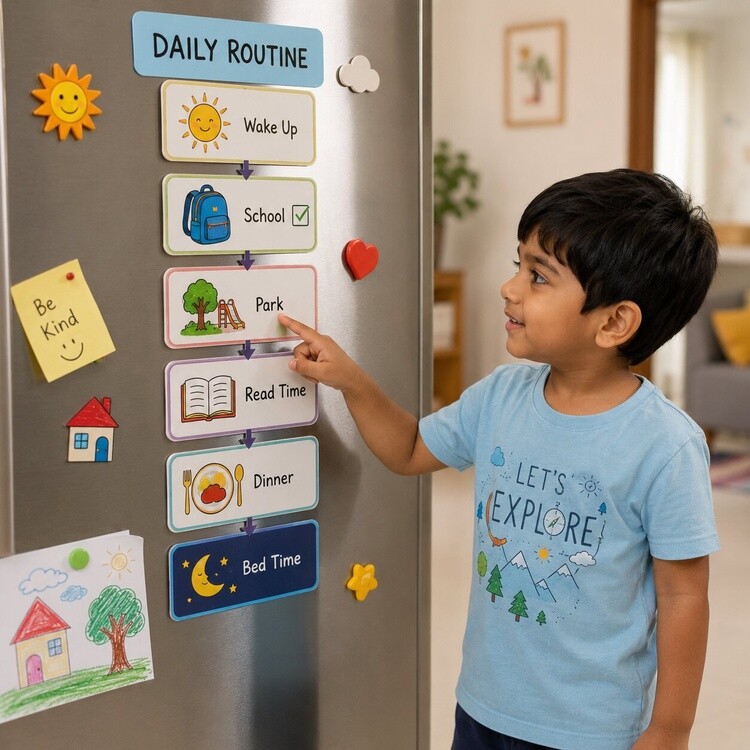
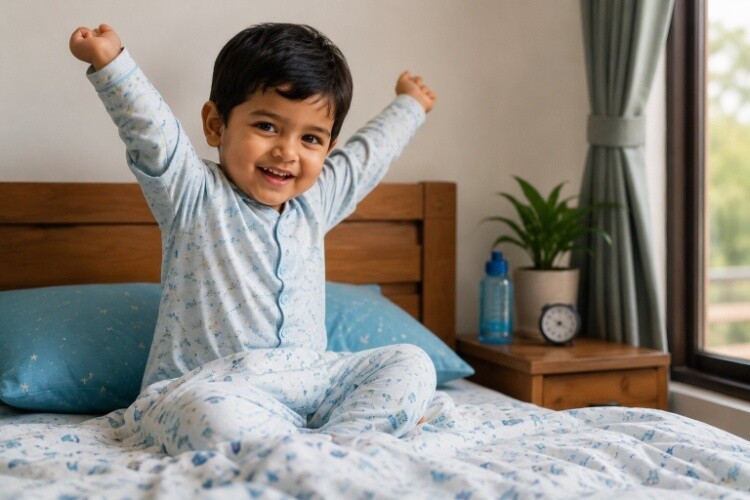
Wake, morning routine with buffer time (rushed mornings poison whole days — build in ten spare minutes) → school → lunch and quiet time or nap → independent play → park hour → bounded screen slot or activity time → dinner with family → bath, books, bed. The times flex; the sequence holds.
Weekends and the routine-flexibility balance
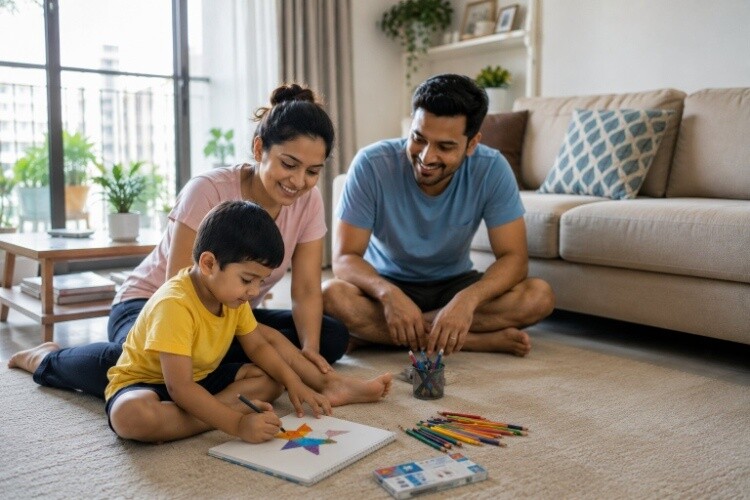
Weekend rhythm can loosen without dissolving — sleep anchors drifting more than an hour bite back on Monday. One structured outing or activity plus generous unstructured time beats over-programmed weekends; boredom windows are where independent play grows.
The household-alignment piece
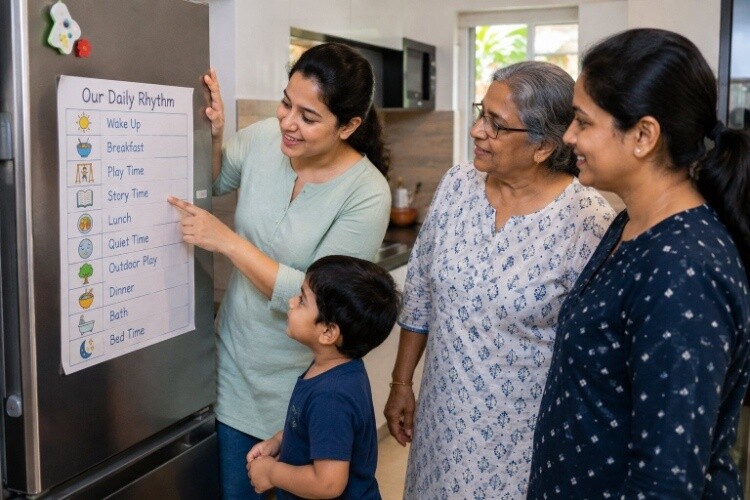
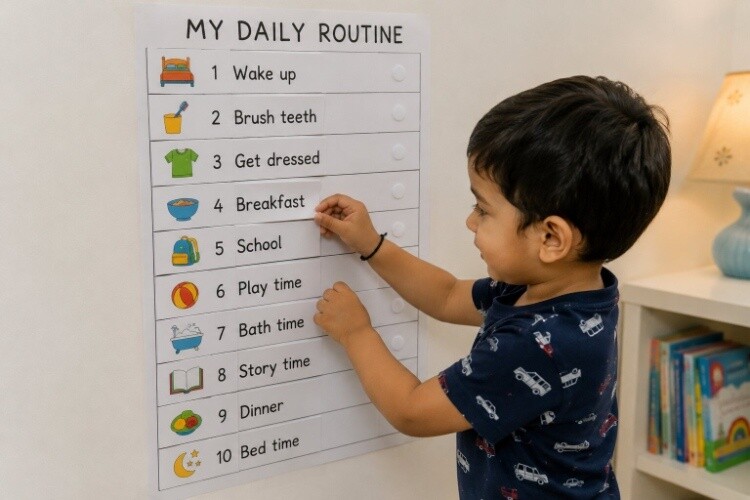
Routines survive only if all caregivers roughly honour them — the grandparent-served 6 PM biscuits or the helper's flexible screen policy can quietly undo the architecture. A visible written rhythm (a simple chart on the fridge) aligns the household better than repeated verbal negotiation, and gives the preschooler themselves a sequence to anticipate and own.
Routine as security, not control
The point isn't compliance — it's that predictability frees a preschooler's energy for growing instead of bracing. Children who know what comes next transition easier, sleep better, and melt down less. The routine serves the child; when it stops serving (developmental shifts, season changes, school transitions), it gets adjusted without ceremony.