
 Summer Camp
 Reading Writing
 Book Club
 Calligraphy
 Creative Writing
 English Speaking
 Handwriting
 Library
 Phonics
 Story Telling
 Art and Craft
 Clay Moulding
 Drawing
 Painting
 Pottery
 Sketching
 Drama Theatre
 Personality Development
 Public Speaking
 Languages
 Arabic
 Chinese
 French
 German
 Hindi
Hindi Italian
 Japanese
 Korean
 Persian
 Portuguese
 Russian
 Spanish
 Turkish
 Uzbek
Uzbek Sports and Fitness
 Aerobics
 Athletics
 Badminton
 Basket Ball
 Chess
Chess Cricket
 Football
 Golf
Golf Gymnastics
 Hulahoop
 Karate
 Martial Arts
 Pickleball
 Rugby
Rugby Skating
 Swimming
 Taekwondo
 Tennis
 Volleyball
 Yoga
Yoga Zumba
Zumba Tuition Classes
 Accounts
 Biology
 Business Studies
 CBSE
CBSE Chemistry
 Commerce
 Economics
 Homework Classes
 IB Board
 IGCSE
IGCSE Mathematics
 Physics
 Psychology
 Science
 Social Studies
 Vedic Maths
 Dance and Music
 Ballet
 Bhangra
 Bharatnatyam
 Bollywood Dance
 Casio
Casio Dandiya and Garba
 Drums
Drums Flute
Flute Guitar
 Harmonium
 Hip Hop
 Jazz
Jazz Kathak
 Keyboard
 Piano
Piano Salsa
Salsa Shlokas
 Sitar
Sitar Tabla
Tabla Ukulele
 Violin
 Vocal
Vocal Play School
 STEM
STEM
 Abacus
 App Development
 Artificial intelligence
 Basic Computer Courses
 Canva
Canva Coding
 Graphic Design
 Lego
Lego Python
 Robotics
 Rubiks Cube
 Scrabble
 Scratch
 Website Development
 Winter Camp
 Workshops
 Diwali Workshop
 Easter
 Ganesh Mahotsav
 Guru Nanak Jayanti Workshop
 Holi
Holi Independence day workshop
 Janmashtami Workshop
 Mothers day
 Navratri Workshops
 Raksha Bandhan workshop
 Ramayana Workshop
 Spring Camp
 Valentines Day Workshops
 Festive
 Daycare
 Cooking and Food
 Spring Camp
 Contests and Competitions
 Special abled
 Republic Day Workshops
 Mela
Mela
 Mela
Mela Cognitive Development
 Mother-Toddler Program
-Jul-03-2026-06-59-25-1926-AM.webp?width=30&height=30&name=Smart_20Skills_20(2)-Jul-03-2026-06-59-25-1926-AM.webp) Smart Skills
Smart Skills
 Financial Literacy
 Mental Wellbeing
 Meditation
 Reiki
Reiki




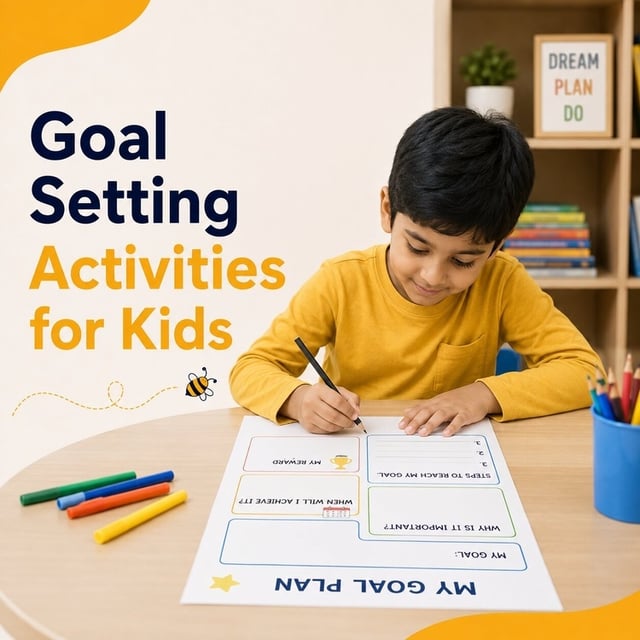
Goal-setting for children works best through small, visible, achievable targets building toward the skill of larger goal pursuit — concrete practice before abstract "dream big" conversations.
Genuine goal-setting skill builds gradually through small, concrete practice — a child who's successfully set and achieved a two-week goal has more real goal-setting capability than one who's only heard inspirational "dream big" messaging without practiced structure.
Age-appropriate goal-setting practice
Ages 5-7 — very short-term, concrete goals (finishing a puzzle by the weekend, learning to tie shoelaces this month) with visible progress tracking (a simple sticker chart).
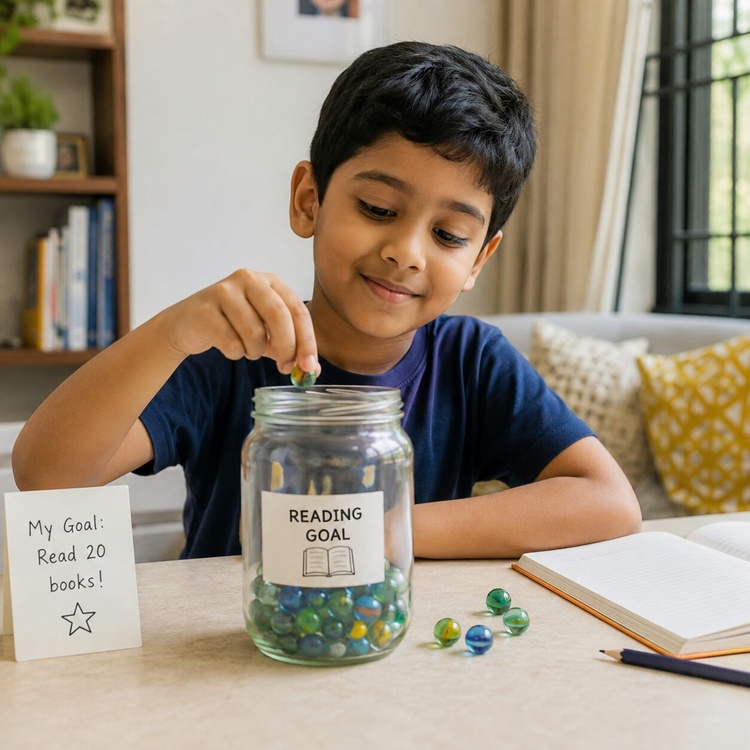
Ages 7-9 — slightly longer goals (a few weeks to a couple of months) with more specific, self-chosen targets (reading a certain number of books, saving toward something specific, mastering a particular skill).
Ages 9-12 — genuine multi-month goals with more sophisticated tracking (a swimming distance goal, an academic improvement target, a saving goal for something significant), and introduction to breaking a bigger goal into smaller milestone steps.
The SMART framework, simplified for kids
Specific (not "get better at math" but "improve my times-tables speed"), measurable (a way to track progress, even simply), achievable (genuinely within reach with real effort, not wishful), and time-bound (a clear timeframe, not open-ended) — introduced conversationally rather than as a rigid formal framework at younger ages.
Visible progress tracking as the key mechanism
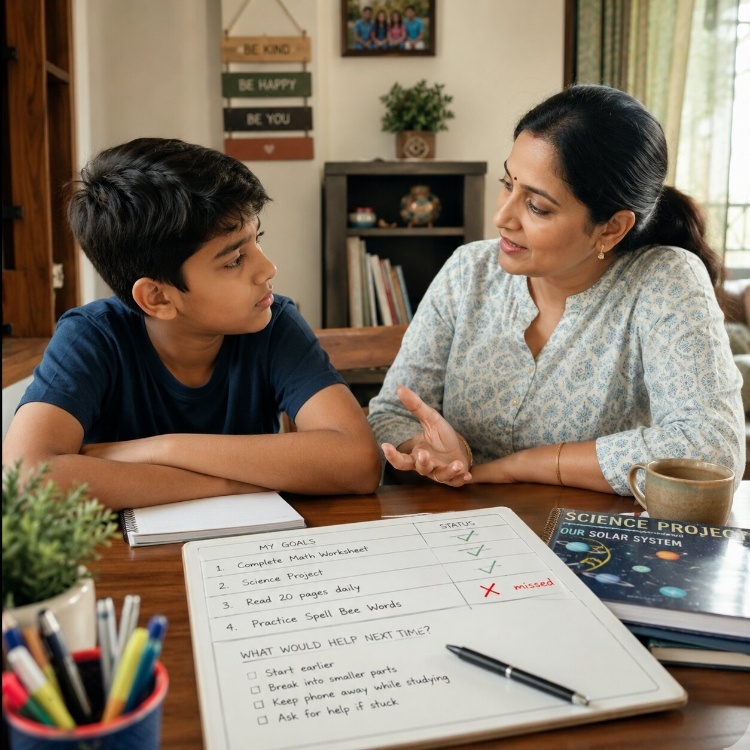
A simple chart, a jar filling with marbles, a visible checklist — concrete, visible progress markers matter enormously for sustained motivation at this age, since abstract "you're making progress" reassurance means far less than a tangible, visible indicator.
Handling goals not achieved, constructively
Not every goal succeeds, and how this gets handled matters for future goal-setting willingness — treating a missed goal as information ("what got in the way? what would help next time?") rather than failure preserves the child's willingness to set future goals rather than avoiding the vulnerability of trying.
The parent's role: support without takeover
Helping a child choose a genuinely achievable (not adult-imposed) goal, checking in periodically without constant monitoring, and celebrating genuine progress rather than only final achievement all support the skill-building without the goal becoming the parent's project rather than the child's.
Connecting goal-setting to genuine interests
Goals a child actually cares about (their own chosen skill, interest, or want) build far more genuine goal-setting engagement than goals imposed by parents, however well-intentioned — the skill transfers regardless of the specific goal's content, so following genuine interest matters more than steering toward "important" goals.