
 Summer Camp
 Reading Writing
 Book Club
 Calligraphy
 Creative Writing
 English Speaking
 Handwriting
 Library
 Phonics
 Story Telling
 Art and Craft
 Clay Moulding
 Drawing
 Painting
 Pottery
 Sketching
 Drama Theatre
 Personality Development
 Public Speaking
 Languages
 Arabic
 Chinese
 French
 German
 Hindi
Hindi Italian
 Japanese
 Korean
 Persian
 Portuguese
 Russian
 Spanish
 Turkish
 Uzbek
Uzbek Sports and Fitness
 Aerobics
 Athletics
 Badminton
 Basket Ball
 Chess
Chess Cricket
 Football
 Golf
Golf Gymnastics
 Hulahoop
 Karate
 Martial Arts
 Pickleball
 Rugby
Rugby Skating
 Swimming
 Taekwondo
 Tennis
 Volleyball
 Yoga
Yoga Zumba
Zumba Tuition Classes
 Accounts
 Biology
 Business Studies
 CBSE
CBSE Chemistry
 Commerce
 Economics
 Homework Classes
 IB Board
 IGCSE
IGCSE Mathematics
 Physics
 Psychology
 Science
 Social Studies
 Vedic Maths
 Dance and Music
 Ballet
 Bhangra
 Bharatnatyam
 Bollywood Dance
 Casio
Casio Dandiya and Garba
 Drums
Drums Flute
Flute Guitar
 Harmonium
 Hip Hop
 Jazz
Jazz Kathak
 Keyboard
 Piano
Piano Salsa
Salsa Shlokas
 Sitar
Sitar Tabla
Tabla Ukulele
 Violin
 Vocal
Vocal Play School
 STEM
STEM
 Abacus
 App Development
 Artificial intelligence
 Basic Computer Courses
 Canva
Canva Coding
 Graphic Design
 Lego
Lego Python
 Robotics
 Rubiks Cube
 Scrabble
 Scratch
 Website Development
 Winter Camp
 Workshops
 Diwali Workshop
 Easter
 Ganesh Mahotsav
 Guru Nanak Jayanti Workshop
 Holi
Holi Independence day workshop
 Janmashtami Workshop
 Mothers day
 Navratri Workshops
 Raksha Bandhan workshop
 Ramayana Workshop
 Spring Camp
 Valentines Day Workshops
 Festive
 Daycare
 Cooking and Food
 Spring Camp
 Contests and Competitions
 Special abled
 Republic Day Workshops
 Mela
Mela
 Mela
Mela Cognitive Development
 Mother-Toddler Program
-Jul-03-2026-06-59-25-1926-AM.webp?width=30&height=30&name=Smart_20Skills_20(2)-Jul-03-2026-06-59-25-1926-AM.webp) Smart Skills
Smart Skills
 Financial Literacy
 Mental Wellbeing
 Meditation
 Reiki
Reiki




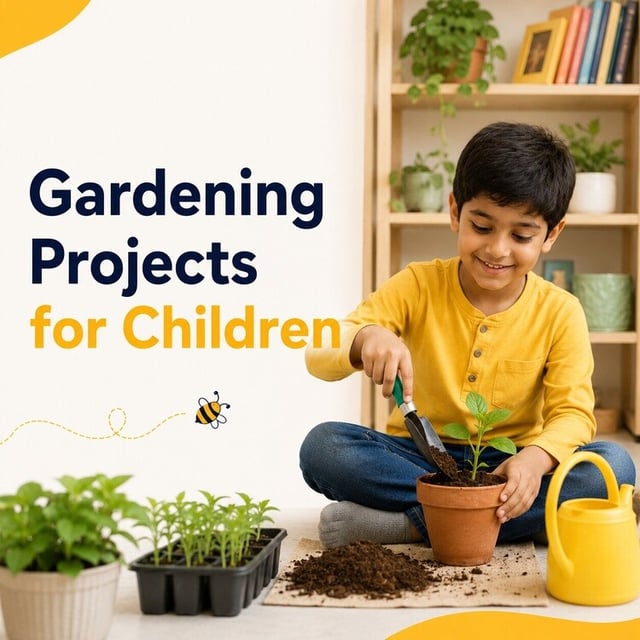
Gardening builds patience, responsibility, and science understanding through a slow, tangible process — genuinely achievable even in Delhi NCR's typical balcony and small-space living situations.
Gardening offers a uniquely patient-building activity in an increasingly instant-gratification world — the slow, visible process of planting, tending, and eventually harvesting builds genuine understanding of growth, responsibility, and natural cycles, achievable even without a proper garden.
Balcony and small-space gardening realities
Most Delhi NCR families work with balconies, small terraces, or window ledges rather than proper gardens — and genuinely successful, satisfying gardening is entirely achievable within these constraints with appropriately chosen plants and containers.
Beginner-friendly plants for Indian balcony conditions
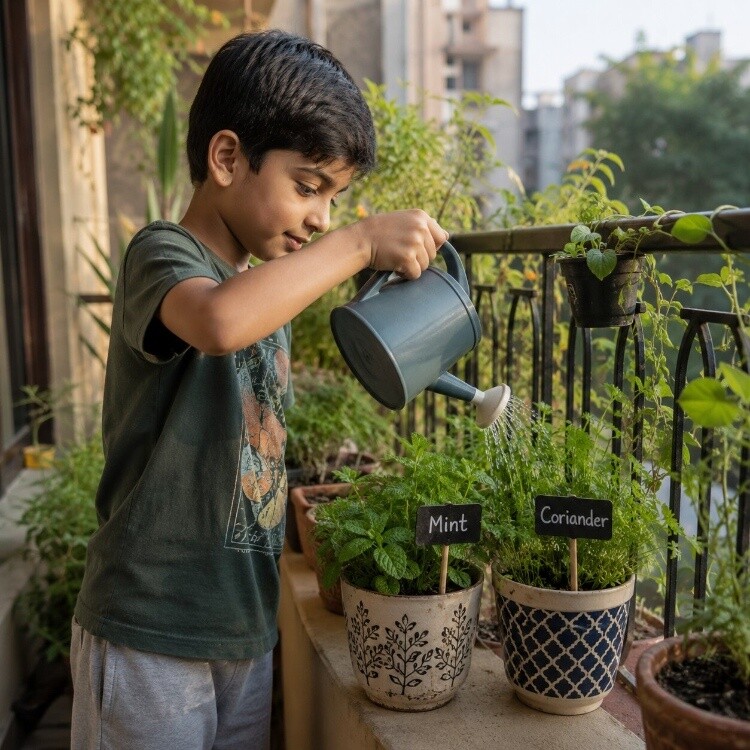
Herbs — mint, coriander, and curry leaf plants grow relatively easily in Indian conditions and offer genuine kitchen use, adding real-world purpose to the growing process.
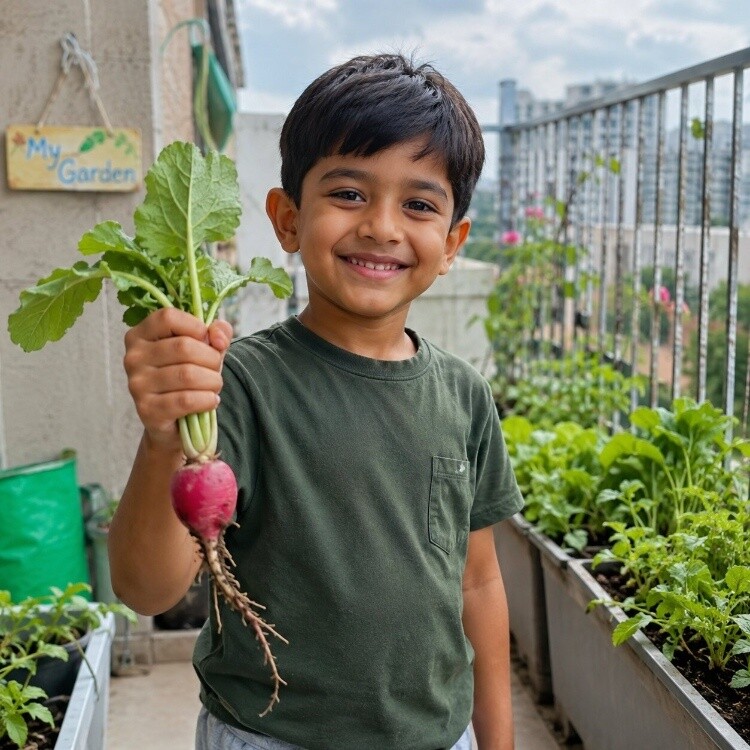
Quick-growing vegetables — radish and spinach (palak) grow relatively fast, offering satisfying, visible progress within weeks rather than months — important for maintaining a child's engagement.
Flowering plants for visible reward — marigold and other hardy, colourful flowering plants offer bright, satisfying visual results relatively quickly.
Tomatoes and chillies — slightly more involved but genuinely rewarding, particularly appealing given their direct connection to family cooking.
Age-appropriate gardening tasks
Ages 3-5 — watering (with supervision and appropriately sized containers), helping press seeds into soil, observing and describing changes.
Ages 6-9 — understanding basic plant needs (water, light, soil), independent watering responsibility for their specific plant, simple pest observation and basic organic pest management.
Ages 9-12 — planning what to grow and understanding growing seasons, more complex care (pruning, repotting, understanding soil quality), and genuine harvest-to-table connection (cooking with what they've grown).
Building the patience and responsibility dimension deliberately
Unlike many childhood activities offering relatively quick results, gardening's genuinely slow pace (weeks to see meaningful growth, longer for harvest) builds patience specifically through necessity rather than instruction — there's no way to rush a seed's growth, and children learn this experientially rather than through being told to be patient.
The science learning embedded naturally
Photosynthesis, plant life cycles, the role of water and sunlight, and basic ecosystem understanding (pollinators, soil health) all become concrete and directly observed rather than abstract textbook concepts, when a child has genuinely grown something themselves.
Managing the inevitable failures constructively
Plants die, pests appear, growth doesn't proceed as expected — these genuine setbacks, handled with curiosity ("what do you think went wrong? what could we try differently?") rather than distress, build resilience alongside the botanical knowledge, mirroring the broader problem-solving and goal-setting skills covered elsewhere in this series.
The harvest-to-table connection, particularly valuable
Children who've grown their own coriander or radish frequently show notably increased willingness to actually eat it — the ownership and pride built through the growing process translates directly into reduced food pickiness for that specific item, a genuinely useful side benefit for families managing fussy eating.