
 Summer Camp
 Reading Writing
 Book Club
 Calligraphy
 Creative Writing
 English Speaking
 Handwriting
 Library
 Phonics
 Story Telling
 Art and Craft
 Clay Moulding
 Drawing
 Painting
 Pottery
 Sketching
 Drama Theatre
 Personality Development
 Public Speaking
 Languages
 Arabic
 Chinese
 French
 German
 Hindi
Hindi Italian
 Japanese
 Korean
 Persian
 Portuguese
 Russian
 Spanish
 Turkish
 Uzbek
Uzbek Sports and Fitness
 Aerobics
 Athletics
 Badminton
 Basket Ball
 Chess
Chess Cricket
 Football
 Golf
Golf Gymnastics
 Hulahoop
 Karate
 Martial Arts
 Pickleball
 Rugby
Rugby Skating
 Swimming
 Taekwondo
 Tennis
 Volleyball
 Yoga
Yoga Zumba
Zumba Tuition Classes
 Accounts
 Biology
 Business Studies
 CBSE
CBSE Chemistry
 Commerce
 Economics
 Homework Classes
 IB Board
 IGCSE
IGCSE Mathematics
 Physics
 Psychology
 Science
 Social Studies
 Vedic Maths
 Dance and Music
 Ballet
 Bhangra
 Bharatnatyam
 Bollywood Dance
 Casio
Casio Dandiya and Garba
 Drums
Drums Flute
Flute Guitar
 Harmonium
 Hip Hop
 Jazz
Jazz Kathak
 Keyboard
 Piano
Piano Salsa
Salsa Shlokas
 Sitar
Sitar Tabla
Tabla Ukulele
 Violin
 Vocal
Vocal Play School
 STEM
STEM
 Abacus
 App Development
 Artificial intelligence
 Basic Computer Courses
 Canva
Canva Coding
 Graphic Design
 Lego
Lego Python
 Robotics
 Rubiks Cube
 Scrabble
 Scratch
 Website Development
 Winter Camp
 Workshops
 Diwali Workshop
 Easter
 Ganesh Mahotsav
 Guru Nanak Jayanti Workshop
 Holi
Holi Independence day workshop
 Janmashtami Workshop
 Mothers day
 Navratri Workshops
 Raksha Bandhan workshop
 Ramayana Workshop
 Spring Camp
 Valentines Day Workshops
 Festive
 Daycare
 Cooking and Food
 Spring Camp
 Contests and Competitions
 Special abled
 Republic Day Workshops
 Mela
Mela
 Mela
Mela Cognitive Development
 Mother-Toddler Program
-Jul-03-2026-06-59-25-1926-AM.webp?width=30&height=30&name=Smart_20Skills_20(2)-Jul-03-2026-06-59-25-1926-AM.webp) Smart Skills
Smart Skills
 Financial Literacy
 Mental Wellbeing
 Meditation
 Reiki
Reiki




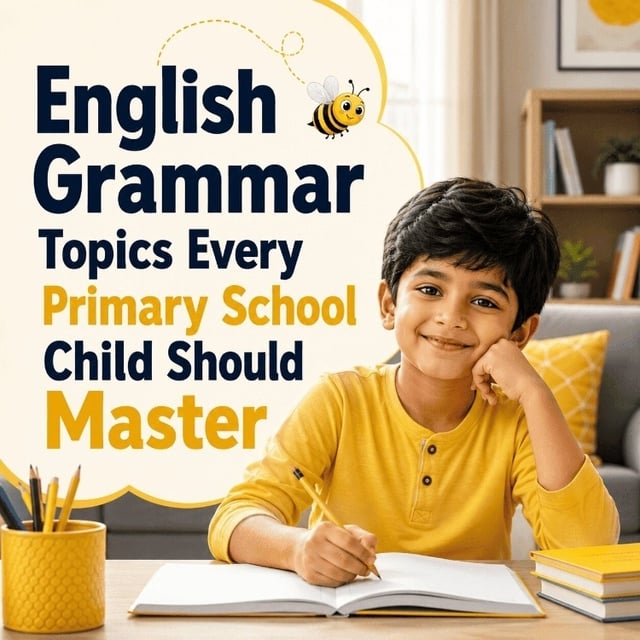
CBSE and ICSE primary curricula introduce grammar concepts in a fairly predictable sequence by grade. Here's what's typically expected by Grades 1-5, so you can support without second-guessing whether your child is on track.
Grammar homework often arrives home with unfamiliar terms — "helping verbs," "conjunctions," "adjectives of degree" — and it's easy to feel unsure whether your child is behind, on track, or ahead. Having a rough map of what's typically covered by grade removes a lot of that uncertainty.
The gap between "knowing the rule" and "using it naturally"
A common pattern: children can correctly identify a noun or verb on a worksheet but don't apply the same accuracy in their own creative writing or speech. This gap is completely normal — grammar knowledge typically becomes automatic through years of reading and writing exposure, not through memorising rules alone.
A specific challenge in Indian classrooms: translation thinking
Many children mentally translate from Hindi (or another home language) before speaking or writing in English, which can create grammar patterns that don't quite match standard English structure — for example, question formation or verb tense usage. This isn't a mistake to be anxious about; it typically resolves with continued exposure and gently modelled correction, not drilling.
How to support grammar without turning it into a chore
Point out grammar naturally during reading time rather than as a separate lesson — "did you notice that sentence used 'was' because it already happened?" Read a wide variety of material, since exposure to correctly-structured sentences does more long-term grammar work than any worksheet. Avoid over-correcting spoken grammar in casual conversation, which can make a child self-conscious about speaking at all.
When it's worth extra support
If grammar concepts from two grades ago are still consistently causing confusion despite regular reading and practice, a focused reading habit or occasional tuition support (common and completely normal in Indian households) can help close the gap without needing to feel like a red flag.
Grammar as a foundation, not a finish line
Ultimately, grammar rules exist to support clear communication — the goal isn't a child who can recite the definition of a conjunction, but one who can write and speak clearly and confidently. Building genuine reading habits alongside structured grammar teaching tends to produce far more lasting results than grammar drilling alone.