
 Summer Camp
 Reading Writing
 Book Club
 Calligraphy
 Creative Writing
 English Speaking
 Handwriting
 Library
 Phonics
 Story Telling
 Art and Craft
 Clay Moulding
 Drawing
 Painting
 Pottery
 Sketching
 Drama Theatre
 Personality Development
 Public Speaking
 Languages
 Arabic
 Chinese
 French
 German
 Hindi
Hindi Italian
 Japanese
 Korean
 Persian
 Portuguese
 Russian
 Spanish
 Turkish
 Uzbek
Uzbek Sports and Fitness
 Aerobics
 Athletics
 Badminton
 Basket Ball
 Chess
Chess Cricket
 Football
 Golf
Golf Gymnastics
 Hulahoop
 Karate
 Martial Arts
 Pickleball
 Rugby
Rugby Skating
 Swimming
 Taekwondo
 Tennis
 Volleyball
 Yoga
Yoga Zumba
Zumba Tuition Classes
 Accounts
 Biology
 Business Studies
 CBSE
CBSE Chemistry
 Commerce
 Economics
 Homework Classes
 IB Board
 IGCSE
IGCSE Mathematics
 Physics
 Psychology
 Science
 Social Studies
 Vedic Maths
 Dance and Music
 Ballet
 Bhangra
 Bharatnatyam
 Bollywood Dance
 Casio
Casio Dandiya and Garba
 Drums
Drums Flute
Flute Guitar
 Harmonium
 Hip Hop
 Jazz
Jazz Kathak
 Keyboard
 Piano
Piano Salsa
Salsa Shlokas
 Sitar
Sitar Tabla
Tabla Ukulele
 Violin
 Vocal
Vocal Play School
 STEM
STEM
 Abacus
 App Development
 Artificial intelligence
 Basic Computer Courses
 Canva
Canva Coding
 Graphic Design
 Lego
Lego Python
 Robotics
 Rubiks Cube
 Scrabble
 Scratch
 Website Development
 Winter Camp
 Workshops
 Diwali Workshop
 Easter
 Ganesh Mahotsav
 Guru Nanak Jayanti Workshop
 Holi
Holi Independence day workshop
 Janmashtami Workshop
 Mothers day
 Navratri Workshops
 Raksha Bandhan workshop
 Ramayana Workshop
 Spring Camp
 Valentines Day Workshops
 Festive
 Daycare
 Cooking and Food
 Spring Camp
 Contests and Competitions
 Special abled
 Republic Day Workshops
 Mela
Mela
 Mela
Mela Cognitive Development
 Mother-Toddler Program
-Jul-03-2026-06-59-25-1926-AM.webp?width=30&height=30&name=Smart_20Skills_20(2)-Jul-03-2026-06-59-25-1926-AM.webp) Smart Skills
Smart Skills
 Financial Literacy
 Mental Wellbeing
 Meditation
 Reiki
Reiki



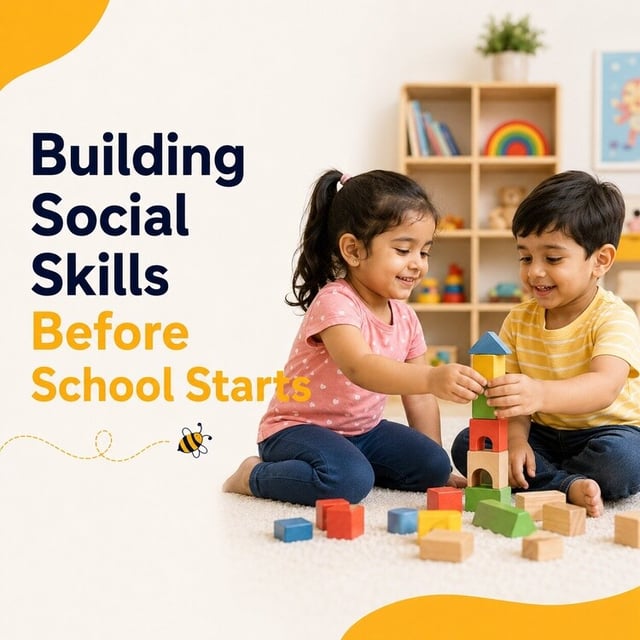
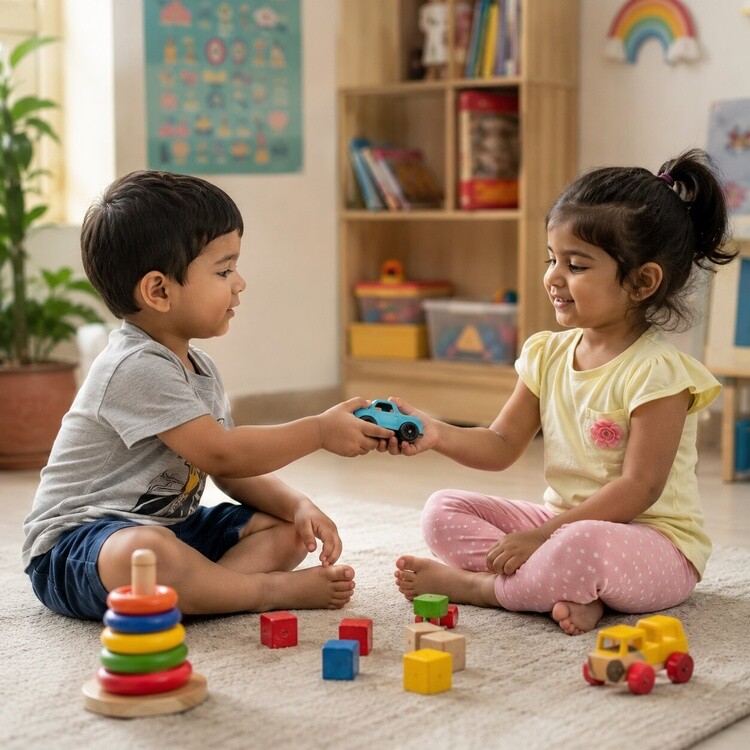
School-entry social skills — turn-taking, joining play, managing small conflicts — are built through practice, not lectures. Here's the pre-school social curriculum, delivered via playdates and park time.
The school-readiness skill that most shapes early school happiness isn't academic — it's social: entering a group, waiting a turn, surviving a "no," and repairing a small conflict. All are practicable in the year before.
The core skills and their practice grounds
Turn-taking — board games, swing queues, and "your turn, my turn" pretend play — the everyday rep-building of waiting.
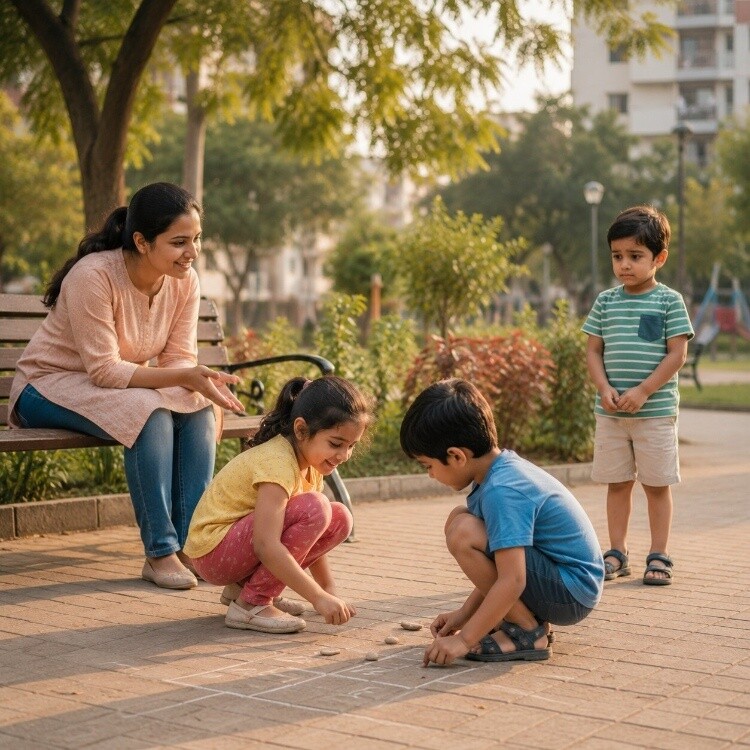
Joining ongoing play — the hardest playground skill: watching, finding a role, asking in. Rehearsable through role-play at home ("what could you say?") and coached gently from the park bench — coached, not performed for them.
Sharing, realistically framed — true sharing is developmentally late; taking turns with desired objects is the honest age-appropriate target. Pre-playdate agreements ("which toys are put away, which are for everyone?") prevent most meltdowns.
Handling "no" and losing — small doses, warmly supported: losing at snakes-and-ladders with a parent who models "oh well, next time!" is inoculation for playground disappointments.
Conflict repair — the words for it ("I don't like that," "can I have it after you?") taught as scripts, plus adult-supported repair after clashes rather than forced hollow sorries.
Reading feelings — naming emotions in books, in themselves, and in playmates ("look at his face — how does he feel?") builds the perception underneath all social skill.
Playdate architecture
Short (60-90 minutes beats a long unraveling afternoon), activity-anchored (a craft, a game, a snack project — structure prevents drift into conflict), slightly hungry-proofed (fed children negotiate better), and debriefed lightly afterward ("what was fun? what was tricky?").
The temperament honesty
Slow-to-warm children need arrival buffers (coming early to settle before the group forms), advance previews ("Aarav and Diya will be there"), and zero push-into-the-group pressure — warm-up time is legitimate, not a deficiency. Big-energy children need pre-run energy discharge and more turn-taking reps. Matching the practice to the child beats generic socialising volume.
Where group settings help
Structured group activities for 3-4 year olds — music groups, toddler sports intros, art classes — offer social practice with built-in structure: shared materials, turn systems, adult-mediated fairness. For children who find free-form park socialising overwhelming, the structured route is often the gentler on-ramp, and both together cover the full range.