
 Summer Camp
 Reading Writing
 Book Club
 Calligraphy
 Creative Writing
 English Speaking
 Handwriting
 Library
 Phonics
 Story Telling
 Art and Craft
 Clay Moulding
 Drawing
 Painting
 Pottery
 Sketching
 Drama Theatre
 Personality Development
 Public Speaking
 Languages
 Arabic
 Chinese
 French
 German
 Hindi
Hindi Italian
 Japanese
 Korean
 Persian
 Portuguese
 Russian
 Spanish
 Turkish
 Uzbek
Uzbek Sports and Fitness
 Aerobics
 Athletics
 Badminton
 Basket Ball
 Chess
Chess Cricket
 Football
 Golf
Golf Gymnastics
 Hulahoop
 Karate
 Martial Arts
 Pickleball
 Rugby
Rugby Skating
 Swimming
 Taekwondo
 Tennis
 Volleyball
 Yoga
Yoga Zumba
Zumba Tuition Classes
 Accounts
 Biology
 Business Studies
 CBSE
CBSE Chemistry
 Commerce
 Economics
 Homework Classes
 IB Board
 IGCSE
IGCSE Mathematics
 Physics
 Psychology
 Science
 Social Studies
 Vedic Maths
 Dance and Music
 Ballet
 Bhangra
 Bharatnatyam
 Bollywood Dance
 Casio
Casio Dandiya and Garba
 Drums
Drums Flute
Flute Guitar
 Harmonium
 Hip Hop
 Jazz
Jazz Kathak
 Keyboard
 Piano
Piano Salsa
Salsa Shlokas
 Sitar
Sitar Tabla
Tabla Ukulele
 Violin
 Vocal
Vocal Play School
 STEM
STEM
 Abacus
 App Development
 Artificial intelligence
 Basic Computer Courses
 Canva
Canva Coding
 Graphic Design
 Lego
Lego Python
 Robotics
 Rubiks Cube
 Scrabble
 Scratch
 Website Development
 Winter Camp
 Workshops
 Diwali Workshop
 Easter
 Ganesh Mahotsav
 Guru Nanak Jayanti Workshop
 Holi
Holi Independence day workshop
 Janmashtami Workshop
 Mothers day
 Navratri Workshops
 Raksha Bandhan workshop
 Ramayana Workshop
 Spring Camp
 Valentines Day Workshops
 Festive
 Daycare
 Cooking and Food
 Spring Camp
 Contests and Competitions
 Special abled
 Republic Day Workshops
 Mela
Mela
 Mela
Mela Cognitive Development
 Mother-Toddler Program
-Jul-03-2026-06-59-25-1926-AM.webp?width=30&height=30&name=Smart_20Skills_20(2)-Jul-03-2026-06-59-25-1926-AM.webp) Smart Skills
Smart Skills
 Financial Literacy
 Mental Wellbeing
 Meditation
 Reiki
Reiki




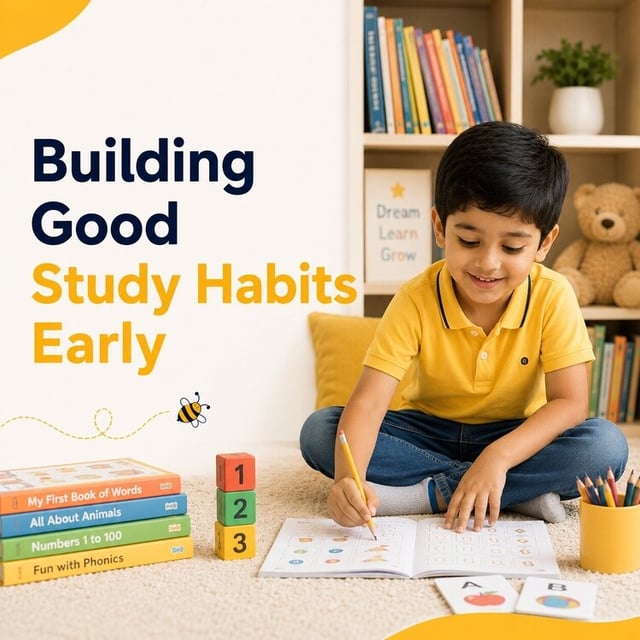
Study habits at 5-6 are about architecture, not hours — a consistent slot, a settled spot, a calm tone, and done-is-done brevity. The habits built now are the ones exams later run on.
The study habits that matter at fifteen are installed at five — not through longer hours but through the daily architecture: when, where, how it feels, and how it ends.
The four pillars, sized for age five-six
The slot — Same time daily (post-snack, post-play works for most energy curves), brief (10-20 minutes covers this age's entire legitimate homework load), and anchored to the routine's sequence rather than the clock.
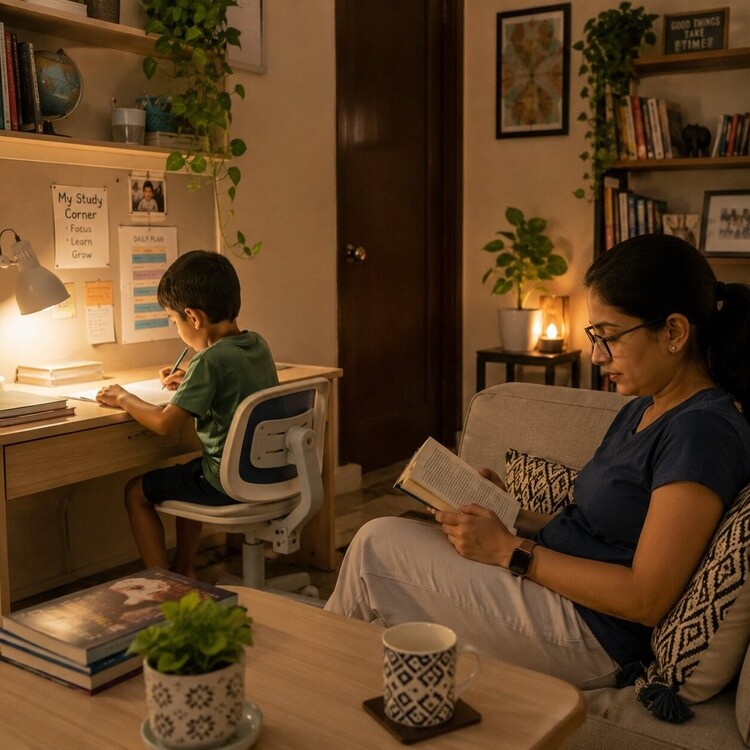
The spot — One consistent, boring-ish place: dining-table corner, small desk, floor cushion — consistency over furniture. Screens out of sightline; siblings' chaos managed as feasible; the shared-room reality accommodated with timing rather than renovation.
The tone — Parent nearby, not hovering; calm as the non-negotiable (the session that ends in tears taught only aversion); struggle allowed a beat before help; effort acknowledged over correctness.
The ending — Done is done — no perfectionist re-dos, no "since we're sitting, let's do extra." The session that ends cleanly gets repeated willingly.
Habit mechanics that help
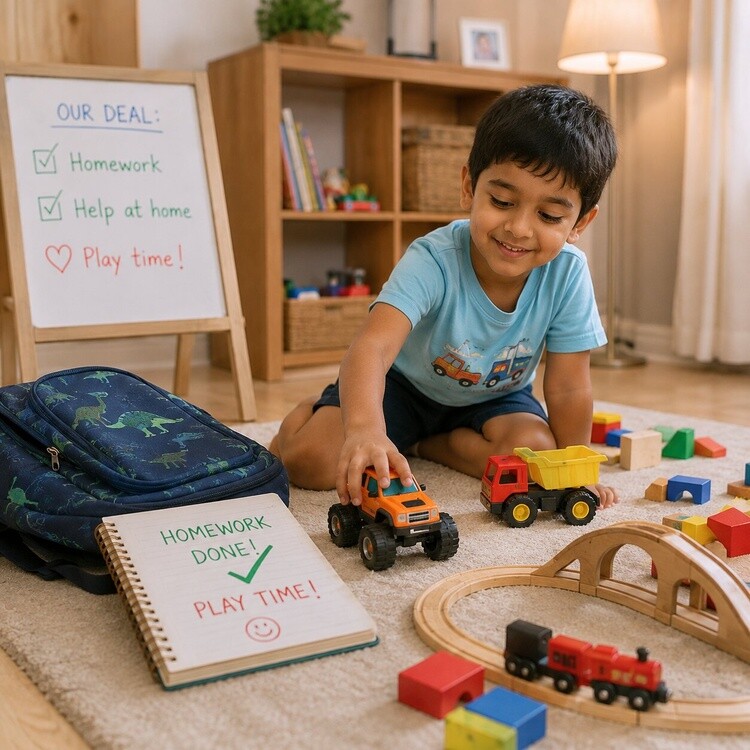
The visible sequence (a small chart: snack → play → study → free) making the slot predictable rather than negotiable. The child's own setup ritual — fetching their bag, choosing the pencil — as ownership infrastructure. A settling minute (water sip, three breaths, page ready) marking the transition. And the post-slot freedom honoured absolutely — the deal's integrity is the habit's fuel.
What home study is NOT at this age
Not tuition-by-parent (re-teaching the day's content sours two relationships at once), not extension work beyond school's ask, and not performance review. Where school work seems genuinely mismatched — too much, too hard, too easy — the conversation is with the teacher, not compensated at the dining table.
The working-parent and help reality
Where homework hour lands on grandparents or help, the architecture transfers better than the judgment calls: the written sequence, the fixed spot, the "calm, brief, done-is-done" brief communicated explicitly. Consistency across supervisors beats quality variance between them.
The long game, named
Nothing in the five-year-old's homework matters academically; everything in the habit does. The child who arrives at Class 6 with a settled slot, a working spot, and a neutral-to-positive study association owns infrastructure that no crash-course later replicates — the entire point of starting now, gently.