
 Summer Camp
 Reading Writing
 Book Club
 Calligraphy
 Creative Writing
 English Speaking
 Handwriting
 Library
 Phonics
 Story Telling
 Art and Craft
 Clay Moulding
 Drawing
 Painting
 Pottery
 Sketching
 Drama Theatre
 Personality Development
 Public Speaking
 Languages
 Arabic
 Chinese
 French
 German
 Hindi
Hindi Italian
 Japanese
 Korean
 Persian
 Portuguese
 Russian
 Spanish
 Turkish
 Uzbek
Uzbek Sports and Fitness
 Aerobics
 Athletics
 Badminton
 Basket Ball
 Chess
Chess Cricket
 Football
 Golf
Golf Gymnastics
 Hulahoop
 Karate
 Martial Arts
 Pickleball
 Rugby
Rugby Skating
 Swimming
 Taekwondo
 Tennis
 Volleyball
 Yoga
Yoga Zumba
Zumba Tuition Classes
 Accounts
 Biology
 Business Studies
 CBSE
CBSE Chemistry
 Commerce
 Economics
 Homework Classes
 IB Board
 IGCSE
IGCSE Mathematics
 Physics
 Psychology
 Science
 Social Studies
 Vedic Maths
 Dance and Music
 Ballet
 Bhangra
 Bharatnatyam
 Bollywood Dance
 Casio
Casio Dandiya and Garba
 Drums
Drums Flute
Flute Guitar
 Harmonium
 Hip Hop
 Jazz
Jazz Kathak
 Keyboard
 Piano
Piano Salsa
Salsa Shlokas
 Sitar
Sitar Tabla
Tabla Ukulele
 Violin
 Vocal
Vocal Play School
 STEM
STEM
 Abacus
 App Development
 Artificial intelligence
 Basic Computer Courses
 Canva
Canva Coding
 Graphic Design
 Lego
Lego Python
 Robotics
 Rubiks Cube
 Scrabble
 Scratch
 Website Development
 Winter Camp
 Workshops
 Diwali Workshop
 Easter
 Ganesh Mahotsav
 Guru Nanak Jayanti Workshop
 Holi
Holi Independence day workshop
 Janmashtami Workshop
 Mothers day
 Navratri Workshops
 Raksha Bandhan workshop
 Ramayana Workshop
 Spring Camp
 Valentines Day Workshops
 Festive
 Daycare
 Cooking and Food
 Spring Camp
 Contests and Competitions
 Special abled
 Republic Day Workshops
 Mela
Mela
 Mela
Mela Cognitive Development
 Mother-Toddler Program
-Jul-03-2026-06-59-25-1926-AM.webp?width=30&height=30&name=Smart_20Skills_20(2)-Jul-03-2026-06-59-25-1926-AM.webp) Smart Skills
Smart Skills
 Financial Literacy
 Mental Wellbeing
 Meditation
 Reiki
Reiki





Five-year-olds are ready for richer stories — longer arcs, layered feelings, first chapter books read aloud — while their own reading starts on much simpler parallel tracks.
The five-year-old story appetite outruns their reading ability by years — which is exactly right. The bookshelf serves the appetite; the practice shelf serves the skill.
What the listening diet includes now
Longer picture books with emotional depth — jealousy, courage, unfairness, and repair — stories processing the feelings school life now generates.
First chapter books read across nights — short chapters, recurring characters, gentle cliffhangers — the serialised bedtime as reading-hunger engine.
Mythology and epics in child versions — Ramayana and Mahabharata retellings, Panchatantra's full range, regional folk tales — the cultural story-inheritance landing properly now.
Funny books, deliberately stocked — the books that make them laugh are the books that make them readers.
Information books following obsessions — dinosaurs, space, cricket, how bodies work — non-fiction riding the question years.
School and friendship stories — classroom dilemmas and playground politics rehearsed through characters.
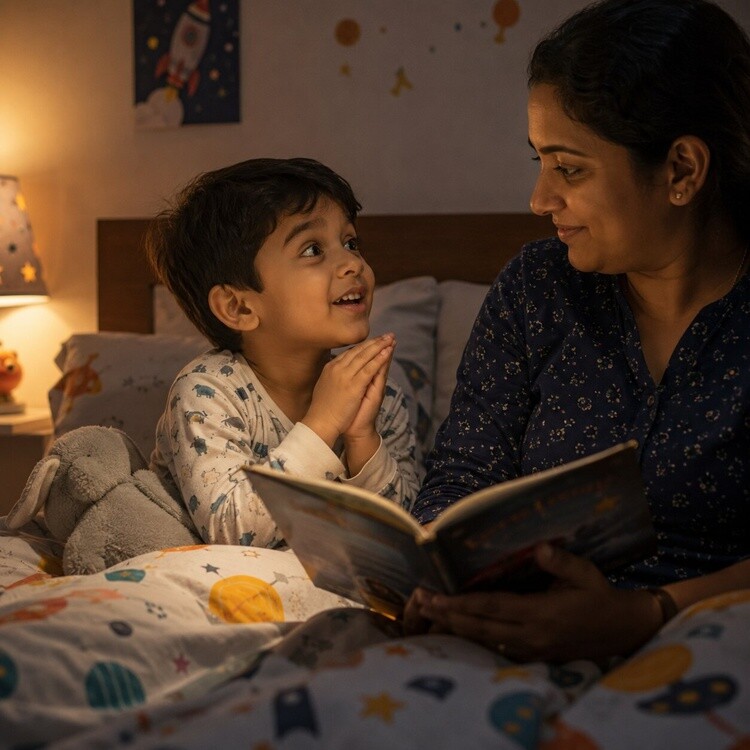
The Indian shelf, age five edition
Tulika and Karadi Tales for picture-book depth, Pratham for volume affordability, Duckbill and Puffin India for early chapter material, Amar Chitra Katha entering as the mythology-comics bridge — the Indian children's publishing ecosystem covers this age genuinely well.
Read-aloud craft at five
Voices and drama still welcome; pausing for predictions and "what would you do?" deepens engagement; and the post-chapter conversation — favourite part, confusing part, what next? — is comprehension development wearing pyjamas.
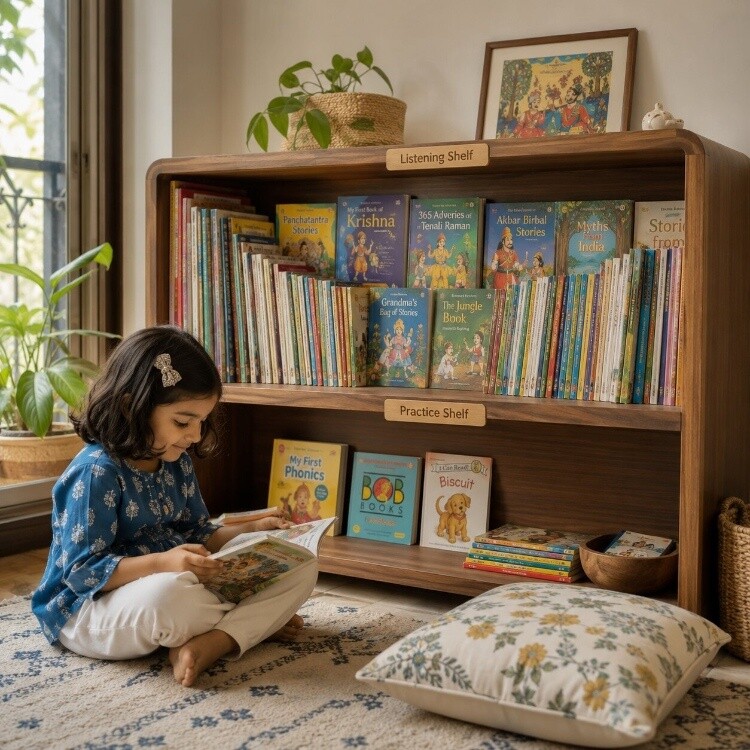
Their parallel reading shelf
Alongside the rich listening diet: the simple decodables and early readers matched to actual skill — the two-shelf system, kept distinct. The listening shelf builds the reader they'll become; the practice shelf builds the mechanics to get there.
Library rhythm and book culture
A regular library visit (or the borrowing circle among parent friends) keeps volume affordable, and the child choosing their own books — even repeat choices, even "too easy" ones — builds the ownership that makes readers. The home signal that matters most stays constant: books visible, adults reading, and the bedtime slot protected.