
 Summer Camp
 Reading Writing
 Book Club
 Calligraphy
 Creative Writing
 English Speaking
 Handwriting
 Library
 Phonics
 Story Telling
 Art and Craft
 Clay Moulding
 Drawing
 Painting
 Pottery
 Sketching
 Drama Theatre
 Personality Development
 Public Speaking
 Languages
 Arabic
 Chinese
 French
 German
 Hindi
Hindi Italian
 Japanese
 Korean
 Persian
 Portuguese
 Russian
 Spanish
 Turkish
 Uzbek
Uzbek Sports and Fitness
 Aerobics
 Athletics
 Badminton
 Basket Ball
 Chess
Chess Cricket
 Football
 Golf
Golf Gymnastics
 Hulahoop
 Karate
 Martial Arts
 Pickleball
 Rugby
Rugby Skating
 Swimming
 Taekwondo
 Tennis
 Volleyball
 Yoga
Yoga Zumba
Zumba Tuition Classes
 Accounts
 Biology
 Business Studies
 CBSE
CBSE Chemistry
 Commerce
 Economics
 Homework Classes
 IB Board
 IGCSE
IGCSE Mathematics
 Physics
 Psychology
 Science
 Social Studies
 Vedic Maths
 Dance and Music
 Ballet
 Bhangra
 Bharatnatyam
 Bollywood Dance
 Casio
Casio Dandiya and Garba
 Drums
Drums Flute
Flute Guitar
 Harmonium
 Hip Hop
 Jazz
Jazz Kathak
 Keyboard
 Piano
Piano Salsa
Salsa Shlokas
 Sitar
Sitar Tabla
Tabla Ukulele
 Violin
 Vocal
Vocal Play School
 STEM
STEM
 Abacus
 App Development
 Artificial intelligence
 Basic Computer Courses
 Canva
Canva Coding
 Graphic Design
 Lego
Lego Python
 Robotics
 Rubiks Cube
 Scrabble
 Scratch
 Website Development
 Winter Camp
 Workshops
 Diwali Workshop
 Easter
 Ganesh Mahotsav
 Guru Nanak Jayanti Workshop
 Holi
Holi Independence day workshop
 Janmashtami Workshop
 Mothers day
 Navratri Workshops
 Raksha Bandhan workshop
 Ramayana Workshop
 Spring Camp
 Valentines Day Workshops
 Festive
 Daycare
 Cooking and Food
 Spring Camp
 Contests and Competitions
 Special abled
 Republic Day Workshops
 Mela
Mela
 Mela
Mela Cognitive Development
 Mother-Toddler Program
-Jul-03-2026-06-59-25-1926-AM.webp?width=30&height=30&name=Smart_20Skills_20(2)-Jul-03-2026-06-59-25-1926-AM.webp) Smart Skills
Smart Skills
 Financial Literacy
 Mental Wellbeing
 Meditation
 Reiki
Reiki




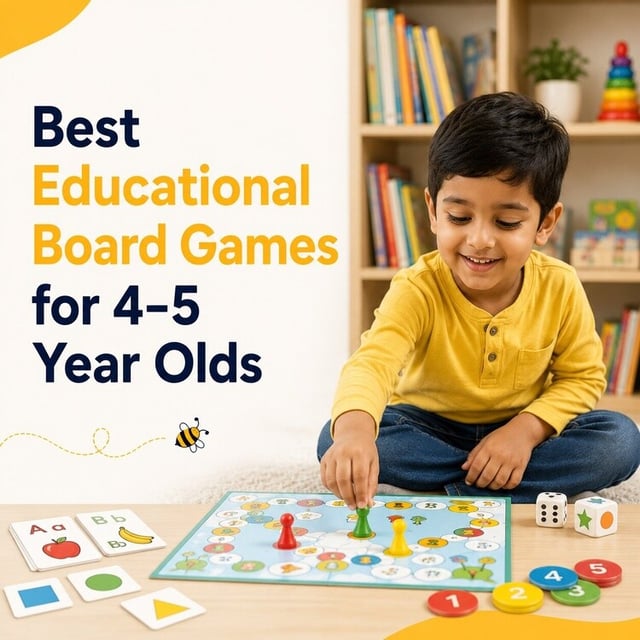
Board games at 4-5 build counting, turn-taking, focus, and losing-gracefully — a genuine curriculum in a box. Here's what works at this age and how to play it well.
The family board game shelf earns its space at 4-5: games deliver math practice, attention stretching, rule-following, and the emotional education of losing — all inside genuine fun.
What games teach at this age
Counting and number recognition — dice reading and space-counting as high-repetition math practice with zero worksheet feel.
Turn-taking and patience — the waiting is the training.
Rule-following and structure — games as the gentlest introduction to systems with fixed rules.
Winning and losing — the practice ground for disappointment management, with stakes small enough to survive.
Focus duration — a full game's arc stretches attention spans naturally.
Categories and classics that work
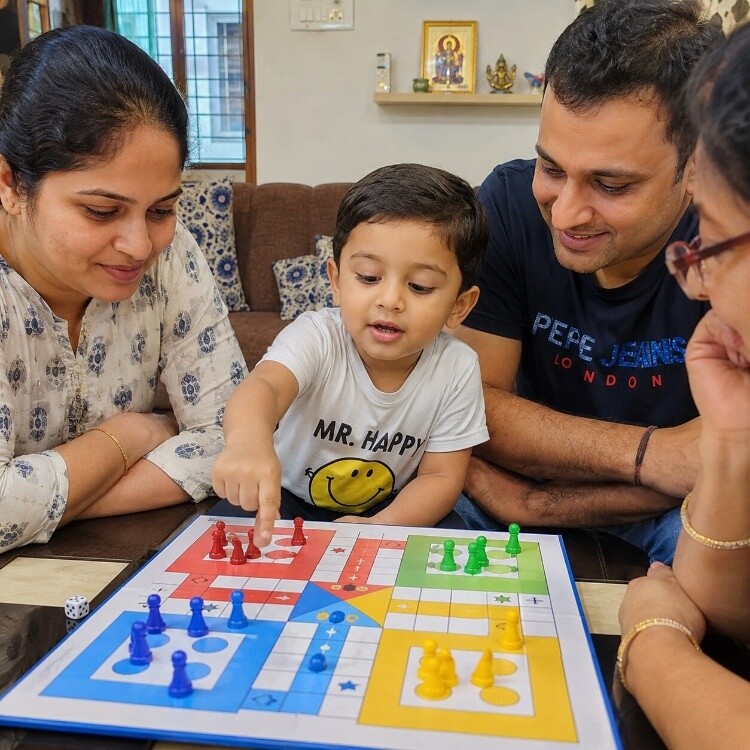
Roll-and-move classics — Snakes and Ladders and Ludo (shortened variants for stamina) — the counting workhorses every Indian home already owns.
Matching and memory games — picture-card memory games scaling in pair count.
Simple strategy starters — Connect Four-style games introducing "thinking ahead one move."
Cooperative games — everyone-wins-together formats, genuinely valuable for children finding losing hard — the team beats the game, not each other.
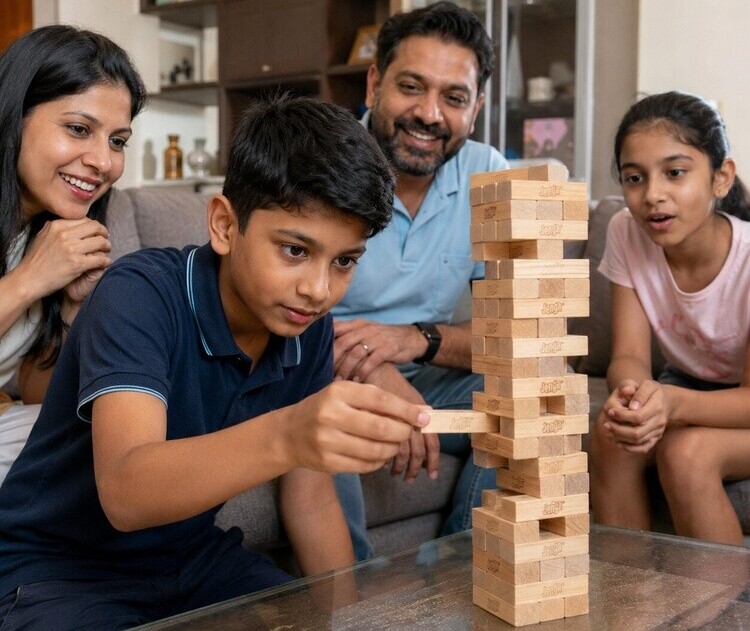
Dexterity games — stacking and balancing games (wooden block towers) mixing motor skill with suspense.
Bingo variants — picture, number, and letter bingo — recognition practice across the curriculum.
Playing well with this age
House-rule freely: shorten games, allow re-rolls, adjust for stamina — the box rules serve the family, not the reverse. Lose some games genuinely but not all — children need both wins and supported losses. Model the losing script out loud ("oh no! oh well — good game, let's play again") because the script is the actual product. And end before meltdown territory — one game wanted-more beats three games ending in tears.
The losing-meltdown phase
Most 4-5 year olds pass through a losing-is-unbearable phase; it's regulation development, not character. Cooperative games, shorter formats, and matter-of-fact loss modelling carry a family through it — and the child who practices losing at Ludo at five handles playground and classroom competition at seven measurably better.
Screen-free family infrastructure
A regular family game slot — Sunday evening, post-dinner Fridays — builds a screen-free ritual with compounding returns: math reps, connection, and the family's shared game vocabulary. Cheap, repeatable, and genuinely formative.