
 Summer Camp
 Reading Writing
 Book Club
 Calligraphy
 Creative Writing
 English Speaking
 Handwriting
 Library
 Phonics
 Story Telling
 Art and Craft
 Clay Moulding
 Drawing
 Painting
 Pottery
 Sketching
 Drama Theatre
 Personality Development
 Public Speaking
 Languages
 Arabic
 Chinese
 French
 German
 Hindi
Hindi Italian
 Japanese
 Korean
 Persian
 Portuguese
 Russian
 Spanish
 Turkish
 Uzbek
Uzbek Sports and Fitness
 Aerobics
 Athletics
 Badminton
 Basket Ball
 Chess
Chess Cricket
 Football
 Golf
Golf Gymnastics
 Hulahoop
 Karate
 Martial Arts
 Pickleball
 Rugby
Rugby Skating
 Swimming
 Taekwondo
 Tennis
 Volleyball
 Yoga
Yoga Zumba
Zumba Tuition Classes
 Accounts
 Biology
 Business Studies
 CBSE
CBSE Chemistry
 Commerce
 Economics
 Homework Classes
 IB Board
 IGCSE
IGCSE Mathematics
 Physics
 Psychology
 Science
 Social Studies
 Vedic Maths
 Dance and Music
 Ballet
 Bhangra
 Bharatnatyam
 Bollywood Dance
 Casio
Casio Dandiya and Garba
 Drums
Drums Flute
Flute Guitar
 Harmonium
 Hip Hop
 Jazz
Jazz Kathak
 Keyboard
 Piano
Piano Salsa
Salsa Shlokas
 Sitar
Sitar Tabla
Tabla Ukulele
 Violin
 Vocal
Vocal Play School
 STEM
STEM
 Abacus
 App Development
 Artificial intelligence
 Basic Computer Courses
 Canva
Canva Coding
 Graphic Design
 Lego
Lego Python
 Robotics
 Rubiks Cube
 Scrabble
 Scratch
 Website Development
 Winter Camp
 Workshops
 Diwali Workshop
 Easter
 Ganesh Mahotsav
 Guru Nanak Jayanti Workshop
 Holi
Holi Independence day workshop
 Janmashtami Workshop
 Mothers day
 Navratri Workshops
 Raksha Bandhan workshop
 Ramayana Workshop
 Spring Camp
 Valentines Day Workshops
 Festive
 Daycare
 Cooking and Food
 Spring Camp
 Contests and Competitions
 Special abled
 Republic Day Workshops
 Mela
Mela
 Mela
Mela Cognitive Development
 Mother-Toddler Program
-Jul-03-2026-06-59-25-1926-AM.webp?width=30&height=30&name=Smart_20Skills_20(2)-Jul-03-2026-06-59-25-1926-AM.webp) Smart Skills
Smart Skills
 Financial Literacy
 Mental Wellbeing
 Meditation
 Reiki
Reiki




Kindergarten reading life runs on two tracks — richer read-alouds stretching comprehension, and simple decodable books feeding the emerging reader. Both tracks matter; neither replaces the other.
The kindergarten bookshelf serves two readers in one child: the listener whose comprehension handles real stories, and the emerging decoder who needs winnable simple texts. Feeding both is the strategy.
Track one: the read-aloud diet
Longer picture books with real plots — problems, attempts, and resolutions; characters who change.
Early chapter read-alouds — short-chapter series read across nights introduce sustained narrative — the cliffhanger bedtime is a reading-hunger builder.
Folk and mythology retellings — Panchatantra, Jataka, and regional tales in age-right versions — cultural inheritance plus story structure.
Non-fiction for the question years — animal books, how-things-work books, atlas browsing — the "why?" phase, fed in print.
Humour that lands — books that make them genuinely laugh convert reluctant listeners fastest.
Track two: the emerging-reader diet
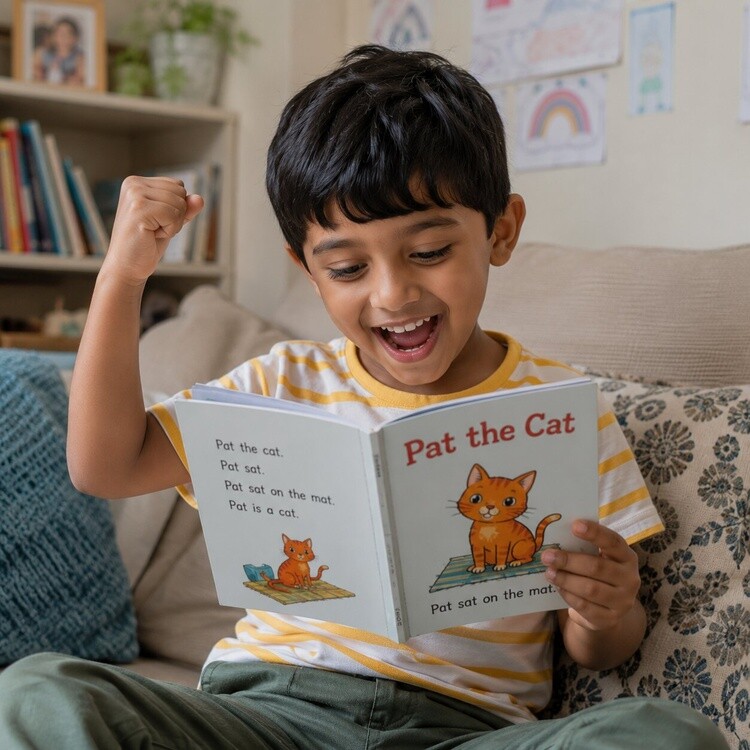
Decodable readers — simple phonics-matched texts where they can win — success density is the design principle.
Repetitive-pattern books — predictable structures where memory scaffolds decoding.
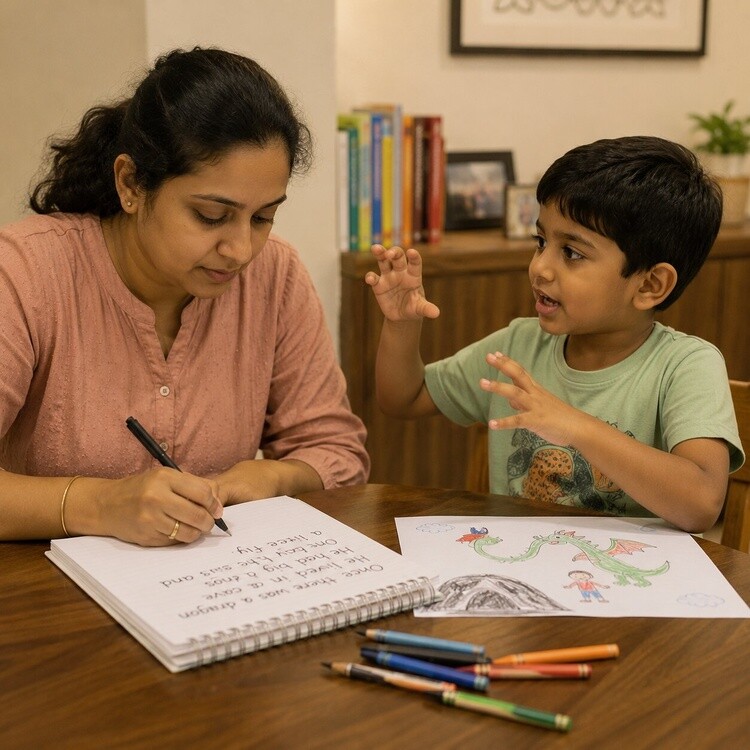
Their own dictated stories — child narrates, parent writes, child "reads" back — authorship as reading motivation.
Environmental print — packets, signs, and menus as wild reading material.
Working both tracks without confusing them
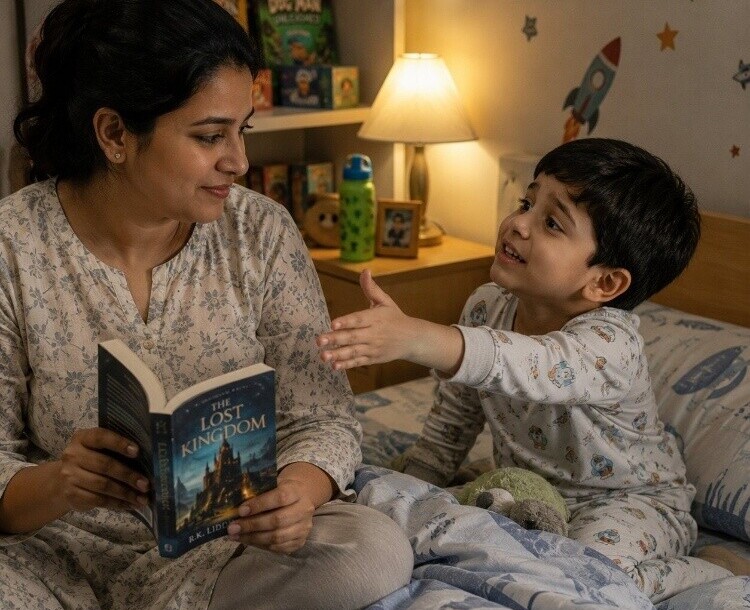
The read-aloud track runs ahead of decoding ability on purpose — comprehension and vocabulary grow through the ear years before the eye catches up. Keeping the tracks separate protects both: bedtime stays rich and effortless (their listening level), practice reading stays short and winnable (their decoding level). Collapsing bedtime into decoding practice is the classic mistake that sours both.
The Indian-English publishing note, continued
Tulika, Pratham, Karadi Tales, and Duckbill carry both tracks with Indian settings; Pratham's leveled readers specifically serve the decodable track at famously low cost — library-building on a budget remains genuinely possible.
Signs the reading engine is catching
Spontaneous sign-reading in the wild, requesting to read their part, memorised-book "reading" evolving toward actual tracking — the engine catching is gradual and non-linear, and the fuel for it is the same at every stage: daily read-alouds, winnable practice, zero pressure.