
 Summer Camp
 Reading Writing
 Book Club
 Calligraphy
 Creative Writing
 English Speaking
 Handwriting
 Library
 Phonics
 Story Telling
 Art and Craft
 Clay Moulding
 Drawing
 Painting
 Pottery
 Sketching
 Drama Theatre
 Personality Development
 Public Speaking
 Languages
 Arabic
 Chinese
 French
 German
 Hindi
Hindi Italian
 Japanese
 Korean
 Persian
 Portuguese
 Russian
 Spanish
 Turkish
 Uzbek
Uzbek Sports and Fitness
 Aerobics
 Athletics
 Badminton
 Basket Ball
 Chess
Chess Cricket
 Football
 Golf
Golf Gymnastics
 Hulahoop
 Karate
 Martial Arts
 Pickleball
 Rugby
Rugby Skating
 Swimming
 Taekwondo
 Tennis
 Volleyball
 Yoga
Yoga Zumba
Zumba Tuition Classes
 Accounts
 Biology
 Business Studies
 CBSE
CBSE Chemistry
 Commerce
 Economics
 Homework Classes
 IB Board
 IGCSE
IGCSE Mathematics
 Physics
 Psychology
 Science
 Social Studies
 Vedic Maths
 Dance and Music
 Ballet
 Bhangra
 Bharatnatyam
 Bollywood Dance
 Casio
Casio Dandiya and Garba
 Drums
Drums Flute
Flute Guitar
 Harmonium
 Hip Hop
 Jazz
Jazz Kathak
 Keyboard
 Piano
Piano Salsa
Salsa Shlokas
 Sitar
Sitar Tabla
Tabla Ukulele
 Violin
 Vocal
Vocal Play School
 STEM
STEM
 Abacus
 App Development
 Artificial intelligence
 Basic Computer Courses
 Canva
Canva Coding
 Graphic Design
 Lego
Lego Python
 Robotics
 Rubiks Cube
 Scrabble
 Scratch
 Website Development
 Winter Camp
 Workshops
 Diwali Workshop
 Easter
 Ganesh Mahotsav
 Guru Nanak Jayanti Workshop
 Holi
Holi Independence day workshop
 Janmashtami Workshop
 Mothers day
 Navratri Workshops
 Raksha Bandhan workshop
 Ramayana Workshop
 Spring Camp
 Valentines Day Workshops
 Festive
 Daycare
 Cooking and Food
 Spring Camp
 Contests and Competitions
 Special abled
 Republic Day Workshops
 Mela
Mela
 Mela
Mela Cognitive Development
 Mother-Toddler Program
-Jul-03-2026-06-59-25-1926-AM.webp?width=30&height=30&name=Smart_20Skills_20(2)-Jul-03-2026-06-59-25-1926-AM.webp) Smart Skills
Smart Skills
 Financial Literacy
 Mental Wellbeing
 Meditation
 Reiki
Reiki





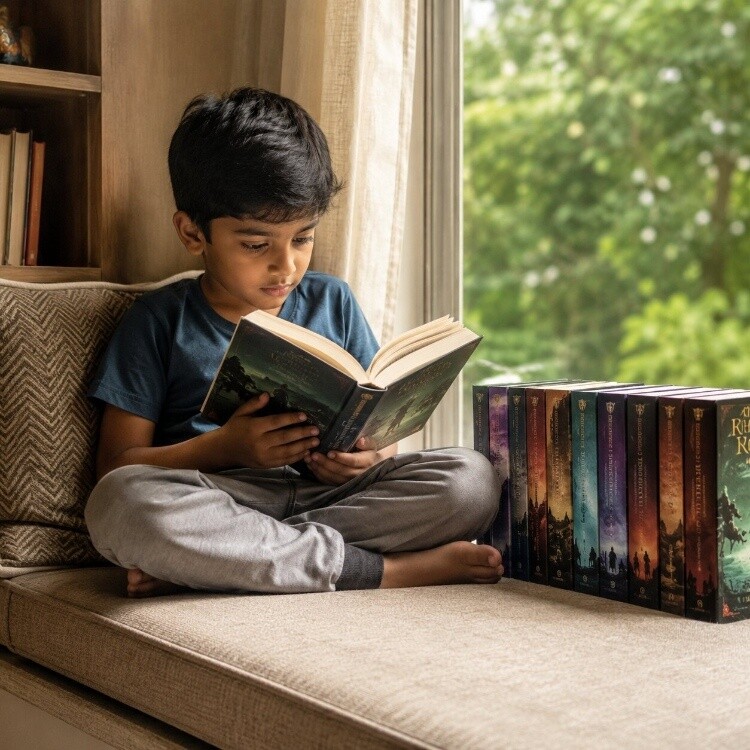
Eight-year-old readers want thicker worlds — full middle-grade series, deeper characters, first big themes — while non-fiction serves the specialist obsessions. Choice stays theirs; the shelf just gets deeper.
At eight, the reading appetite (where established) wants immersion: longer books, continuing worlds, characters with real interiors, and the first brushes with big themes at survivable distance.
The fiction shelf deepening
Full middle-grade series — the immersive multi-book worlds this age famously disappears into — fantasy, adventure, school-story, and mystery lanes all serving.
Character-driven stories — protagonists with real dilemmas — friendship betrayals, fairness battles, courage tests — fiction as emotional rehearsal space.
Funny novels maturing — humour with plot now, not just gags.
Indian middle-grade properly — the growing original Indian list: contemporary school stories, mythology-inspired fantasy, and history-adjacent adventure with Indian protagonists — identity-mirroring at the age identity forms.
Classic entry points, honestly filtered — the abridged-classics question answered by the child's pull, not the canon's push.
The non-fiction specialist shelf
Eight is peak obsession age — space, cricket statistics, dinosaurs, how-machines-work — and deep non-fiction serves it: single-subject deep-dives, visual encyclopedias, and biography entering via heroes (sportspeople, scientists, freedom fighters). The specialist reading fully counts — expertise-building is reading comprehension at maximum motivation.
Reading around the reader
Book conversations as genuine interest ("what's happening in it now?") not comprehension audit; the movie-of-the-book negotiation (book first, usually); series-completion celebrated like the achievement it is; and the family reading culture's quiet signals — adults visibly reading, books as normal gifts, the library run as fixture.
The widening-gap reality at eight
Reading ranges at eight span years — voracious novel-consumers share classrooms with early-reader strugglers, and both are common. For the striving reader: high-interest/lower-level books (publishers serve this deliberately), graphic novels' legitimate on-ramp, audiobooks building story-stamina alongside, and the assessment conversation where struggle persists — eight is squarely within the window where reading-difficulty support changes trajectories.

Screen-era reading defence, pragmatically
The competition for eight-year-old attention is real; reading's defence is friction asymmetry — the bedside book versus the negotiated screen, the everywhere-book versus the not-everywhere-tablet — and the household default patterns doing quiet heavy lifting.