
 Summer Camp
 Reading Writing
 Book Club
 Calligraphy
 Creative Writing
 English Speaking
 Handwriting
 Library
 Phonics
 Story Telling
 Art and Craft
 Clay Moulding
 Drawing
 Painting
 Pottery
 Sketching
 Drama Theatre
 Personality Development
 Public Speaking
 Languages
 Arabic
 Chinese
 French
 German
 Hindi
Hindi Italian
 Japanese
 Korean
 Persian
 Portuguese
 Russian
 Spanish
 Turkish
 Uzbek
Uzbek Sports and Fitness
 Aerobics
 Athletics
 Badminton
 Basket Ball
 Chess
Chess Cricket
 Football
 Golf
Golf Gymnastics
 Hulahoop
 Karate
 Martial Arts
 Pickleball
 Rugby
Rugby Skating
 Swimming
 Taekwondo
 Tennis
 Volleyball
 Yoga
Yoga Zumba
Zumba Tuition Classes
 Accounts
 Biology
 Business Studies
 CBSE
CBSE Chemistry
 Commerce
 Economics
 Homework Classes
 IB Board
 IGCSE
IGCSE Mathematics
 Physics
 Psychology
 Science
 Social Studies
 Vedic Maths
 Dance and Music
 Ballet
 Bhangra
 Bharatnatyam
 Bollywood Dance
 Casio
Casio Dandiya and Garba
 Drums
Drums Flute
Flute Guitar
 Harmonium
 Hip Hop
 Jazz
Jazz Kathak
 Keyboard
 Piano
Piano Salsa
Salsa Shlokas
 Sitar
Sitar Tabla
Tabla Ukulele
 Violin
 Vocal
Vocal Play School
 STEM
STEM
 Abacus
 App Development
 Artificial intelligence
 Basic Computer Courses
 Canva
Canva Coding
 Graphic Design
 Lego
Lego Python
 Robotics
 Rubiks Cube
 Scrabble
 Scratch
 Website Development
 Winter Camp
 Workshops
 Diwali Workshop
 Easter
 Ganesh Mahotsav
 Guru Nanak Jayanti Workshop
 Holi
Holi Independence day workshop
 Janmashtami Workshop
 Mothers day
 Navratri Workshops
 Raksha Bandhan workshop
 Ramayana Workshop
 Spring Camp
 Valentines Day Workshops
 Festive
 Daycare
 Cooking and Food
 Spring Camp
 Contests and Competitions
 Special abled
 Republic Day Workshops
 Mela
Mela
 Mela
Mela Cognitive Development
 Mother-Toddler Program
-Jul-03-2026-06-59-25-1926-AM.webp?width=30&height=30&name=Smart_20Skills_20(2)-Jul-03-2026-06-59-25-1926-AM.webp) Smart Skills
Smart Skills
 Financial Literacy
 Mental Wellbeing
 Meditation
 Reiki
Reiki





Six is the bridge year — decoding gaining speed while listening comprehension still leads by years. The shelf strategy: early readers they conquer, chapter books you read, and the humour that hooks.
The six-year-old reading life runs its two tracks at maximum divergence: conquering simple texts solo while devouring real stories by ear. Both shelves matter.
Their-own-reading shelf
Early reader series — levelled, character-consistent, and predictable-structured — the training wheels that work; success density remains the design principle.
Funny early readers especially — the joke that lands in self-read text is the strongest reading-is-worth-it evidence available.
Comics and graphic early readers — picture-supported decoding with genuine story payoff — a legitimate and powerful format, not a lesser one.
Non-fiction easy readers — animal facts and how-things-work in decodable form — for the child whose motivation is information.
Pratham and Indian levelled readers — the affordable-volume backbone, with Indian names and settings supporting recognition.
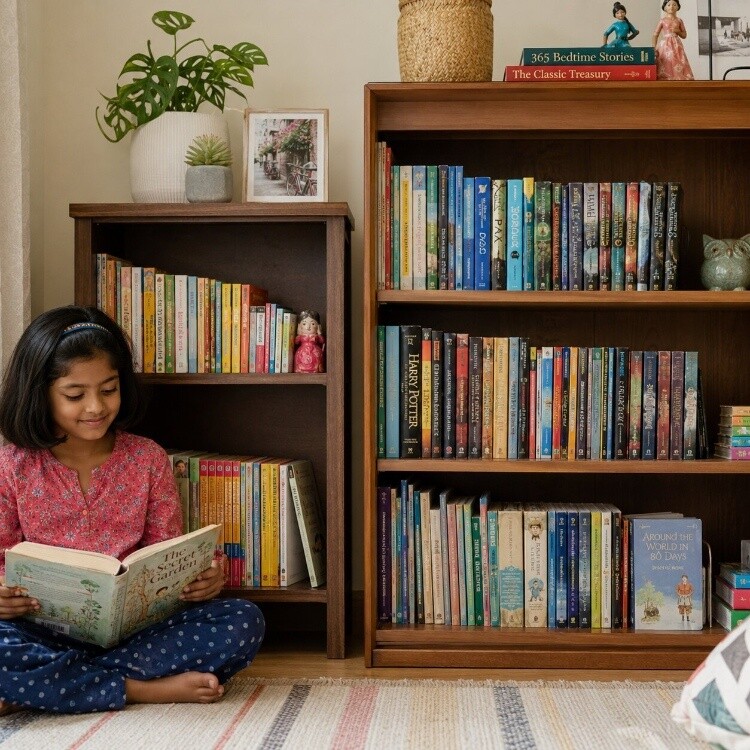
The read-aloud shelf, still leading
Chapter book serials — nightly-chapter series with cliffhangers — the bedtime pull now genuinely narrative.
Mythology continuing — fuller Ramayana/Mahabharata episodes, Amar Chitra Katha entering strongly.
School-life fiction — friendship politics and classroom dilemmas at exactly their stakes.
The family classics — the books you loved, tested against modern attention honestly — some hold, some don't, and the shared ones become inheritance.

Bridge behaviours to encourage
Their reading the first page, you the rest; the paired-reading of comic panels; their "reading ahead" of tomorrow's chapter secretly (celebrate the crime); and re-reading conquered books freely — fluency lives in re-reads.
The reluctant-reader playbook at six
Interest-first (cricket books for the cricket child, however "unliterary"), format-flexible (comics, joke books, fact books all count), success-dense (easier than seems necessary), and pressure-free (reading-as-punishment or forced-daily-logging builds avoidance with compound interest). The six-year-old refusing books is usually refusing difficulty or boredom, not reading — change the offer, not the child.
Library-and-budget rhythm continuing
The fortnightly library run, the parent-circle exchange, and the child's own card and choosing rights — volume, variety, and ownership on a household budget.