
 Summer Camp
 Reading Writing
 Book Club
 Calligraphy
 Creative Writing
 English Speaking
 Handwriting
 Library
 Phonics
 Story Telling
 Art and Craft
 Clay Moulding
 Drawing
 Painting
 Pottery
 Sketching
 Drama Theatre
 Personality Development
 Public Speaking
 Languages
 Arabic
 Chinese
 French
 German
 Hindi
Hindi Italian
 Japanese
 Korean
 Persian
 Portuguese
 Russian
 Spanish
 Turkish
 Uzbek
Uzbek Sports and Fitness
 Aerobics
 Athletics
 Badminton
 Basket Ball
 Chess
Chess Cricket
 Football
 Golf
Golf Gymnastics
 Hulahoop
 Karate
 Martial Arts
 Pickleball
 Rugby
Rugby Skating
 Swimming
 Taekwondo
 Tennis
 Volleyball
 Yoga
Yoga Zumba
Zumba Tuition Classes
 Accounts
 Biology
 Business Studies
 CBSE
CBSE Chemistry
 Commerce
 Economics
 Homework Classes
 IB Board
 IGCSE
IGCSE Mathematics
 Physics
 Psychology
 Science
 Social Studies
 Vedic Maths
 Dance and Music
 Ballet
 Bhangra
 Bharatnatyam
 Bollywood Dance
 Casio
Casio Dandiya and Garba
 Drums
Drums Flute
Flute Guitar
 Harmonium
 Hip Hop
 Jazz
Jazz Kathak
 Keyboard
 Piano
Piano Salsa
Salsa Shlokas
 Sitar
Sitar Tabla
Tabla Ukulele
 Violin
 Vocal
Vocal Play School
 STEM
STEM
 Abacus
 App Development
 Artificial intelligence
 Basic Computer Courses
 Canva
Canva Coding
 Graphic Design
 Lego
Lego Python
 Robotics
 Rubiks Cube
 Scrabble
 Scratch
 Website Development
 Winter Camp
 Workshops
 Diwali Workshop
 Easter
 Ganesh Mahotsav
 Guru Nanak Jayanti Workshop
 Holi
Holi Independence day workshop
 Janmashtami Workshop
 Mothers day
 Navratri Workshops
 Raksha Bandhan workshop
 Ramayana Workshop
 Spring Camp
 Valentines Day Workshops
 Festive
 Daycare
 Cooking and Food
 Spring Camp
 Contests and Competitions
 Special abled
 Republic Day Workshops
 Mela
Mela
 Mela
Mela Cognitive Development
 Mother-Toddler Program
-Jul-03-2026-06-59-25-1926-AM.webp?width=30&height=30&name=Smart_20Skills_20(2)-Jul-03-2026-06-59-25-1926-AM.webp) Smart Skills
Smart Skills
 Financial Literacy
 Mental Wellbeing
 Meditation
 Reiki
Reiki




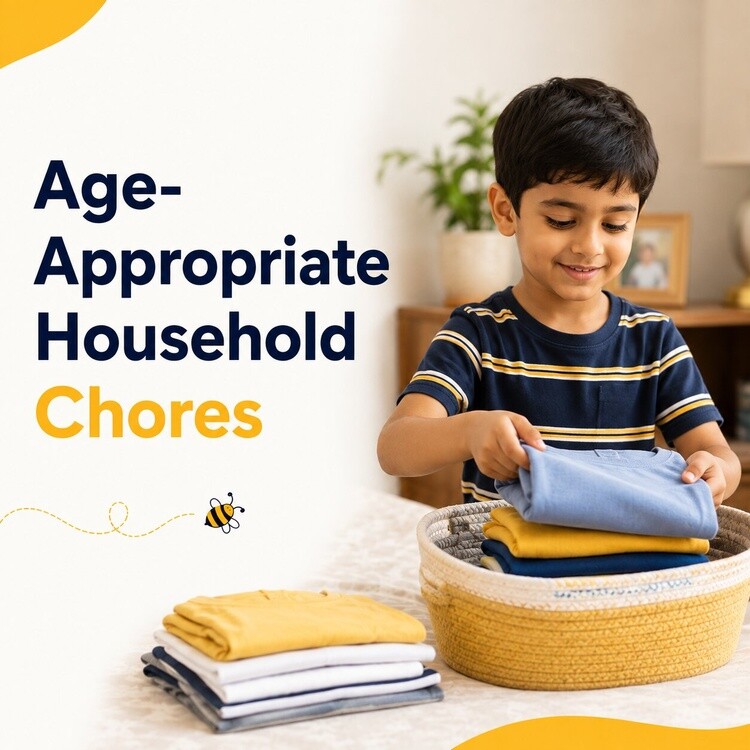
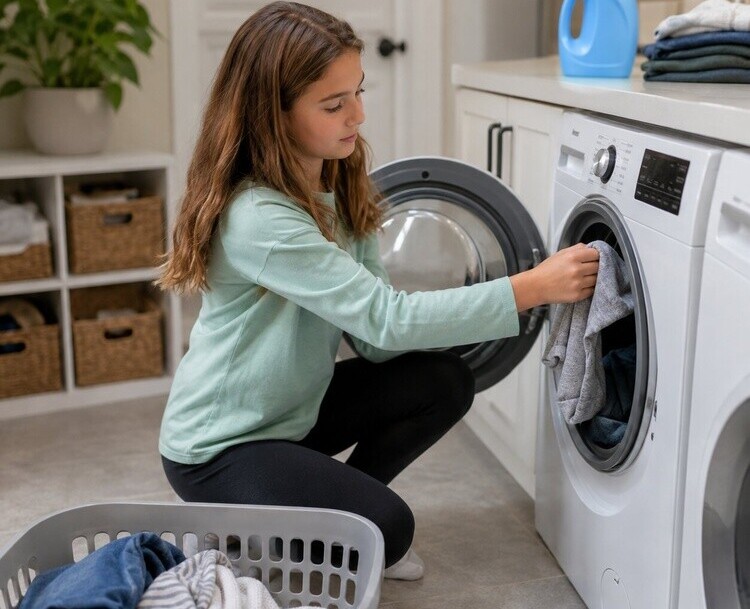
Chores build competence, responsibility, and family contribution awareness — with expectations reasonably calibrated by age. Here's a practical age-by-age chore guide for Indian households.
Household chores, thoughtfully assigned, build genuine competence and a sense of family contribution — the calibration challenge is matching expectations to actual developmental capability at each age.
The domestic-help nuance, addressed directly
In households with regular help, chores often get skipped as "unnecessary" since help handles them — but the developmental value of chores isn't really about the task completion, it's about responsibility, competence, and contribution habit-building. Designating specific child-only tasks (regardless of help's presence) preserves this value; framing it to household help and family as intentional development, not duplicate effort, avoids friction.
The compensation question
Financial experts and child psychologists generally recommend separating basic household contribution (expected simply as a family member) from any paid allowance — tying all chores to payment can undermine the "we contribute because we're family" value in favour of a pure transaction mindset, though separate, additional paid tasks beyond baseline expectations can coexist reasonably.

Making chores stick without constant battles
Visual chore charts (especially for younger children who respond well to checking things off), consistent timing (chores at predictable points in the routine rather than randomly assigned), and reasonable standards (a child's folded laundry won't match adult precision, and that's fine) all reduce daily friction.
The long-term payoff, genuinely documented
Research on childhood chore participation consistently links it to later measures of responsibility, work ethic, and even some measures of adult life satisfaction — the habit of contributing to shared spaces and tasks, built early, tends to persist as a broader life orientation.