

 Reading Writing
 Book Club
 Calligraphy
 Creative Writing
 English Speaking
 Handwriting
 Library
 Phonics
 Story Telling
 Art and Craft
 Clay Moulding
 Drawing
 Painting
 Pottery
 Sketching
 Drama Theatre
 Personality Development
 Public Speaking
 Languages
 Arabic
 Chinese
 French
 German
 Hindi
 Italian
 Japanese
 Korean
 Persian
 Portuguese
 Russian
 Spanish
 Turkish
 Uzbek
 Sports and Fitness
 Aerobics
 Athletics
 Badminton
 Basket Ball
 Chess
 Cricket
 Football
 Golf
 Gymnastics
 Hulahoop
 Karate
 Martial Arts
 Pickleball
 Rugby
 Skating
 Swimming
 Taekwondo
 Tennis
 Volleyball
 Yoga
 Zumba
 Tuition Classes
 Accounts
 Biology
 Business Studies
 CBSE
 Chemistry
 Commerce
 Economics
 Homework Classes
 IB Board
 IGCSE
 Mathematics
 Physics
 Psychology
 Science
 Social Studies
 Vedic Maths
 Dance and Music
 Ballet
 Bhangra
 Bharatnatyam
 Bollywood Dance
 Casio
 Dandiya and Garba
 Drums
 Flute
 Guitar
 Harmonium
 Hip Hop
 Jazz
 Kathak
 Keyboard
 Piano
 Salsa
 Shlokas
 Sitar
 Tabla
 Ukulele
 Violin
 Vocal
 Play School
 STEM
 Abacus
 App Development
 Artificial intelligence
 Basic Computer Courses
 Canva
 Coding
 Graphic Design
 Lego
 Python
 Robotics
 Rubiks Cube
 Scrabble
 Scratch
 Website Development
 Workshops
 Diwali Workshops
 Guru Nanak Jayanti Workshop
 Halloween
 Independence day workshop
 Navratri Workshops
 Raksha Bandhan workshop
 Ramayana Workshop
 Spring Camp
 Valentines Day Workshops
 Festive
 Daycare
 Cooking and Food
 Spring Camp
 Contests and Competitions
 Special abled
 Republic Day Workshops
 Mela
 Mela
 Cognitive Development
 Mother-Toddler Program
 Music
 Dance
 Smart Skills
 Financial Literacy
 Mental Wellbeing
 Meditation
 Reiki






Distinguishing genuinely concerning nutritional gaps from normal, temporary picky-eating phases prevents both dangerous complacency and unnecessary anxiety. This closing post in the nutrition series provides a practical framework for making that call.
Across this nutrition and taste series, a consistent underlying question has run beneath most specific topics: when does picky eating or food selectivity represent a genuine nutritional concern requiring active intervention, versus a normal developmental phase that patience and the techniques covered throughout this series will gradually resolve?

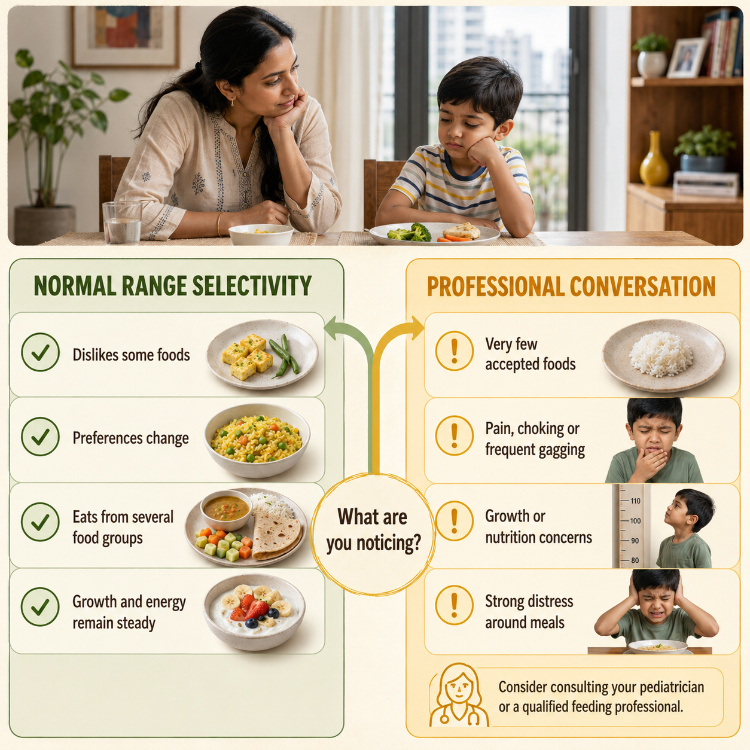
Signs that most food selectivity remains within normal range
The child accepts at least some foods across most major food groups, even if the specific accepted items within each category are limited — some vegetables, some protein sources, some grains, even if the variety within each category is narrow. Growth continues along the child's own expected trajectory (tracked through regular paediatric visits) despite the selective eating pattern. The selectivity, while frustrating, doesn't involve extreme physical distress (gagging, vomiting) with most foods, distinct from occasional dislike-driven refusal. And the pattern, while persistent, shows at least gradual change over time (even slowly) rather than complete, unchanging rigidity across months and years.

Signs warranting a genuine paediatric or feeding specialist conversation
Extremely limited food acceptance — fewer than roughly 10-15 total accepted foods across all categories, a pattern sometimes described as "extreme picky eating" or, in more severe cases, potentially connecting to Avoidant/Restrictive Food Intake Disorder (ARFID), a genuine clinical condition distinct from typical picky eating. Growth faltering or genuine weight concerns identified through regular paediatric growth tracking, rather than subjective parental impression alone. Complete rejection of entire food group categories (no protein sources accepted at all, for instance, rather than limited but present protein acceptance) sustained over extended periods. Significant mealtime distress — genuine gagging, vomiting, or severe emotional distress with most new or non-preferred foods, beyond typical reluctance or mild fussing. And any pattern accompanied by other developmental concerns (sensory processing differences beyond food specifically, communication difficulties) that might suggest a broader developmental consideration warranting comprehensive assessment.

The nutritional gap check worth doing directly, regardless of overall pattern severity
Beyond the broader pattern assessment, specifically checking whether your child's current accepted-food range provides reasonable coverage of key nutrients — adequate protein sources, some iron-rich foods, calcium sources, and general caloric adequacy for their growth — helps identify specific, addressable gaps even within an overall pattern that doesn't meet the more concerning thresholds above. A paediatrician or nutritionist can help assess this directly if you're genuinely uncertain, and in some cases, targeted supplementation (discussed with a doctor, not self-directed) can bridge specific gaps while the broader food-acceptance work covered throughout this series continues gradually.

Why premature medical intervention isn't automatically the safer choice
It's worth naming directly that unnecessary anxiety and premature intervention (forcing supplements, excessive medical testing, high-pressure feeding therapy for genuinely normal-range selectivity) carries its own costs — increased mealtime stress, potential for creating the more entrenched food aversion that pressure tends to produce, and unnecessary parental and child distress over a pattern that patient, technique-based approaches would likely have resolved gradually regardless.
The practical decision framework to actually use
If your child's pattern falls within the "normal range" signals described above, the patient, gradual, technique-based approaches covered throughout this series — reduced pressure, genuine taste and texture experimentation, bounded choice involvement, realistic meal planning — represent the appropriate response, with reasonable expectation of gradual improvement over months, not days. If your child's pattern includes any of the more concerning signals, a paediatric conversation is the appropriate next step, not because something is necessarily seriously wrong, but because professional assessment can properly distinguish concerning patterns from normal variation, and connect you with appropriate specific support (feeding therapy, nutritional guidance) if genuinely warranted.
A closing thought for this nutrition series
The overarching theme across this entire series — taste and nutrition working together rather than in tension, patience and technique over pressure and forcing, realistic expectations about actual consumption versus idealised planning — serves most families navigating typical childhood food selectivity well. For the smaller number of families facing genuinely more significant patterns, this same patient, technique-based foundation remains valuable, now supplemented by appropriate professional guidance rather than either dismissed as unnecessary or treated as insufficient on its own.