

 Reading Writing
 Book Club
 Calligraphy
 Creative Writing
 English Speaking
 Handwriting
 Library
 Phonics
 Story Telling
 Art and Craft
 Clay Moulding
 Drawing
 Painting
 Pottery
 Sketching
 Drama Theatre
 Personality Development
 Public Speaking
 Languages
 Arabic
 Chinese
 French
 German
 Hindi
 Italian
 Japanese
 Korean
 Persian
 Portuguese
 Russian
 Spanish
 Turkish
 Uzbek
 Sports and Fitness
 Aerobics
 Athletics
 Badminton
 Basket Ball
 Chess
 Cricket
 Football
 Golf
 Gymnastics
 Hulahoop
 Karate
 Martial Arts
 Pickleball
 Rugby
 Skating
 Swimming
 Taekwondo
 Tennis
 Volleyball
 Yoga
 Zumba
 Tuition Classes
 Accounts
 Biology
 Business Studies
 CBSE
 Chemistry
 Commerce
 Economics
 Homework Classes
 IB Board
 IGCSE
 Mathematics
 Physics
 Psychology
 Science
 Social Studies
 Vedic Maths
 Dance and Music
 Ballet
 Bhangra
 Bharatnatyam
 Bollywood Dance
 Casio
 Dandiya and Garba
 Drums
 Flute
 Guitar
 Harmonium
 Hip Hop
 Jazz
 Kathak
 Keyboard
 Piano
 Salsa
 Shlokas
 Sitar
 Tabla
 Ukulele
 Violin
 Vocal
 Play School
 STEM
 Abacus
 App Development
 Artificial intelligence
 Basic Computer Courses
 Canva
 Coding
 Graphic Design
 Lego
 Python
 Robotics
 Rubiks Cube
 Scrabble
 Scratch
 Website Development
 Workshops
 Diwali Workshops
 Guru Nanak Jayanti Workshop
 Halloween
 Independence day workshop
 Navratri Workshops
 Raksha Bandhan workshop
 Ramayana Workshop
 Spring Camp
 Valentines Day Workshops
 Festive
 Daycare
 Cooking and Food
 Spring Camp
 Contests and Competitions
 Special abled
 Republic Day Workshops
 Mela
 Mela
 Cognitive Development
 Mother-Toddler Program
 Music
 Dance
 Smart Skills
 Financial Literacy
 Mental Wellbeing
 Meditation
 Reiki





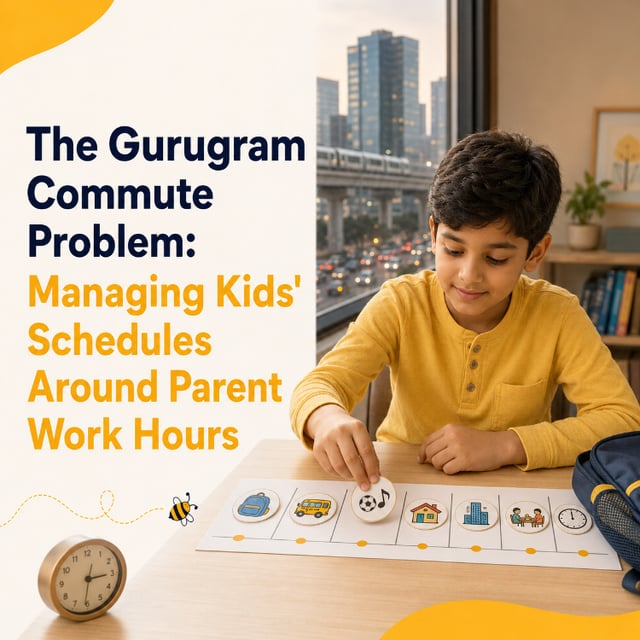
Gurugram's intense corporate commute culture creates genuine, specific scheduling challenges for families with young children, worth addressing directly rather than through generic work-life-balance advice. Here's a practical approach.
Gurugram's status as a major corporate hub creates a genuinely distinct family logistics challenge — long, often unpredictable commutes combined with demanding corporate work cultures — worth addressing with specific, practical strategies rather than generic work-life balance advice that doesn't account for Gurugram's particular intensity.

The specific shape of the Gurugram commute challenge
Many Gurugram-working parents face genuinely long commutes (both within Gurugram's notorious traffic and for those commuting from other NCR areas into Gurugram specifically), combined with corporate work cultures that often expect extended hours or late-evening availability — creating a compressed window of actual available parent-child time on typical workdays that's genuinely narrower than in many other professional contexts.

How this specifically affects children's schedule and activity planning
Activity classes and enrichment programs need genuine scheduling realism against actual parent availability — an evening class requiring parent transport or supervision that consistently conflicts with realistic commute-return timing creates chronic stress and missed sessions rather than a sustainable routine. Homework and connection time compresses into a genuinely narrow window, requiring more deliberate protection and prioritisation than families with more flexible schedules might need. And weekend time takes on disproportionate importance as the more reliable window for genuine extended family connection and less rushed activity participation, given weekday constraints.


Leverage domestic help or extended family for weekday activity logistics, with clear communication
Where household help or grandparents can genuinely support after-school activity transport and supervision, clearly establishing this as a deliberate, communicated arrangement (rather than assumed or ad hoc) tends to work more reliably.

Choose activities with schedule flexibility or make-up session policies
Given genuine commute unpredictability, activities and classes offering some scheduling flexibility or reasonable make-up options for missed sessions reduce the stress of chronic schedule conflict compared to rigid, no-flexibility programs.

Protect a specific, non-negotiable connection window, even if brief
Rather than aiming for an unrealistic amount of daily parent-child time given genuine commute constraints, deliberately protecting even a shorter but genuinely consistent window (a specific 30-45 minutes most evenings, protected from work intrusion) tends to matter more for a child's sense of connection than an inconsistent, aspirational "quality time" that frequently gets displaced by work demands.

Concentrate more activity and connection intentionally into weekends
Given weekday constraints, deliberately building richer weekend structure (connecting to the weekend-activity content covered elsewhere in this series) can meaningfully compensate for necessarily thinner weekday availability.

Communicate the schedule reality honestly with your child, age-appropriately
Rather than a child experiencing parent unavailability as unexplained absence, age-appropriate honesty about work demands and commute reality, paired with explicit reassurance about weekend and available-window connection, tends to support a child's understanding and emotional security better than unexplained scheduling gaps.
The guilt management piece worth naming directly
Many Gurugram-working parents carry genuine guilt about compressed family time given demanding commute and work realities — worth extending yourself the same reasonable, non-perfectionist grace covered in the working-parent content elsewhere in this series, recognising that genuinely present, connected time during your actually available windows serves a child's development considerably better than either absent guilt-driven overcompensation or chronic underlying stress that a child, even young, tends to sense regardless of the specific words used.