

 Reading Writing
 Book Club
 Calligraphy
 Creative Writing
 English Speaking
 Handwriting
 Library
 Phonics
 Story Telling
 Art and Craft
 Clay Moulding
 Drawing
 Painting
 Pottery
 Sketching
 Drama Theatre
 Personality Development
 Public Speaking
 Languages
 Arabic
 Chinese
 French
 German
 Hindi
 Italian
 Japanese
 Korean
 Persian
 Portuguese
 Russian
 Spanish
 Turkish
 Uzbek
 Sports and Fitness
 Aerobics
 Athletics
 Badminton
 Basket Ball
 Chess
 Cricket
 Football
 Golf
 Gymnastics
 Hulahoop
 Karate
 Martial Arts
 Pickleball
 Rugby
 Skating
 Swimming
 Taekwondo
 Tennis
 Volleyball
 Yoga
 Zumba
 Tuition Classes
 Accounts
 Biology
 Business Studies
 CBSE
 Chemistry
 Commerce
 Economics
 Homework Classes
 IB Board
 IGCSE
 Mathematics
 Physics
 Psychology
 Science
 Social Studies
 Vedic Maths
 Dance and Music
 Ballet
 Bhangra
 Bharatnatyam
 Bollywood Dance
 Casio
 Dandiya and Garba
 Drums
 Flute
 Guitar
 Harmonium
 Hip Hop
 Jazz
 Kathak
 Keyboard
 Piano
 Salsa
 Shlokas
 Sitar
 Tabla
 Ukulele
 Violin
 Vocal
 Play School
 STEM
 Abacus
 App Development
 Artificial intelligence
 Basic Computer Courses
 Canva
 Coding
 Graphic Design
 Lego
 Python
 Robotics
 Rubiks Cube
 Scrabble
 Scratch
 Website Development
 Workshops
 Diwali Workshops
 Guru Nanak Jayanti Workshop
 Halloween
 Independence day workshop
 Navratri Workshops
 Raksha Bandhan workshop
 Ramayana Workshop
 Spring Camp
 Valentines Day Workshops
 Festive
 Daycare
 Cooking and Food
 Spring Camp
 Contests and Competitions
 Special abled
 Republic Day Workshops
 Mela
 Mela
 Cognitive Development
 Mother-Toddler Program
 Music
 Dance
 Smart Skills
 Financial Literacy
 Mental Wellbeing
 Meditation
 Reiki





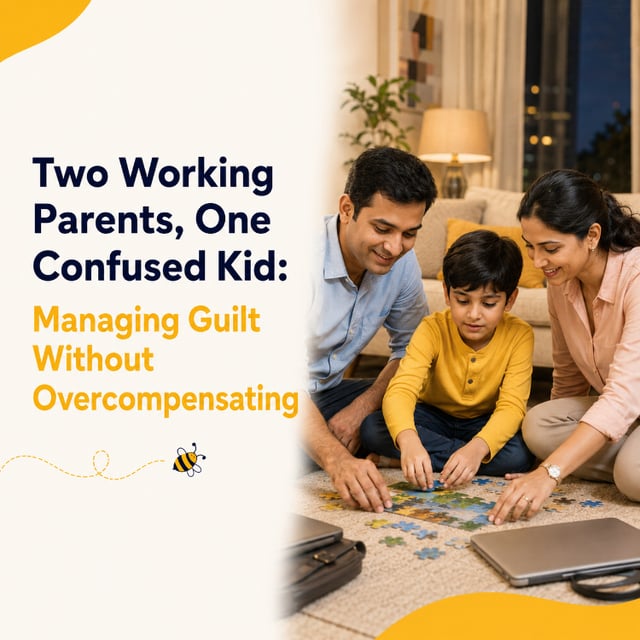
Dual-income households are the norm, not the exception, across Delhi NCR and Chandigarh — yet many working parents carry disproportionate guilt that leads to overcompensating patterns that don't actually serve children well. Here's a more honest, sustainable approach.
Dual-working-parent households represent the genuine norm across most urban Delhi NCR and Chandigarh families, yet many parents in this now-standard arrangement carry a disproportionate sense of guilt — worth examining directly, since guilt-driven overcompensation often produces worse outcomes than a more honest, sustainable approach.
Why guilt often exceeds what the actual research supports
A substantial body of child development research on dual-working-parent households, when quality of available time and overall family stability are accounted for, generally doesn't support the assumption that working parenthood inherently harms children — the specific mechanisms that matter (genuine connection quality, consistent care arrangements, family stability, appropriate developmental support) can be achieved within working-parent households as reliably as within single-income households, meaning much parental guilt reflects internalised social expectation more than genuine, evidence-supported concern about outcomes.

Common overcompensation patterns worth recognising
Excessive, guilt-driven material giving or activity over-scheduling, attempting to "make up for" perceived time deficits through quantity of things or experiences rather than genuine quality connection. Inconsistent boundary-setting, where guilt leads to reduced willingness to maintain reasonable limits and expectations, sometimes producing behavioural challenges that reduced-guilt, more consistent parenting would avoid. Excessive weekend over-scheduling, attempting to compress an unrealistic amount of "quality time" and enrichment into available windows, ironically creating exhaustion and reduced genuine connection rather than the intended opposite. And difficulty being genuinely present during available time, since underlying guilt and anxiety about work-life balance can itself distract from full presence during the time that is actually available, undermining the very connection the guilt is meant to protect.

What genuinely matters more than total time quantity, per available research
Consistency and reliability of care arrangements — a child with stable, predictable, warm care (whether from parents directly or trusted alternative caregivers during work hours) generally shows better outcomes than total parental time quantity alone would predict. Genuine quality of available connection time — full presence, warmth, and responsive engagement during actually available windows matters considerably more than the absolute duration of that window. And overall family stability and reduced household stress — a functioning, reasonably low-conflict, financially stable dual-income household often provides genuinely better developmental conditions than a more stressed single-income arrangement might, directly countering the assumption that working parenthood is inherently a developmental compromise.

A more sustainable approach than guilt-driven overcompensation
Focusing energy on the genuine levers that matter — consistent, reliable care arrangements; full presence and connection during available time; reasonable, non-excessive boundaries and expectations — rather than guilt-driven compensation through material or activity excess. Being honest with yourself and your child, age-appropriately, about work demands and reality, rather than either hiding work stress entirely or transmitting excessive anxiety about it. And extending genuine self-compassion regarding the working-parent arrangement itself, recognising it as a reasonable, common, and research-supported viable family structure rather than an inherent deficit requiring constant guilt-driven correction.

The specific Delhi NCR and Chandigarh context worth naming
Given how genuinely standard dual-working-parent households are across these urban contexts, much of the surrounding social narrative (including some traditional family and community commentary) may not have fully caught up to this reality, sometimes generating additional, not fully warranted guilt pressure from extended family or community expectation — worth holding your own informed, research-grounded confidence in your family's arrangement rather than absorbing outdated assumptions about what working parenthood necessarily means for children.
A closing reframe worth holding
The goal isn't eliminating all guilt (a genuinely impossible standard for most caring parents) but rather distinguishing genuinely useful guilt (prompting a real, needed adjustment) from disproportionate, evidence-unsupported guilt that primarily produces overcompensating patterns working against, rather than for, your child's genuine wellbeing — a distinction worth actively, deliberately making rather than allowing undifferentiated guilt to drive parenting decisions unchecked.