
 Summer Camp
 Reading Writing
 Book Club
 Calligraphy
 Creative Writing
 English Speaking
 Handwriting
 Library
 Phonics
 Story Telling
 Art and Craft
 Clay Moulding
 Drawing
 Painting
 Pottery
 Sketching
 Drama Theatre
 Personality Development
 Public Speaking
 Languages
 Arabic
 Chinese
 French
 German
 Hindi
Hindi Italian
 Japanese
 Korean
 Persian
 Portuguese
 Russian
 Spanish
 Turkish
 Uzbek
Uzbek Sports and Fitness
 Aerobics
 Athletics
 Badminton
 Basket Ball
 Chess
Chess Cricket
 Football
 Golf
Golf Gymnastics
 Hulahoop
 Karate
 Martial Arts
 Pickleball
 Rugby
Rugby Skating
 Swimming
 Taekwondo
 Tennis
 Volleyball
 Yoga
Yoga Zumba
Zumba Tuition Classes
 Accounts
 Biology
 Business Studies
 CBSE
CBSE Chemistry
 Commerce
 Economics
 Homework Classes
 IB Board
 IGCSE
IGCSE Mathematics
 Physics
 Psychology
 Science
 Social Studies
 Vedic Maths
 Dance and Music
 Ballet
 Bhangra
 Bharatnatyam
 Bollywood Dance
 Casio
Casio Dandiya and Garba
 Drums
Drums Flute
Flute Guitar
 Harmonium
 Hip Hop
 Jazz
Jazz Kathak
 Keyboard
 Piano
Piano Salsa
Salsa Shlokas
 Sitar
Sitar Tabla
Tabla Ukulele
 Violin
 Vocal
Vocal Play School
 STEM
STEM
 Abacus
 App Development
 Artificial intelligence
 Basic Computer Courses
 Canva
Canva Coding
 Graphic Design
 Lego
Lego Python
 Robotics
 Rubiks Cube
 Scrabble
 Scratch
 Website Development
 Winter Camp
 Workshops
 Diwali Workshop
 Easter
 Ganesh Mahotsav
 Guru Nanak Jayanti Workshop
 Holi
Holi Independence day workshop
 Janmashtami Workshop
 Mothers day
 Navratri Workshops
 Raksha Bandhan workshop
 Ramayana Workshop
 Spring Camp
 Valentines Day Workshops
 Festive
 Daycare
 Cooking and Food
 Spring Camp
 Contests and Competitions
 Special abled
 Republic Day Workshops
 Mela
Mela
 Mela
Mela Cognitive Development
 Mother-Toddler Program
-Jul-03-2026-06-59-25-1926-AM.webp?width=30&height=30&name=Smart_20Skills_20(2)-Jul-03-2026-06-59-25-1926-AM.webp) Smart Skills
Smart Skills
 Financial Literacy
 Mental Wellbeing
 Meditation
 Reiki
Reiki




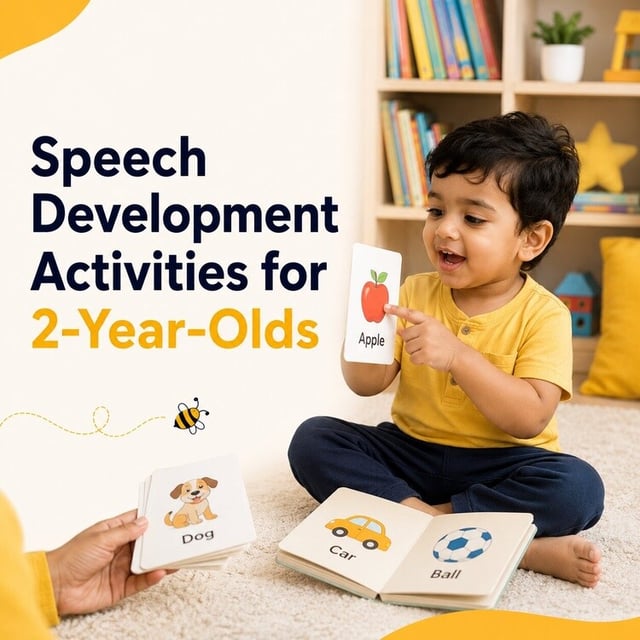
Age two typically brings a vocabulary explosion and first sentences. These activities support the leap — with clear guidance on bilingual homes and when "late talking" merits professional input.
Between two and three, most children go from words to sentences — a transformation as dramatic as learning to walk. The environment that supports it is built from ordinary interactions, done deliberately.
The expansion technique
When your child says "car!", respond with a slightly fuller version: "Yes, a red car! The car is going fast." Expanding their utterance by a word or two models the next step without correcting — the single most effective everyday speech technique available.
Activities that build speech at two
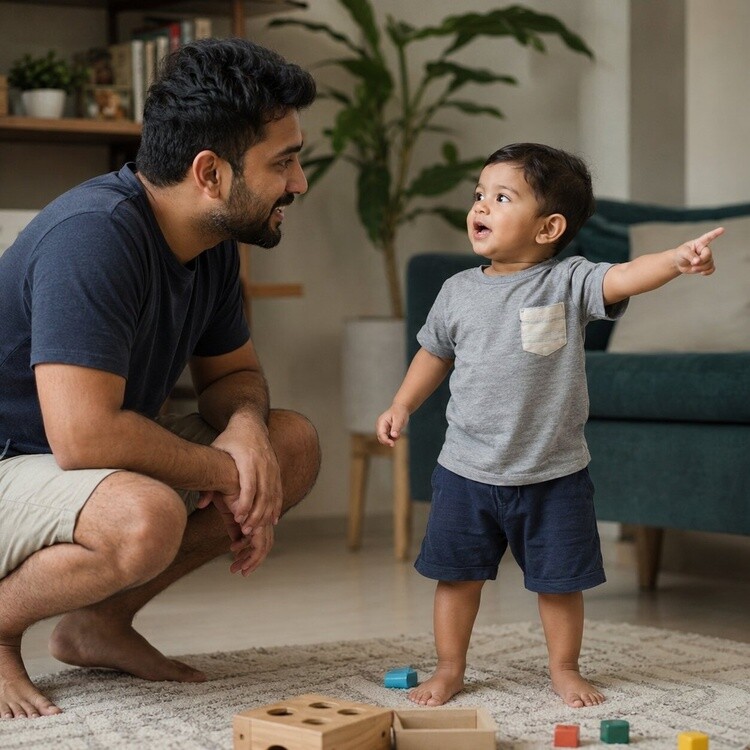
Running commentary, both directions — narrate your actions and theirs: "You're putting the block on top. It's so tall!"
Choice questions over yes/no — "Mango or banana?" invites a word; "Do you want fruit?" invites a nod.
The pause — after asking something, wait longer than feels natural. Toddlers need processing time, and adults who fill silence steal the answer.
Picture book conversations — beyond reading text: "Where's the dog? What's he doing?" — books as conversation scaffolds.
Songs with missing words — pause before a familiar rhyme's last word and let them supply it.
Pretend phone calls — an old phone and a pretend call to dadi generates surprising speech from reluctant talkers.
Sabotage games, gently — hand them the wrong shoe, put the biscuit slightly out of reach — engineered moments that invite communication.
Repeat-and-add during pretend play — pretend scenarios generate the richest toddler speech; joining and narrating their play multiplies it.
The bilingual reality, restated for this age
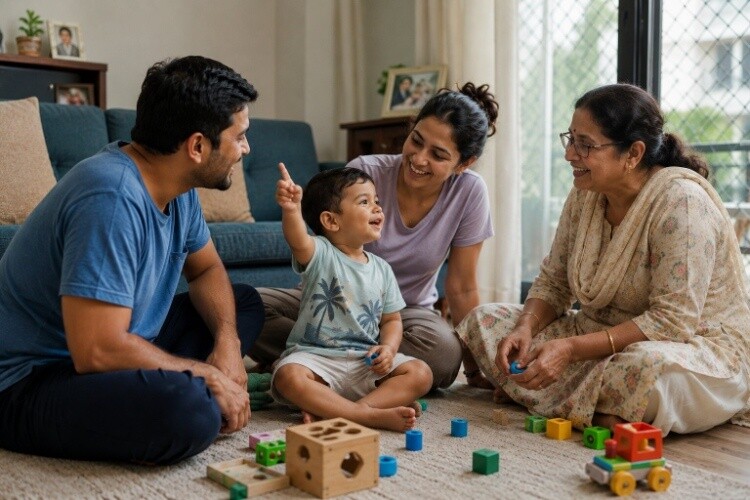
Hindi at home, English at daycare, Punjabi or Tamil or Bengali from grandparents — mixing languages in one sentence at this age is a normal bilingual milestone, not confusion. Total vocabulary across all languages is what counts. Keep speaking whatever is natural; toddler brains sort languages remarkably well.
What's typical at two, roughly
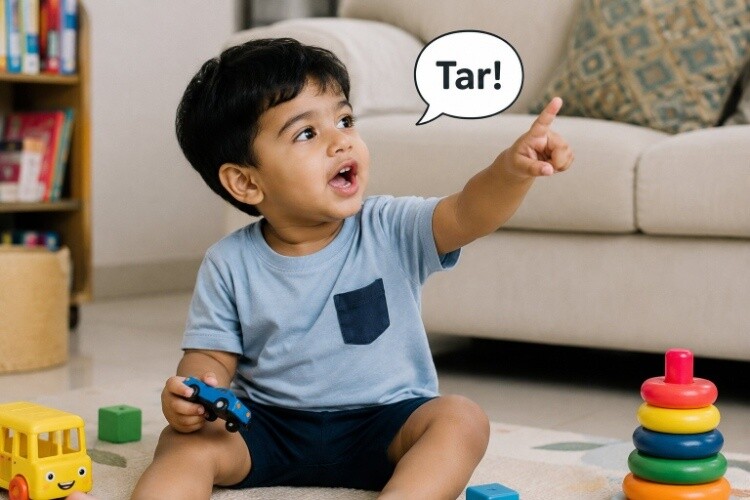
By 24 months: often 50+ words and emerging two-word phrases. By 30 months: two-to-three-word combinations and vocabulary too fast to count. By 36 months: short sentences, understandable to family most of the time. Pronunciation stays wonderfully imperfect throughout — "tar" for car needs no correction, just clear modelling.
When to seek input rather than wait
Fewer than 50 words or no two-word combinations by 24-30 months, speech understandable to strangers less than half the time by three, apparent comprehension gaps, or any regression — these merit a paediatrician conversation and possibly a speech-language assessment. The "boys talk late, he'll catch up" reassurance is sometimes true and sometimes costly delay; professional input is cheap, and early support works best early. Many late talkers do catch up — but identifying the ones who need help is a professional's call, not a WhatsApp group's.

Screen displacement, one more time
The strongest environmental drag on toddler speech isn't what screens do — it's the conversation they displace. An hour of background TV is an hour of reduced back-and-forth. The speech activities above all share one ingredient: a responsive human, which no app replicates.