
 Summer Camp
 Reading Writing
 Book Club
 Calligraphy
 Creative Writing
 English Speaking
 Handwriting
 Library
 Phonics
 Story Telling
 Art and Craft
 Clay Moulding
 Drawing
 Painting
 Pottery
 Sketching
 Drama Theatre
 Personality Development
 Public Speaking
 Languages
 Arabic
 Chinese
 French
 German
 Hindi
Hindi Italian
 Japanese
 Korean
 Persian
 Portuguese
 Russian
 Spanish
 Turkish
 Uzbek
Uzbek Sports and Fitness
 Aerobics
 Athletics
 Badminton
 Basket Ball
 Chess
Chess Cricket
 Football
 Golf
Golf Gymnastics
 Hulahoop
 Karate
 Martial Arts
 Pickleball
 Rugby
Rugby Skating
 Swimming
 Taekwondo
 Tennis
 Volleyball
 Yoga
Yoga Zumba
Zumba Tuition Classes
 Accounts
 Biology
 Business Studies
 CBSE
CBSE Chemistry
 Commerce
 Economics
 Homework Classes
 IB Board
 IGCSE
IGCSE Mathematics
 Physics
 Psychology
 Science
 Social Studies
 Vedic Maths
 Dance and Music
 Ballet
 Bhangra
 Bharatnatyam
 Bollywood Dance
 Casio
Casio Dandiya and Garba
 Drums
Drums Flute
Flute Guitar
 Harmonium
 Hip Hop
 Jazz
Jazz Kathak
 Keyboard
 Piano
Piano Salsa
Salsa Shlokas
 Sitar
Sitar Tabla
Tabla Ukulele
 Violin
 Vocal
Vocal PlaySchools
 Preschool
 STEM
STEM
 Abacus
 App Development
 Artificial intelligence
 Basic Computer Courses
 Canva
Canva Coding
 Graphic Design
 Lego
Lego Python
 Robotics
 Rubiks Cube
 Scrabble
 Scratch
 Website Development
 Winter Camp
 Workshops
 Diwali Workshop
 Easter
 Ganesh Mahotsav
 Guru Nanak Jayanti Workshop
 Holi
Holi Independence day workshop
 Janmashtami Workshop
 Mothers day
 Navratri Workshops
 Raksha Bandhan workshop
 Ramayana Workshop
 Spring Camp
 Valentines Day Workshops
 Festive
 Daycare
 Cooking and Food
 Spring Camp
 Contests and Competitions
 Special abled
 Republic Day Workshops
 Mela
Mela
 Mela
Mela Cognitive Development
 Mother-Toddler Program
-Jul-03-2026-06-59-25-1926-AM.webp?width=30&height=30&name=Smart_20Skills_20(2)-Jul-03-2026-06-59-25-1926-AM.webp) Smart Skills
Smart Skills
 Financial Literacy





Most paediatric guidelines suggest avoiding screens before age 2, limiting to about 1 hour a day for ages 2-5, and focusing on content quality and balance (not just strict time limits) for ages 6-12. What matters most is what screens are replacing.
If you've felt guilty handing your child a phone during a work call or while dinner is being cooked, you're not alone — and you're also not doing anything unusual. In most urban Indian homes, with both parents working and help managing multiple things at once, some screen time is simply part of daily reality.
What the guidelines actually say
For children under 2, most paediatric bodies recommend avoiding screens altogether, except for video calls with family.
For ages 2-5, guidance suggests around 1 hour a day of high-quality content, ideally watched with a parent rather than alone.
For ages 6-12, the focus shifts from strict time limits to balance — ensuring screens aren't replacing sleep, physical activity, homework, or in-person interaction.
The question that matters more than the clock
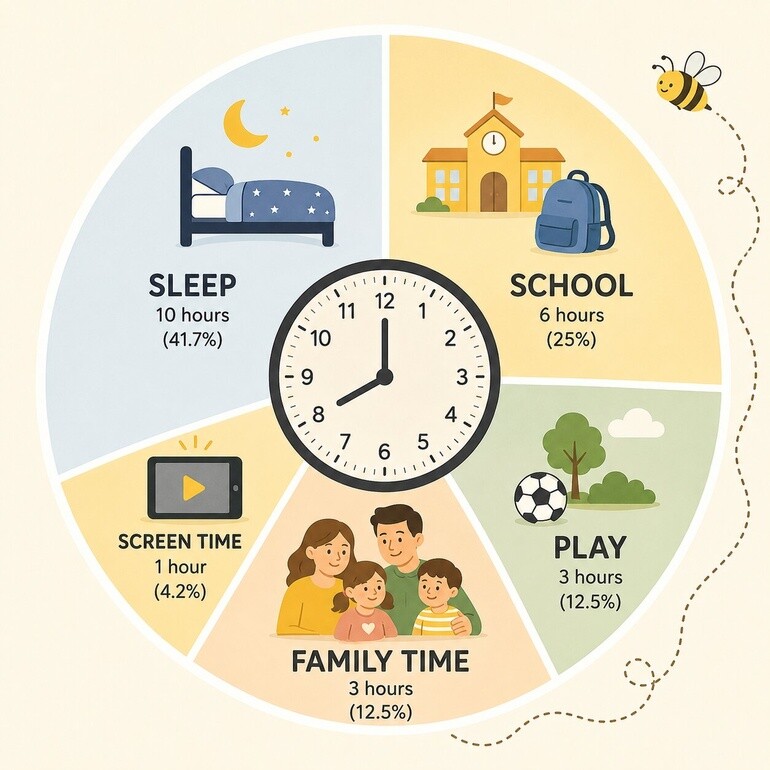
Paediatricians increasingly agree that the exact number of minutes matters less than what the screen is replacing. An hour of screen time on a day that also included an hour of outdoor play, a full night's sleep, and some reading is very different from three hours that replaced all of those things.
A specific concern in many Indian households: who's holding the phone
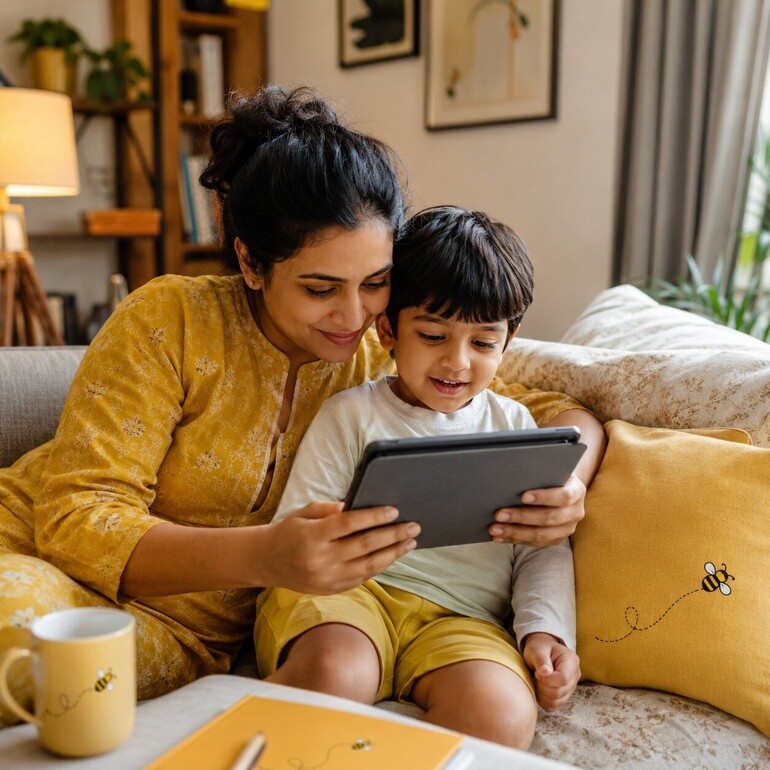
In many homes with domestic help managing children for parts of the day, screens sometimes fill gaps when supervision is stretched thin. This isn't a judgement — it's a real, common situation. The practical fix isn't to eliminate this entirely (often not realistic), but to be intentional about what's being watched during that time — pre-downloaded, age-appropriate content rather than open access to autoplay recommendations, which can drift into inappropriate territory surprisingly fast.
A simple structure that works for most families
Rather than counting minutes precisely, many parents find it easier to protect specific windows — no screens during meals, no screens in the hour before bedtime, and no screens during the first hour after school when a child needs to decompress through play instead.
What to watch for
Signs that screen time has become a genuine concern rather than a normal part of daily life: difficulty transitioning away from screens without meltdowns, screens replacing sleep hours, declining interest in any offline activity, or seeking screens specifically to avoid social interaction.
The realistic goal
Zero screen time isn't the standard most families can or need to hit — and chasing that standard usually just creates guilt without changing much. The more achievable goal is making sure screens aren't the default filler for every gap in the day, and that a child still has daily stretches of outdoor play, reading, and family time that don't involve a screen at all.