
 Summer Camp
 Reading Writing
 Book Club
 Calligraphy
 Creative Writing
 English Speaking
 Handwriting
 Library
 Phonics
 Story Telling
 Art and Craft
 Clay Moulding
 Drawing
 Painting
 Pottery
 Sketching
 Drama Theatre
 Personality Development
 Public Speaking
 Languages
 Arabic
 Chinese
 French
 German
 Hindi
Hindi Italian
 Japanese
 Korean
 Persian
 Portuguese
 Russian
 Spanish
 Turkish
 Uzbek
Uzbek Sports and Fitness
 Aerobics
 Athletics
 Badminton
 Basket Ball
 Chess
Chess Cricket
 Football
 Golf
Golf Gymnastics
 Hulahoop
 Karate
 Martial Arts
 Pickleball
 Rugby
Rugby Skating
 Swimming
 Taekwondo
 Tennis
 Volleyball
 Yoga
Yoga Zumba
Zumba Tuition Classes
 Accounts
 Biology
 Business Studies
 CBSE
CBSE Chemistry
 Commerce
 Economics
 Homework Classes
 IB Board
 IGCSE
IGCSE Mathematics
 Physics
 Psychology
 Science
 Social Studies
 Vedic Maths
 Dance and Music
 Ballet
 Bhangra
 Bharatnatyam
 Bollywood Dance
 Casio
Casio Dandiya and Garba
 Drums
Drums Flute
Flute Guitar
 Harmonium
 Hip Hop
 Jazz
Jazz Kathak
 Keyboard
 Piano
Piano Salsa
Salsa Shlokas
 Sitar
Sitar Tabla
Tabla Ukulele
 Violin
 Vocal
Vocal Play School
 STEM
STEM
 Abacus
 App Development
 Artificial intelligence
 Basic Computer Courses
 Canva
Canva Coding
 Graphic Design
 Lego
Lego Python
 Robotics
 Rubiks Cube
 Scrabble
 Scratch
 Website Development
 Winter Camp
 Workshops
 Diwali Workshop
 Easter
 Ganesh Mahotsav
 Guru Nanak Jayanti Workshop
 Holi
Holi Independence day workshop
 Janmashtami Workshop
 Mothers day
 Navratri Workshops
 Raksha Bandhan workshop
 Ramayana Workshop
 Spring Camp
 Valentines Day Workshops
 Festive
 Daycare
 Cooking and Food
 Spring Camp
 Contests and Competitions
 Special abled
 Republic Day Workshops
 Mela
Mela
 Mela
Mela Cognitive Development
 Mother-Toddler Program
-Jul-03-2026-06-59-25-1926-AM.webp?width=30&height=30&name=Smart_20Skills_20(2)-Jul-03-2026-06-59-25-1926-AM.webp) Smart Skills
Smart Skills
 Financial Literacy
 Mental Wellbeing
 Meditation
 Reiki
Reiki





A study routine that works isn't about rigid hour-long blocks — it's about consistency, realistic timing, and fitting around your family's actual living situation, including shared rooms and joint family schedules.
Pinterest-perfect study schedules with color-coded hourly blocks rarely survive contact with real family life — especially in homes where space is shared, evenings involve managing multiple children's needs at once, or a parent's work schedule shifts day to day. A realistic study routine looks different, and it works better because it's actually sustainable.
Start with your family's real constraints, not an ideal timetable
If you live in a joint family with a shared living room, or a smaller flat where a dedicated study room isn't possible, plan around that reality rather than trying to force an unrealistic setup. A consistent corner of the dining table, used at the same time daily, works better than an idealised study room used inconsistently.
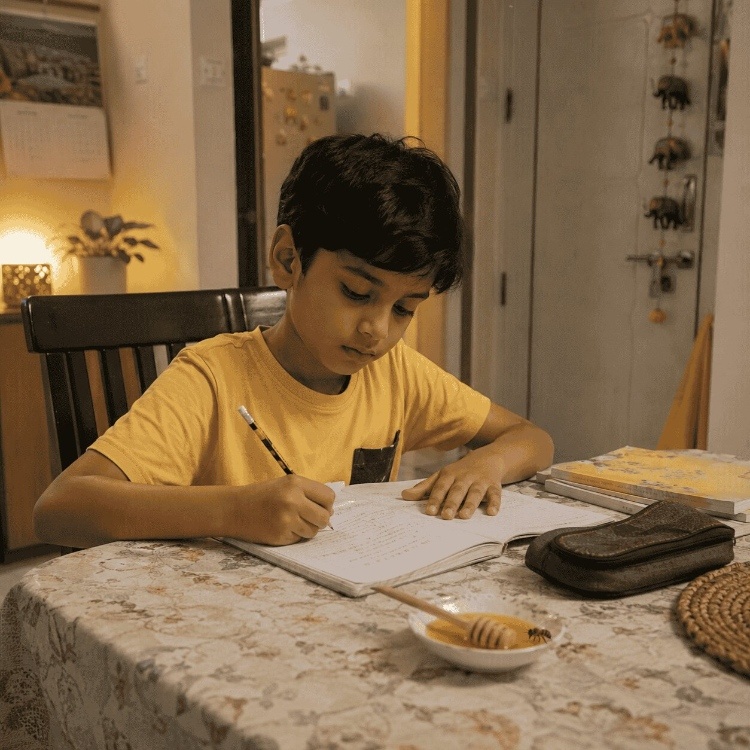

Anchor the routine to a fixed daily event, not a clock time
Rather than "study starts at 6 PM sharp" (which breaks the moment something runs late), anchor it to something consistent — "after evening snack" or "after the youngest goes down for a nap." This survives schedule variability far better.
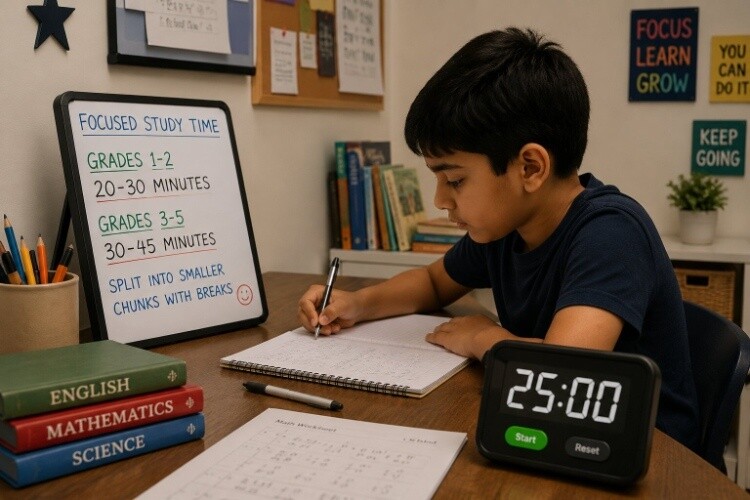
Keep total focused study time realistic for the age
As a rough guide: 20-30 minutes for Grades 1-2, 30-45 minutes for Grades 3-5, split into smaller chunks with breaks rather than one continuous block.
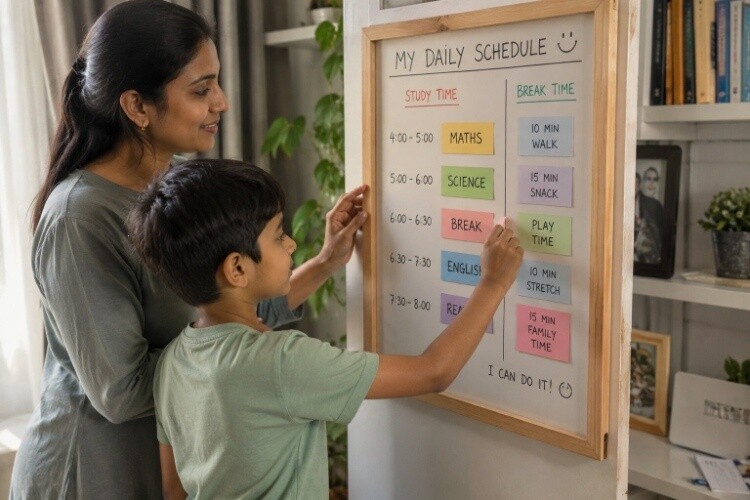
Involve your child in building the routine, even loosely
A child who has some say in the order of subjects, or when the short break happens, tends to cooperate more than one following a routine imposed entirely without input.
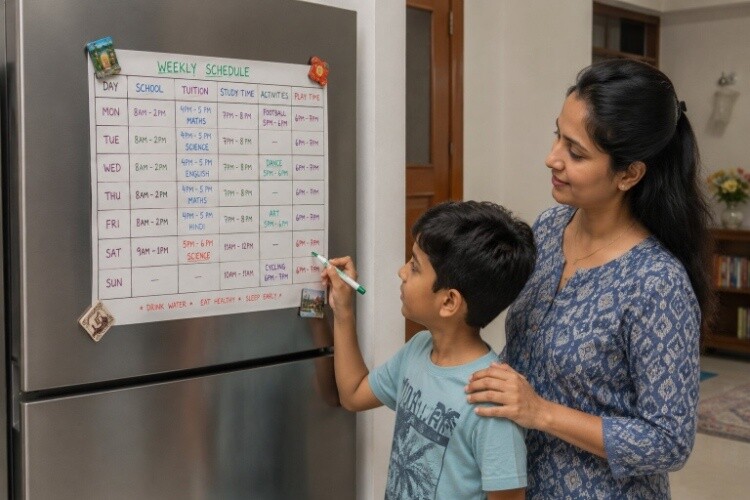
Account for tuition schedules explicitly
Many Indian households layer school, tuition, and study time across the evening — mapping this out clearly (even a simple handwritten weekly chart on the fridge) reduces daily negotiation about "what's next."
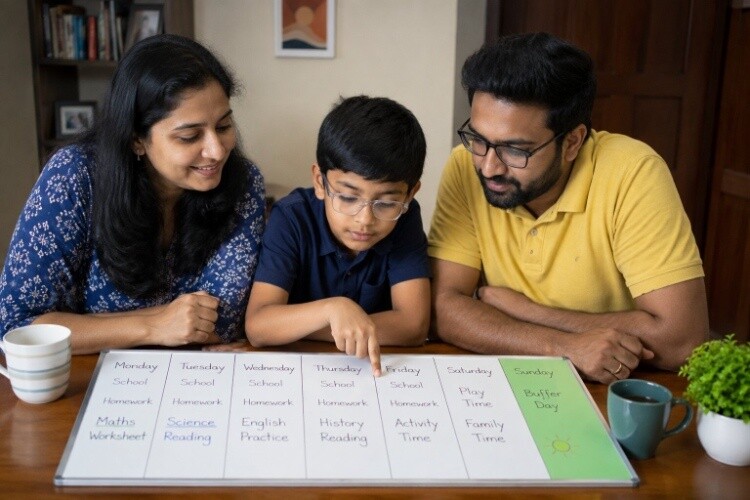
Build in a genuine buffer for off days
Some evenings will be disrupted — a family function, a sick day, unexpected guests. A routine with zero flexibility creates guilt and conflict on these days; one with a built-in "catch-up" slot (like Sunday morning) handles this gracefully.
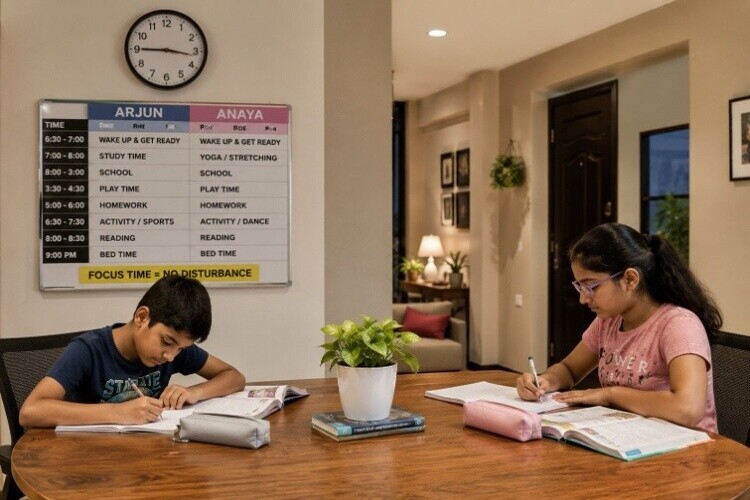
Keep siblings' routines separate but visible
In homes with multiple children, overlapping study times (rather than staggered) can work well since it normalises focused time as a shared household rhythm, not something singling one child out.

Involve grandparents or domestic help thoughtfully, where relevant
In joint family or help-supported households, being clear about who's overseeing study time during specific hours avoids both duplication and gaps — a quick conversation about expectations helps everyone stay aligned.
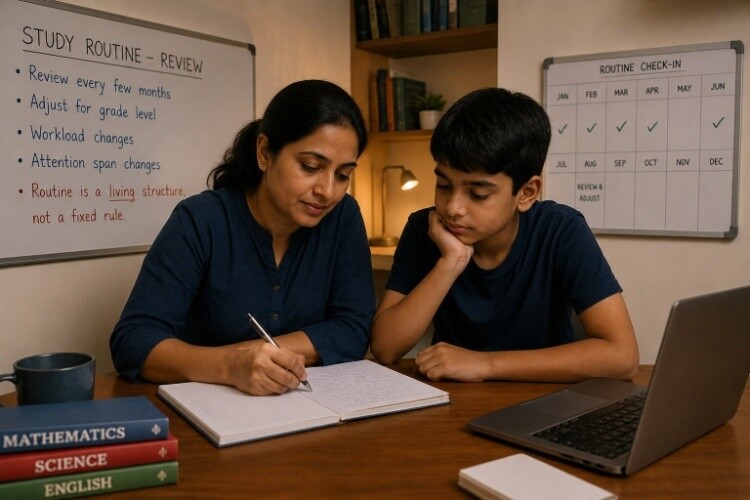
Reassess every few months, not rigidly
A routine that worked well in Grade 2 will likely need adjusting by Grade 4 as workload and attention span both change — treat the routine as a living structure, not a fixed rule.
The realistic goal
A good study routine isn't the one that looks most impressive on paper — it's the one your family can actually sustain most days, most weeks, without becoming another daily battle. Consistency over months matters far more than intensity on any single evening.