
 Summer Camp
 Reading Writing
 Book Club
 Calligraphy
 Creative Writing
 English Speaking
 Handwriting
 Library
 Phonics
 Story Telling
 Art and Craft
 Clay Moulding
 Drawing
 Painting
 Pottery
 Sketching
 Drama Theatre
 Personality Development
 Public Speaking
 Languages
 Arabic
 Chinese
 French
 German
 Hindi
Hindi Italian
 Japanese
 Korean
 Persian
 Portuguese
 Russian
 Spanish
 Turkish
 Uzbek
Uzbek Sports and Fitness
 Aerobics
 Athletics
 Badminton
 Basket Ball
 Chess
Chess Cricket
 Football
 Golf
Golf Gymnastics
 Hulahoop
 Karate
 Martial Arts
 Pickleball
 Rugby
Rugby Skating
 Swimming
 Taekwondo
 Tennis
 Volleyball
 Yoga
Yoga Zumba
Zumba Tuition Classes
 Accounts
 Biology
 Business Studies
 CBSE
CBSE Chemistry
 Commerce
 Economics
 Homework Classes
 IB Board
 IGCSE
IGCSE Mathematics
 Physics
 Psychology
 Science
 Social Studies
 Vedic Maths
 Dance and Music
 Ballet
 Bhangra
 Bharatnatyam
 Bollywood Dance
 Casio
Casio Dandiya and Garba
 Drums
Drums Flute
Flute Guitar
 Harmonium
 Hip Hop
 Jazz
Jazz Kathak
 Keyboard
 Piano
Piano Salsa
Salsa Shlokas
 Sitar
Sitar Tabla
Tabla Ukulele
 Violin
 Vocal
Vocal PlaySchools
 Preschool
 STEM
STEM
 Abacus
 App Development
 Artificial intelligence
 Basic Computer Courses
 Canva
Canva Coding
 Graphic Design
 Lego
Lego Python
 Robotics
 Rubiks Cube
 Scrabble
 Scratch
 Website Development
 Winter Camp
 Workshops
 Diwali Workshop
 Easter
 Ganesh Mahotsav
 Guru Nanak Jayanti Workshop
 Holi
Holi Independence day workshop
 Janmashtami Workshop
 Mothers day
 Navratri Workshops
 Raksha Bandhan workshop
 Ramayana Workshop
 Spring Camp
 Valentines Day Workshops
 Festive
 Daycare
 Cooking and Food
 Spring Camp
 Contests and Competitions
 Special abled
 Republic Day Workshops
 Mela
Mela
 Mela
Mela Cognitive Development
 Mother-Toddler Program
-Jul-03-2026-06-59-25-1926-AM.webp?width=30&height=30&name=Smart_20Skills_20(2)-Jul-03-2026-06-59-25-1926-AM.webp) Smart Skills
Smart Skills
 Financial Literacy




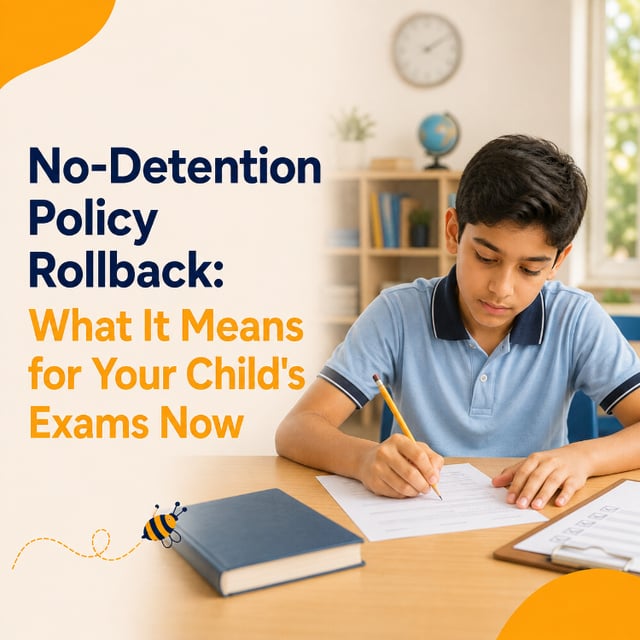
The Right to Education Act's original no-detention policy has been rolled back in several states, reintroducing the possibility of a child repeating Classes 5 and 8. Here's what's actually changed and what it means practically for Delhi NCR and Chandigarh families.
The "no-detention policy" rollback has generated genuine parental anxiety, partly because the change is real and partly because reporting on it has often been more alarmist than the actual policy detail warrants. Here's a clear-eyed look at what changed.
What the original no-detention policy was
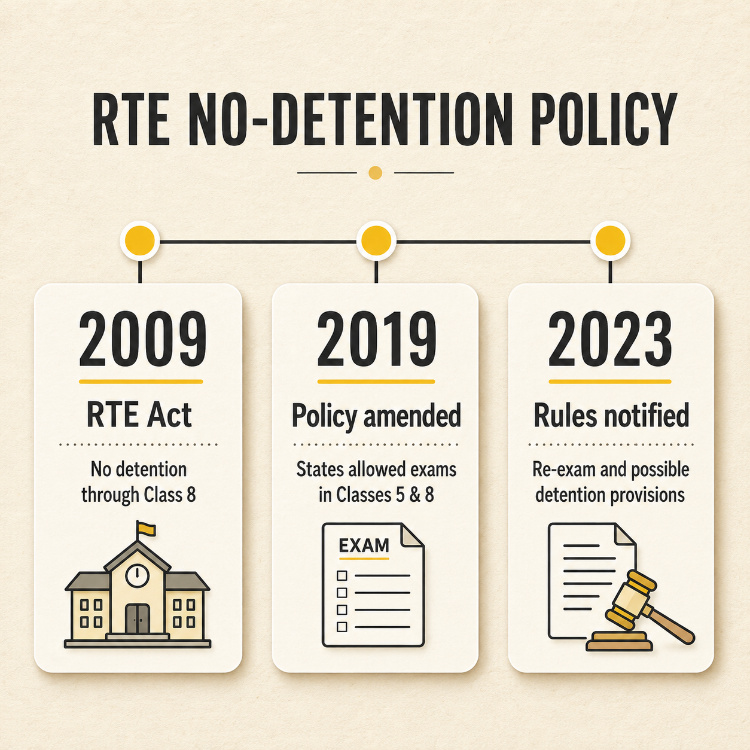
Under the Right to Education Act 2009, children could not be held back (detained) in any grade through Class 8, regardless of academic performance — the intent being to prevent children, particularly from disadvantaged backgrounds, from dropping out due to repeated grade failure and associated stigma.
What has actually changed
The Union government amended the RTE rules in December 2023, allowing states to reintroduce detention specifically at the end of Class 5 and Class 8 for children who don't achieve minimum learning levels in a year-end examination — with a mandated re-examination opportunity within two months before any actual detention decision, and continued protection against detention before Class 5 or between Classes 6-7.
Which states have actually adopted this
Adoption is state-specific and has been rolling out unevenly — some states implemented the change relatively quickly, others have not yet notified corresponding state-level rule changes. For Delhi NCR specifically, this means checking current Delhi and neighbouring-state (UP, Haryana) rules separately, since NCR spans multiple state jurisdictions with potentially different implementation timelines. Chandigarh, as a Union Territory, follows its own notification timeline, again worth verifying directly with current-year school communication rather than assuming a fixed national rule.
What this genuinely means for a primary-level child
For children below Class 5, this change has no direct effect — detention remains prohibited through Class 4 regardless of state adoption. For a child approaching Class 5, in a state/UT that has adopted the change, there is now a genuine (if safeguarded) possibility of being held back if minimum learning levels aren't met, with a re-examination chance built in before that outcome.

The reassurance worth holding onto
The policy change includes explicit safeguards — a mandatory re-examination opportunity, and a requirement that schools provide additional instruction and remedial support to struggling students before any detention decision, rather than detention functioning as a first-resort consequence for a single poor test result. The intent, per government framing, is addressing genuine learning gaps early rather than allowing children to progress without foundational skills — a different goal than simple exam-based punishment, even though the practical anxiety for affected families is understandable regardless of stated intent.
What parents of younger children should do with this information now
Rather than anxiety about a Class 5 decision years away, the more useful response is ensuring genuine foundational learning happens consistently through the early primary years — strong reading and basic numeracy by Class 2-3 make any later assessment, in whatever form it takes, considerably less fraught. This connects directly to the foundational literacy and numeracy focus covered in the next post in this series.