
 Summer Camp
 Reading Writing
 Book Club
 Calligraphy
 Creative Writing
 English Speaking
 Handwriting
 Library
 Phonics
 Story Telling
 Art and Craft
 Clay Moulding
 Drawing
 Painting
 Pottery
 Sketching
 Drama Theatre
 Personality Development
 Public Speaking
 Languages
 Arabic
 Chinese
 French
 German
 Hindi
Hindi Italian
 Japanese
 Korean
 Persian
 Portuguese
 Russian
 Spanish
 Turkish
 Uzbek
Uzbek Sports and Fitness
 Aerobics
 Athletics
 Badminton
 Basket Ball
 Chess
Chess Cricket
 Football
 Golf
Golf Gymnastics
 Hulahoop
 Karate
 Martial Arts
 Pickleball
 Rugby
Rugby Skating
 Swimming
 Taekwondo
 Tennis
 Volleyball
 Yoga
Yoga Zumba
Zumba Tuition Classes
 Accounts
 Biology
 Business Studies
 CBSE
CBSE Chemistry
 Commerce
 Economics
 Homework Classes
 IB Board
 IGCSE
IGCSE Mathematics
 Physics
 Psychology
 Science
 Social Studies
 Vedic Maths
 Dance and Music
 Ballet
 Bhangra
 Bharatnatyam
 Bollywood Dance
 Casio
Casio Dandiya and Garba
 Drums
Drums Flute
Flute Guitar
 Harmonium
 Hip Hop
 Jazz
Jazz Kathak
 Keyboard
 Piano
Piano Salsa
Salsa Shlokas
 Sitar
Sitar Tabla
Tabla Ukulele
 Violin
 Vocal
Vocal Play School
 STEM
STEM
 Abacus
 App Development
 Artificial intelligence
 Basic Computer Courses
 Canva
Canva Coding
 Graphic Design
 Lego
Lego Python
 Robotics
 Rubiks Cube
 Scrabble
 Scratch
 Website Development
 Winter Camp
 Workshops
 Diwali Workshop
 Easter
 Ganesh Mahotsav
 Guru Nanak Jayanti Workshop
 Holi
Holi Independence day workshop
 Janmashtami Workshop
 Mothers day
 Navratri Workshops
 Raksha Bandhan workshop
 Ramayana Workshop
 Spring Camp
 Valentines Day Workshops
 Festive
 Daycare
 Cooking and Food
 Spring Camp
 Contests and Competitions
 Special abled
 Republic Day Workshops
 Mela
Mela
 Mela
Mela Cognitive Development
 Mother-Toddler Program
-Jul-03-2026-06-59-25-1926-AM.webp?width=30&height=30&name=Smart_20Skills_20(2)-Jul-03-2026-06-59-25-1926-AM.webp) Smart Skills
Smart Skills
 Financial Literacy
 Mental Wellbeing
 Meditation
 Reiki
Reiki



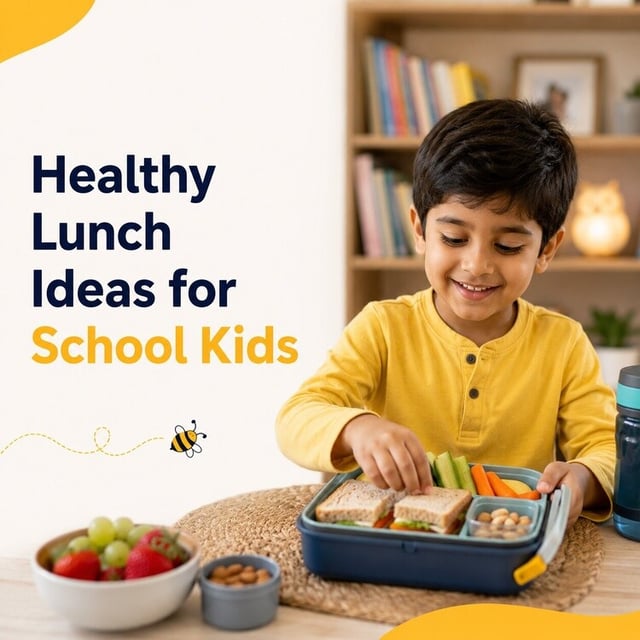
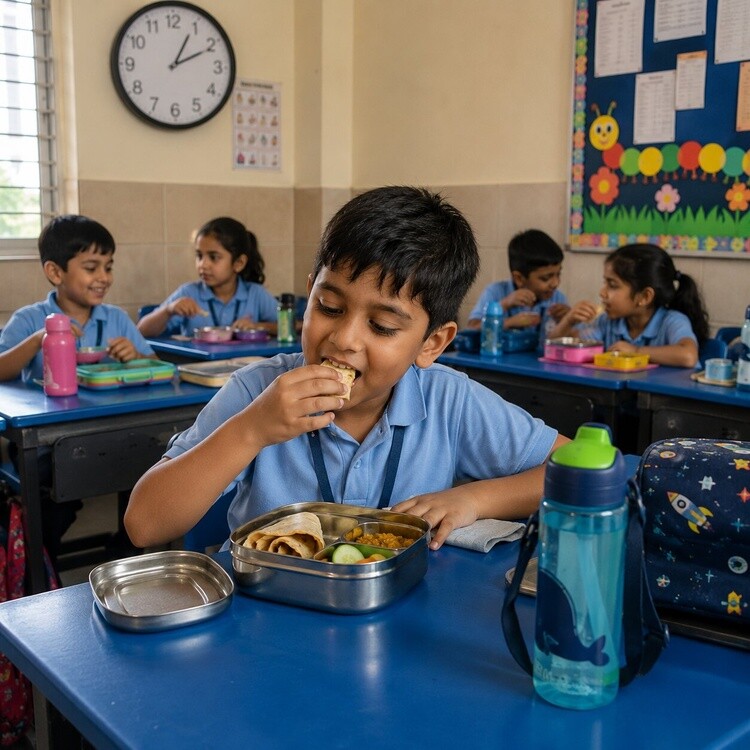
The school lunch brief is brutal: eaten in minutes, at room temperature, one-handed, amid distraction. These lunch ideas are engineered for the actual conditions — and for coming home empty.
The tiffin that returns full wasn't rejected on taste — it lost to the conditions: twenty minutes, cold food, playground pull. Lunch engineering starts from the conditions.
The design constraints, restated
Quick to eat (minutes, not courses), fine at room temperature (four-plus hours post-packing), hand-friendly (cutlery optional), spill-proof (school-bag physics), and familiar-enough (lunch is not the experimentation slot).
Rotation-worthy mains
Paratha rolls and pinwheels — the flagship: stuffed parathas rolled tight and sliced, or plain ones wrapped around paneer bhurji or aloo filling.
Idli and mini-idli boxes — room-temperature champions with podi-ghee or a dry chutney sprinkle.
Cheela strips — besan or moong, with a mint-chutney dab, holding texture for hours.
Vegetable poha or upma — packed slightly dry (they moisten in the box), peanut-crunched.
Curd rice with tempering — the summer stalwart, packed cool with the tadka mixed through.
Stuffed-vegetable pulao — one-box rice meals with vegetables cooked in, raita-free for spill safety.
Dhokla squares — spongy, room-temp-perfect, and naturally hand-food.
Sandwich variants that survive — grilled (structure), chutney-paneer or vegetable fillings (moisture-controlled) — the bread engineering matters.
Roti-sabzi, honestly assessed — the home default travels worst: dry-ish sabzis (aloo-methi, bhindi) survive; gravies don't. Roll format beats side-by-side.
The sides that finish first
Fruit cut and de-seeded (effort removed equals eaten), makhana or roasted chana (crunch quota), a cheese cube, the occasional homemade ladoo — the sides are where the tiffin wins its ratings.
Packing engineering
Compartment boxes (foods touching equals foods rejected, per five-year-old physics), moisture ruthlessly managed (the sog kills more tiffins than taste does), morning-packing over night-packing where feasible, and portion honesty — the overfull tiffin returns fuller; small-and-finished beats generous-and-abandoned for both nutrition and morale.
The feedback loop
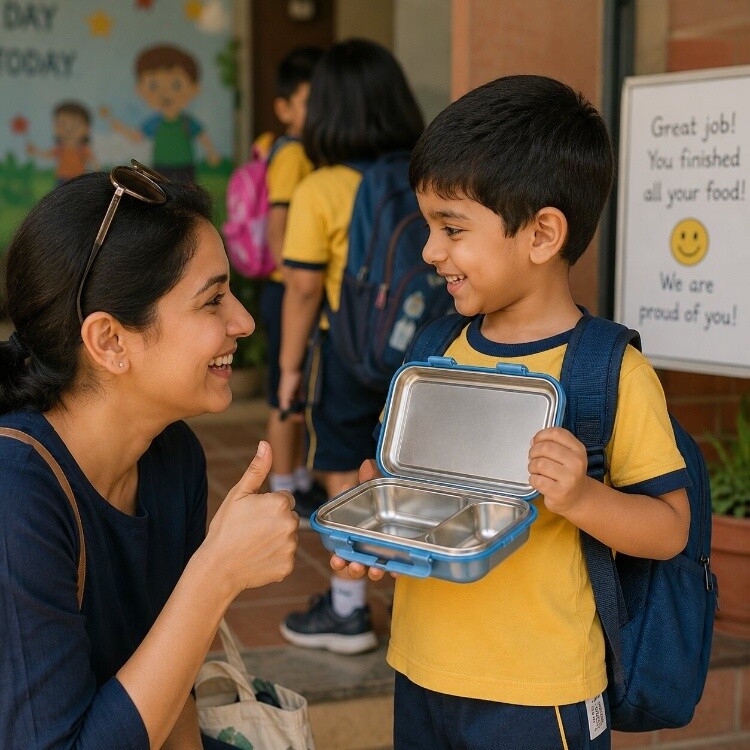
The returning tiffin is data: what came back, in what state, gets a casual (non-interrogative) debrief — "the poha came back — too much? gone cold funny?" The rotation evolves accordingly; the child consulted on the menu eats more of the menu. And the tiffin that comes home empty gets acknowledged — the small wins compound.