
 Summer Camp
 Reading Writing
 Book Club
 Calligraphy
 Creative Writing
 English Speaking
 Handwriting
 Library
 Phonics
 Story Telling
 Art and Craft
 Clay Moulding
 Drawing
 Painting
 Pottery
 Sketching
 Drama Theatre
 Personality Development
 Public Speaking
 Languages
 Arabic
 Chinese
 French
 German
 Hindi
Hindi Italian
 Japanese
 Korean
 Persian
 Portuguese
 Russian
 Spanish
 Turkish
 Uzbek
Uzbek Sports and Fitness
 Aerobics
 Athletics
 Badminton
 Basket Ball
 Chess
Chess Cricket
 Football
 Golf
Golf Gymnastics
 Hulahoop
 Karate
 Martial Arts
 Pickleball
 Rugby
Rugby Skating
 Swimming
 Taekwondo
 Tennis
 Volleyball
 Yoga
Yoga Zumba
Zumba Tuition Classes
 Accounts
 Biology
 Business Studies
 CBSE
CBSE Chemistry
 Commerce
 Economics
 Homework Classes
 IB Board
 IGCSE
IGCSE Mathematics
 Physics
 Psychology
 Science
 Social Studies
 Vedic Maths
 Dance and Music
 Ballet
 Bhangra
 Bharatnatyam
 Bollywood Dance
 Casio
Casio Dandiya and Garba
 Drums
Drums Flute
Flute Guitar
 Harmonium
 Hip Hop
 Jazz
Jazz Kathak
 Keyboard
 Piano
Piano Salsa
Salsa Shlokas
 Sitar
Sitar Tabla
Tabla Ukulele
 Violin
 Vocal
Vocal PlaySchools
 Preschool
 STEM
STEM
 Abacus
 App Development
 Artificial intelligence
 Basic Computer Courses
 Canva
Canva Coding
 Graphic Design
 Lego
Lego Python
 Robotics
 Rubiks Cube
 Scrabble
 Scratch
 Website Development
 Winter Camp
 Workshops
 Diwali Workshop
 Easter
 Ganesh Mahotsav
 Guru Nanak Jayanti Workshop
 Holi
Holi Independence day workshop
 Janmashtami Workshop
 Mothers day
 Navratri Workshops
 Raksha Bandhan workshop
 Ramayana Workshop
 Spring Camp
 Valentines Day Workshops
 Festive
 Daycare
 Cooking and Food
 Spring Camp
 Contests and Competitions
 Special abled
 Republic Day Workshops
 Mela
Mela
 Mela
Mela Cognitive Development
 Mother-Toddler Program
-Jul-03-2026-06-59-25-1926-AM.webp?width=30&height=30&name=Smart_20Skills_20(2)-Jul-03-2026-06-59-25-1926-AM.webp) Smart Skills
Smart Skills
 Financial Literacy




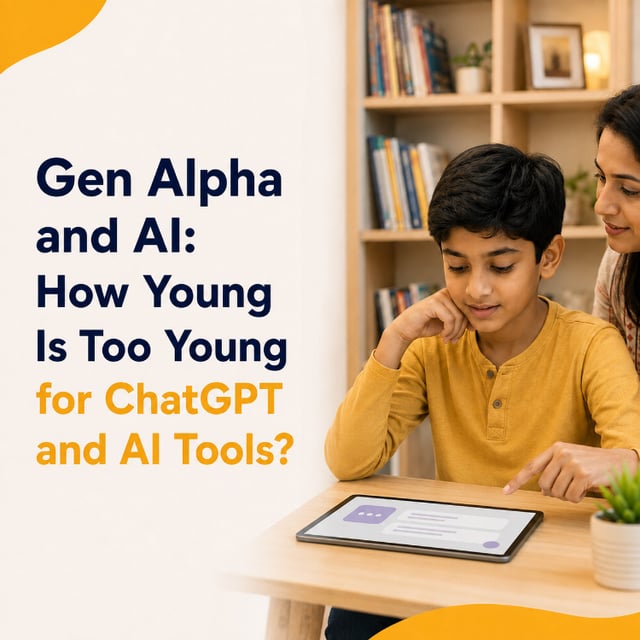
AI tools are becoming a normal part of Gen Alpha's environment, whether or not parents actively introduce them. Here's a genuinely practical framework for thinking about age-appropriate AI exposure, rather than either total avoidance or unmanaged access.
Generative AI tools have moved from novelty to genuine ubiquity faster than almost any technology in memory, and parents of young children face a specific, largely unprecedented question: not whether AI will be part of their child's life, but how and when to introduce it thoughtfully.
Why "avoid it entirely" isn't a fully realistic strategy
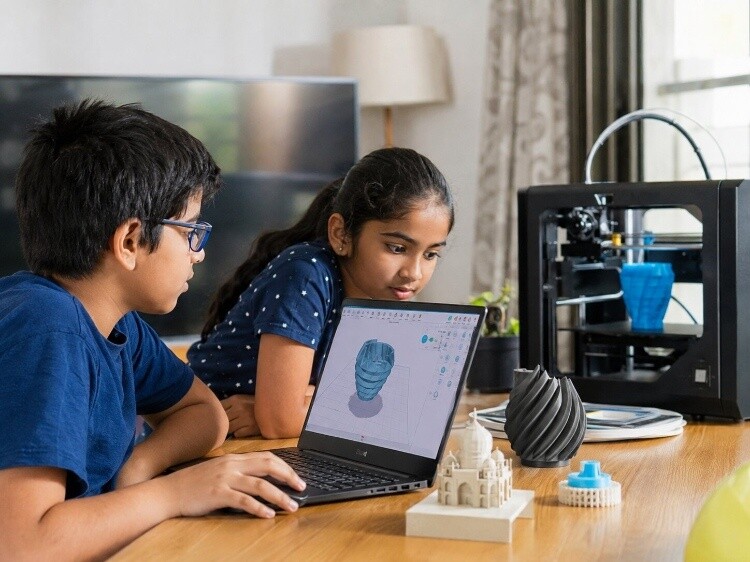
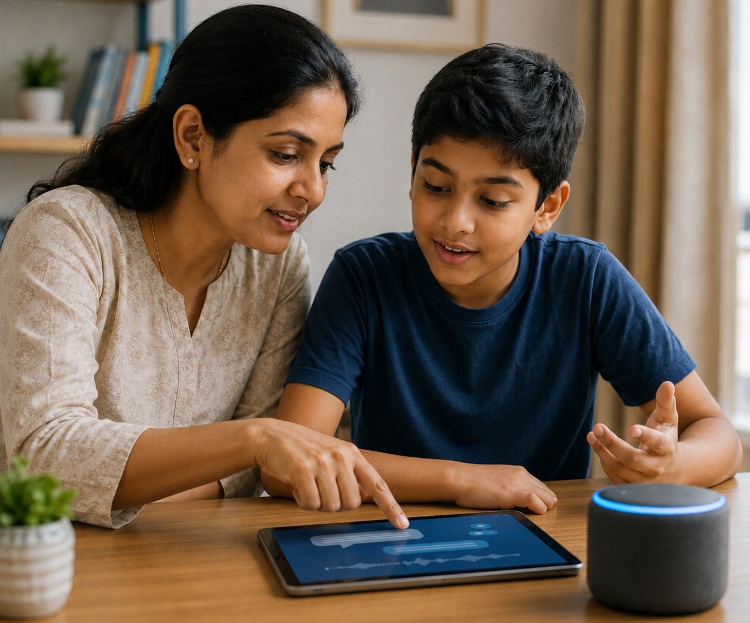
Unlike some previous technology-avoidance debates (a family choosing not to own a television, for instance), AI tools are increasingly embedded in search engines, educational platforms, and everyday digital tools your child will encounter regardless of direct parental introduction — search results now often include AI-generated summaries, homework help apps increasingly incorporate AI features, and voice assistants (already common in many households) are themselves AI-driven. Complete avoidance is decreasingly practical, making thoughtful engagement a more realistic goal than total exclusion.
A reasonable age framework, acknowledging genuine uncertainty
Under roughly age 8-9: minimal to no direct, independent AI tool use makes sense for most children — any AI interaction at this age should be adult-mediated (a parent using a voice assistant together, for instance), given limited capacity to understand what AI actually is, its limitations, and appropriate use boundaries. Roughly ages 9-12: supervised, purpose-specific introduction becomes reasonable for many families — using an AI tool together for a specific homework question, with explicit discussion about checking AI-provided information rather than trusting it uncritically. From early adolescence onward: more independent use becomes appropriate, ideally building on foundational understanding established through earlier supervised exposure.

The specific concerns worth actively addressing, regardless of exact age
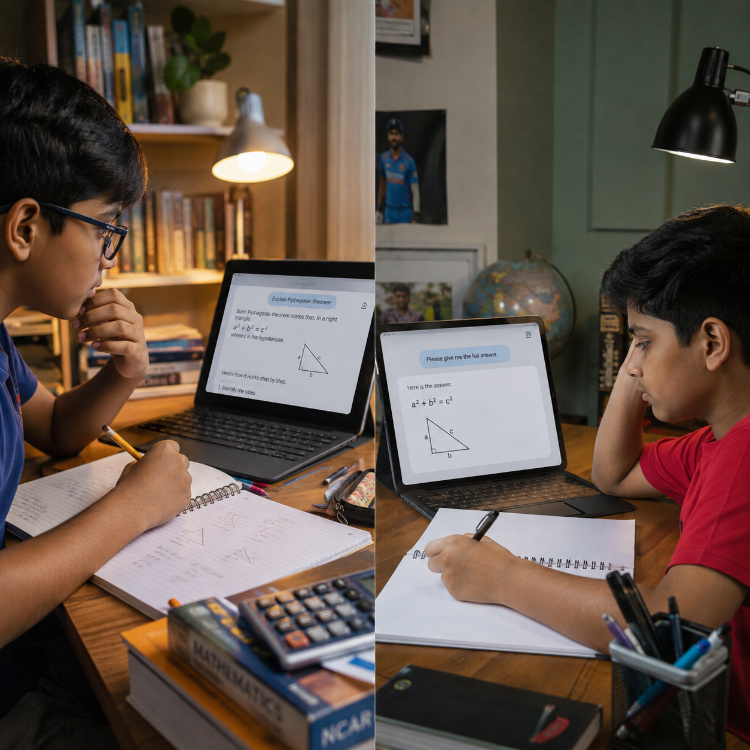
AI tools can produce confidently stated incorrect information — teaching a child explicitly that AI answers require verification, the same critical thinking increasingly taught for internet information generally, matters more than any specific age gate. Over-reliance on AI for tasks a child should be building their own capability in (writing, basic problem-solving) can undermine skill development if not actively managed — using AI as a genuine learning aid differs meaningfully from using it to bypass learning entirely. And AI chatbot interactions, particularly on platforms not specifically designed for children, can occasionally produce inappropriate content or engage in ways not suited to a child audience, making platform choice and supervision genuinely important considerations.

What genuinely productive early AI engagement looks like
Using AI tools together as a novel "how does this work" exploration, building genuine understanding of AI as a tool with real capabilities and real limitations, rather than either magic or something to fear. Using AI specifically for tasks where verification and critical evaluation are part of the activity (checking an AI's factual claim together, discussing why it might have gotten something wrong) rather than passive acceptance. And explicitly modelling and discussing appropriate use — AI as a tool to support thinking and learning, not a replacement for a child's own effort and understanding.

The Indian education context specifically
Given India's strong emphasis on academic achievement and increasingly available AI-powered homework and tutoring tools, the temptation toward AI-as-shortcut (having AI complete homework rather than support learning) is a genuine, specific concern worth families actively discussing and managing, particularly as these tools become more accessible and capable.
A reasonable summary position
Complete avoidance isn't fully realistic given AI's increasing embedding in everyday digital tools, but neither is unmanaged, unsupervised access appropriate for young children — supervised, purposeful, critically-engaged introduction, timed to a child's developing capacity for understanding tool limitations, represents a genuinely reasonable middle path most families can adapt to their specific child's readiness.