
 Summer Camp
 Reading Writing
 Book Club
 Calligraphy
 Creative Writing
 English Speaking
 Handwriting
 Library
 Phonics
 Story Telling
 Art and Craft
 Clay Moulding
 Drawing
 Painting
 Pottery
 Sketching
 Drama Theatre
 Personality Development
 Public Speaking
 Languages
 Arabic
 Chinese
 French
 German
 Hindi
Hindi Italian
 Japanese
 Korean
 Persian
 Portuguese
 Russian
 Spanish
 Turkish
 Uzbek
Uzbek Sports and Fitness
 Aerobics
 Athletics
 Badminton
 Basket Ball
 Chess
Chess Cricket
 Football
 Golf
Golf Gymnastics
 Hulahoop
 Karate
 Martial Arts
 Pickleball
 Rugby
Rugby Skating
 Swimming
 Taekwondo
 Tennis
 Volleyball
 Yoga
Yoga Zumba
Zumba Tuition Classes
 Accounts
 Biology
 Business Studies
 CBSE
CBSE Chemistry
 Commerce
 Economics
 Homework Classes
 IB Board
 IGCSE
IGCSE Mathematics
 Physics
 Psychology
 Science
 Social Studies
 Vedic Maths
 Dance and Music
 Ballet
 Bhangra
 Bharatnatyam
 Bollywood Dance
 Casio
Casio Dandiya and Garba
 Drums
Drums Flute
Flute Guitar
 Harmonium
 Hip Hop
 Jazz
Jazz Kathak
 Keyboard
 Piano
Piano Salsa
Salsa Shlokas
 Sitar
Sitar Tabla
Tabla Ukulele
 Violin
 Vocal
Vocal PlaySchools
 Preschool
 STEM
STEM
 Abacus
 App Development
 Artificial intelligence
 Basic Computer Courses
 Canva
Canva Coding
 Graphic Design
 Lego
Lego Python
 Robotics
 Rubiks Cube
 Scrabble
 Scratch
 Website Development
 Winter Camp
 Workshops
 Diwali Workshop
 Easter
 Ganesh Mahotsav
 Guru Nanak Jayanti Workshop
 Holi
Holi Independence day workshop
 Janmashtami Workshop
 Mothers day
 Navratri Workshops
 Raksha Bandhan workshop
 Ramayana Workshop
 Spring Camp
 Valentines Day Workshops
 Festive
 Daycare
 Cooking and Food
 Spring Camp
 Contests and Competitions
 Special abled
 Republic Day Workshops
 Mela
Mela
 Mela
Mela Cognitive Development
 Mother-Toddler Program
-Jul-03-2026-06-59-25-1926-AM.webp?width=30&height=30&name=Smart_20Skills_20(2)-Jul-03-2026-06-59-25-1926-AM.webp) Smart Skills
Smart Skills
 Financial Literacy




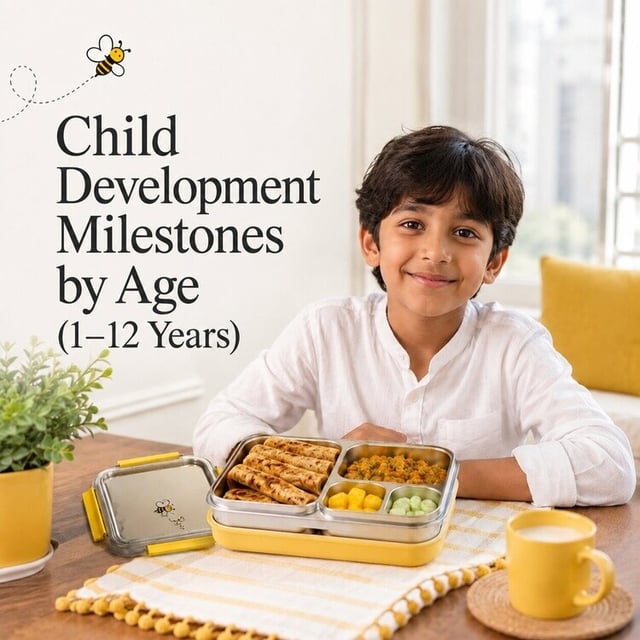
Development milestones give a rough map, not a strict rulebook — the range of "normal" at every age is wider than most milestone charts suggest. Here's a reassurance-first overview by age band.
Milestone charts can be a source of either useful guidance or unnecessary anxiety, depending on how they're used. The framework below is meant as the former — a general sense of what typically develops when, with the reminder that meaningful variation within these ranges is completely normal.
Why the range matters more than any single milestone
Two children can both be entirely typically developing while reaching the same milestone six months or more apart. Charts present tidy age brackets, but real development is genuinely uneven and individual — a child ahead in physical milestones might be right on track (or even behind) in language, and this unevenness within one child is itself completely normal.
What's genuinely worth flagging to a paediatrician
Significant, sudden regression in a previously achieved skill. A cluster of multiple delayed milestones across different developmental areas simultaneously (not just one isolated area). Loss of social interest or connection that seems to be worsening rather than developing. A single delayed milestone in isolation, especially in a child otherwise developing well, is rarely cause for serious concern on its own.
The comparison trap, once again
As with reading and academic milestones, social comparison — at parks, in WhatsApp groups, at family gatherings — tends to amplify anxiety disproportionately to actual risk. Most children within the wide range of "typical" development go on to thrive without any intervention at all.
Using this chart constructively
The most useful way to engage with a milestone chart isn't as a pass/fail checklist, but as a general orientation — noticing broad patterns over months, not obsessing over exact ages, and bringing genuine concerns to a paediatrician calmly rather than anxiously.