
 Reading Writing
 Book Club
 Calligraphy
 Creative Writing
 English Speaking
 Handwriting
 Library
 Phonics
 Story Telling
 Art and Craft
 Clay Moulding
 Drawing
 Painting
 Pottery
 Sketching
 Drama Theatre
 Personality Development
 Public Speaking
 Languages
 Arabic
 Chinese
 French
 German
 Hindi
Hindi Italian
 Japanese
 Korean
 Persian
 Portuguese
 Russian
 Spanish
 Turkish
 Uzbek
Uzbek Sports and Fitness
 Aerobics
 Athletics
 Badminton
 Basket Ball
 Chess
Chess Cricket
 Football
 Golf
Golf Gymnastics
 Hulahoop
 Karate
 Martial Arts
 Pickleball
 Rugby
Rugby Skating
 Swimming
 Taekwondo
 Tennis
 Volleyball
 Yoga
Yoga Zumba
Zumba Tuition Classes
 Accounts
 Biology
 Business Studies
 CBSE
CBSE Chemistry
 Commerce
 Economics
 Homework Classes
 IB Board
 IGCSE
IGCSE Mathematics
 Physics
 Psychology
 Science
 Social Studies
 Vedic Maths
 Dance and Music
 Ballet
 Bhangra
 Bharatnatyam
 Bollywood Dance
 Casio
Casio Dandiya and Garba
 Drums
Drums Flute
Flute Guitar
 Harmonium
 Hip Hop
 Jazz
Jazz Kathak
 Keyboard
 Piano
Piano Salsa
Salsa Shlokas
 Sitar
Sitar Tabla
Tabla Ukulele
 Violin
 Vocal
Vocal Play School
 STEM
STEM
 Abacus
 App Development
 Artificial intelligence
 Basic Computer Courses
 Canva
Canva Coding
 Graphic Design
 Lego
Lego Python
 Robotics
 Rubiks Cube
 Scrabble
 Scratch
 Website Development
 Workshops
 Diwali Workshops
 Guru Nanak Jayanti Workshop
 Halloween
 Independence day workshop
 Navratri Workshops
 Raksha Bandhan workshop
 Ramayana Workshop
 Spring Camp
 Valentines Day Workshops
 Festive
 Daycare
 Cooking and Food
 Spring Camp
 Contests and Competitions
 Special abled
 Republic Day Workshops
 Mela
Mela
 Mela
Mela Cognitive Development
 Mother-Toddler Program
 Music
Music
 Dance
Dance
-Jul-03-2026-06-59-25-1926-AM.webp?width=30&height=30&name=Smart_20Skills_20(2)-Jul-03-2026-06-59-25-1926-AM.webp) Smart Skills
Smart Skills
 Financial Literacy
 Mental Wellbeing
 Meditation
 Reiki
Reiki




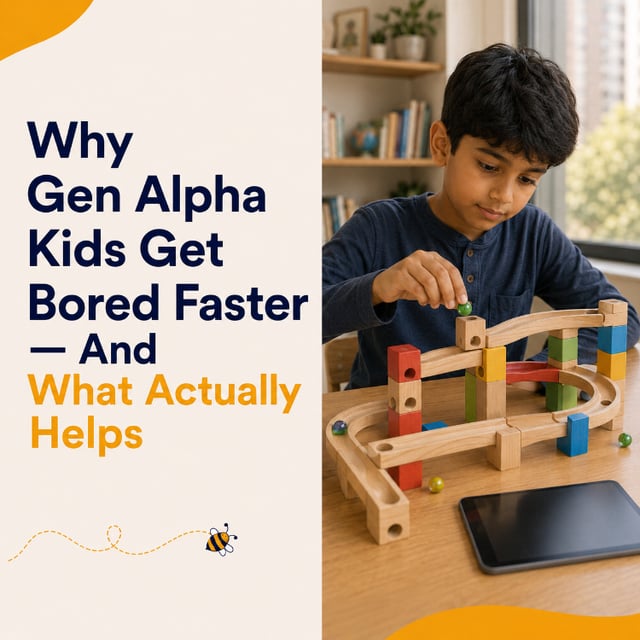
Many parents notice their children seem to tire of activities faster than expected, reaching for a screen or the next stimulus quickly. Here's what's genuinely happening, and evidence-based approaches that help rebuild tolerance for slower-paced engagement.
The complaint is common across Delhi NCR and Chandigarh parent circles alike: a child seems to lose interest in an activity within minutes, reaching for a screen, a new toy, or a demand for the next thing almost immediately — a pattern many parents notice as genuinely different from their own remembered childhood boredom tolerance.
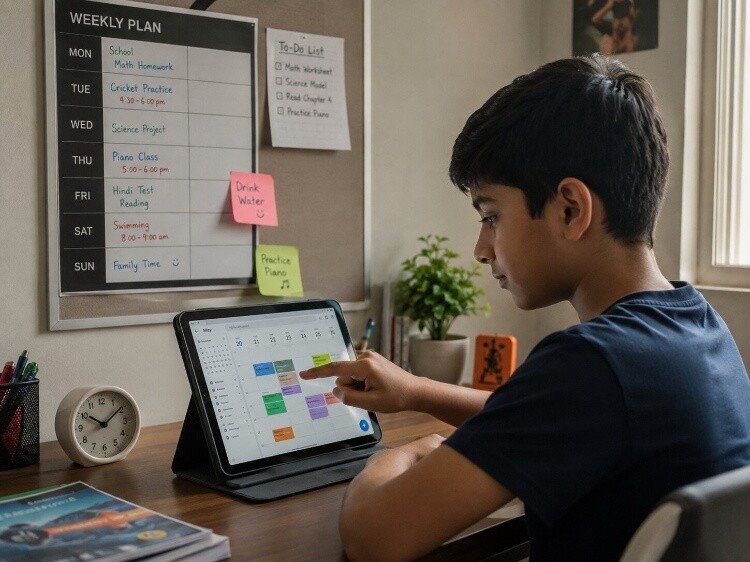
What's genuinely happening, without alarmism
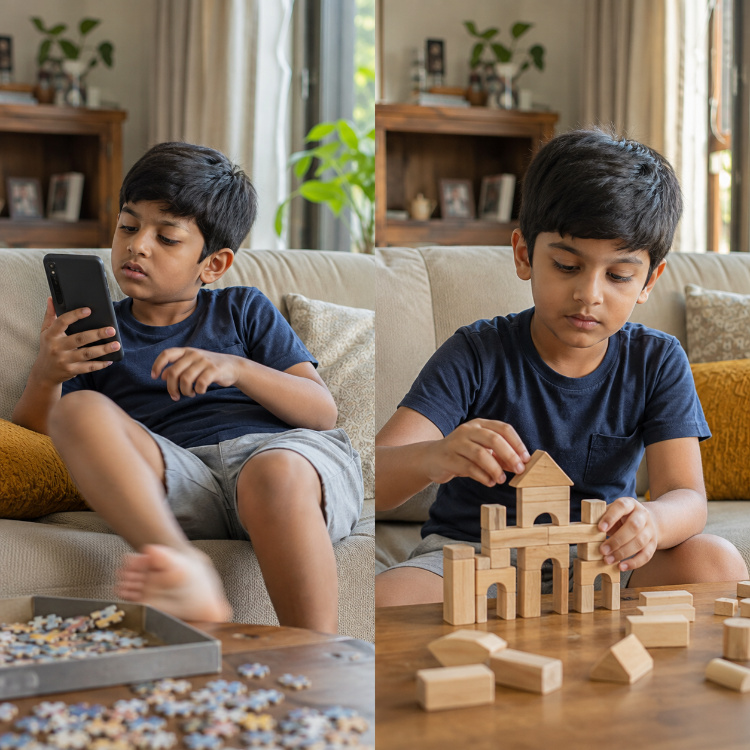
Content specifically engineered for rapid engagement and dopamine-driven attention capture (short-form video being the clearest example) trains a specific expectation: that stimulation should arrive quickly and constantly refresh. Children with significant exposure to this kind of content, even in otherwise well-managed amounts, can develop a genuinely recalibrated baseline for what "interesting enough to sustain attention" means, making slower-paced activities (a puzzle, a book, unstructured play) feel comparatively under-stimulating by contrast.
This isn't the same as an attention deficit
It's worth explicitly distinguishing this pattern — a recalibrated stimulation threshold from content exposure — from clinical attention difficulties, which involve different underlying mechanisms and require different responses. Most "gets bored fast" patterns respond to environmental and habit changes rather than needing clinical intervention, though genuinely persistent, severe attention difficulties across multiple contexts (not just screen-adjacent situations) warrant a paediatric conversation regardless.
What actually helps rebuild tolerance for slower engagement
Gradual exposure to sustained, single-focus activities — starting with genuinely engaging but not screen-based activities (a favourite physical game, a hands-on project) and gradually extending duration, rather than expecting an immediate jump to long, quiet, solo focus.
Reducing rapid-content-switching exposure specifically, not just total screen time — the specific pattern of short-form, algorithm-driven video content appears more strongly linked to attention recalibration than screen time broadly; a child watching one full-length film shows a different pattern than one scrolling short clips for the same duration.
Protecting genuine boredom windows without rescue — as covered elsewhere in this content series, resisting the urge to immediately fill every "I'm bored" moment with a new stimulus allows a child's own attention and self-directed play capacity to develop, which atrophies without practice.
Modelling sustained attention yourself — children absorb attention patterns partly through observation; a household where adults also constantly reach for phones during any lull models exactly the pattern parents often want to counteract in children.
Building in genuinely engaging slower activities specifically — cooking together, extended outdoor play, longer-form reading, building projects that take multiple sessions — activities with genuine appeal that also require and build sustained attention capacity.

The realistic timeline for change
Attention and stimulation-tolerance patterns built over months or years of exposure don't reverse in days — families who commit to the changes above tend to see gradual improvement over weeks to months, not immediate transformation, and expecting rapid change often leads to abandoning genuinely helpful adjustments too early.
A reframe worth holding
This isn't really about "kids today" being deficient compared to previous generations — it's about a specific, identifiable environmental input (rapid-content-switching media) producing a specific, identifiable and genuinely reversible effect, which puts the solution within a family's actual control rather than treating it as an immutable generational characteristic.