
 Summer Camp
 Reading Writing
 Book Club
 Calligraphy
 Creative Writing
 English Speaking
 Handwriting
 Library
 Phonics
 Story Telling
 Art and Craft
 Clay Moulding
 Drawing
 Painting
 Pottery
 Sketching
 Drama Theatre
 Personality Development
 Public Speaking
 Languages
 Arabic
 Chinese
 French
 German
 Hindi
Hindi Italian
 Japanese
 Korean
 Persian
 Portuguese
 Russian
 Spanish
 Turkish
 Uzbek
Uzbek Sports and Fitness
 Aerobics
 Athletics
 Badminton
 Basket Ball
 Chess
Chess Cricket
 Football
 Golf
Golf Gymnastics
 Hulahoop
 Karate
 Martial Arts
 Pickleball
 Rugby
Rugby Skating
 Swimming
 Taekwondo
 Tennis
 Volleyball
 Yoga
Yoga Zumba
Zumba Tuition Classes
 Accounts
 Biology
 Business Studies
 CBSE
CBSE Chemistry
 Commerce
 Economics
 Homework Classes
 IB Board
 IGCSE
IGCSE Mathematics
 Physics
 Psychology
 Science
 Social Studies
 Vedic Maths
 Dance and Music
 Ballet
 Bhangra
 Bharatnatyam
 Bollywood Dance
 Casio
Casio Dandiya and Garba
 Drums
Drums Flute
Flute Guitar
 Harmonium
 Hip Hop
 Jazz
Jazz Kathak
 Keyboard
 Piano
Piano Salsa
Salsa Shlokas
 Sitar
Sitar Tabla
Tabla Ukulele
 Violin
 Vocal
Vocal Play School
 STEM
STEM
 Abacus
 App Development
 Artificial intelligence
 Basic Computer Courses
 Canva
Canva Coding
 Graphic Design
 Lego
Lego Python
 Robotics
 Rubiks Cube
 Scrabble
 Scratch
 Website Development
 Winter Camp
 Workshops
 Diwali Workshop
 Easter
 Ganesh Mahotsav
 Guru Nanak Jayanti Workshop
 Holi
Holi Independence day workshop
 Janmashtami Workshop
 Mothers day
 Navratri Workshops
 Raksha Bandhan workshop
 Ramayana Workshop
 Spring Camp
 Valentines Day Workshops
 Festive
 Daycare
 Cooking and Food
 Spring Camp
 Contests and Competitions
 Special abled
 Republic Day Workshops
 Mela
Mela
 Mela
Mela Cognitive Development
 Mother-Toddler Program
-Jul-03-2026-06-59-25-1926-AM.webp?width=30&height=30&name=Smart_20Skills_20(2)-Jul-03-2026-06-59-25-1926-AM.webp) Smart Skills
Smart Skills
 Financial Literacy
 Mental Wellbeing
 Meditation
 Reiki
Reiki




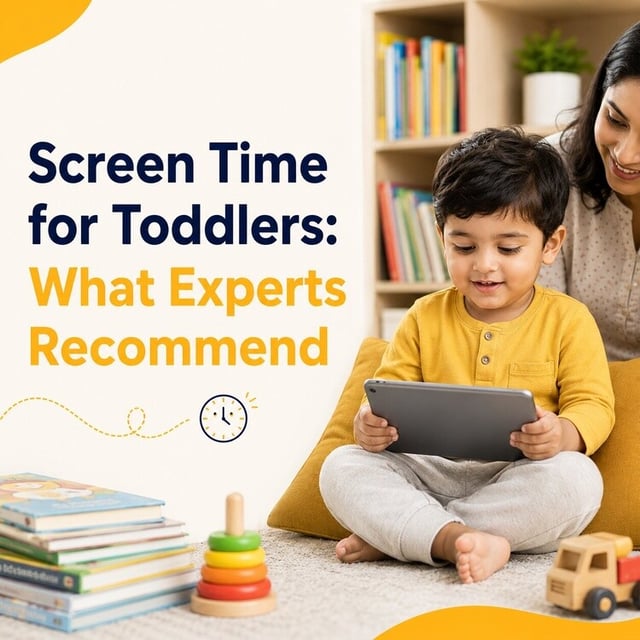
Paediatric guidance for under-2s is close to zero screen time except video calls — but real households need more than an ideal. Here's the guidance, the reasoning, and a workable approach for actual Indian family life.
Screen time for toddlers is where expert guidance and household reality collide harder than almost anywhere else in parenting. Both deserve honest treatment.
What the guidance actually says
Major paediatric bodies, including Indian ones, recommend essentially no screen time before 18-24 months, with video calls to family as the accepted exception. From 2-5 years, the guidance shifts to a limited window — around an hour — of quality content, ideally watched together.
Why under-2 guidance is so strict
Toddler brains learn from responsive, contingent interaction — things that react to what the child does. Screens at this age deliver stimulation without interaction; research consistently shows toddlers learn language and concepts poorly from video compared to identical live interaction. The cost isn't what the screen does to them — it's what it displaces: talk, play, and the back-and-forth that builds brains at this age. Background TV alone measurably reduces parent-child conversation.
The video call exception matters in India
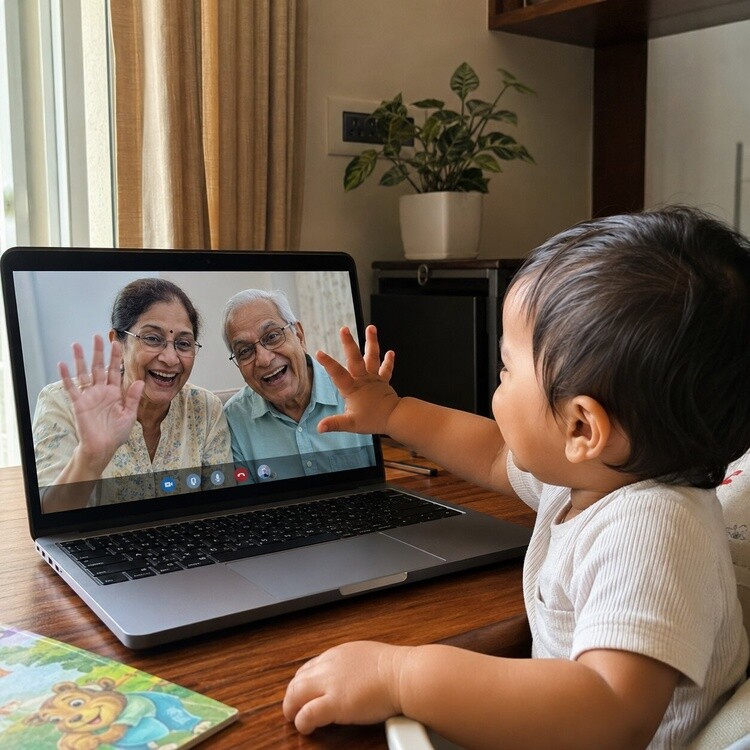
For families with grandparents in another city or country, video calls are genuinely interactive — a responsive human on the other end — and are encouraged, not merely tolerated. A daily video call with dadi-dadu or nana-nani is connection, not screen time in the concerning sense.
The reality gap, named honestly
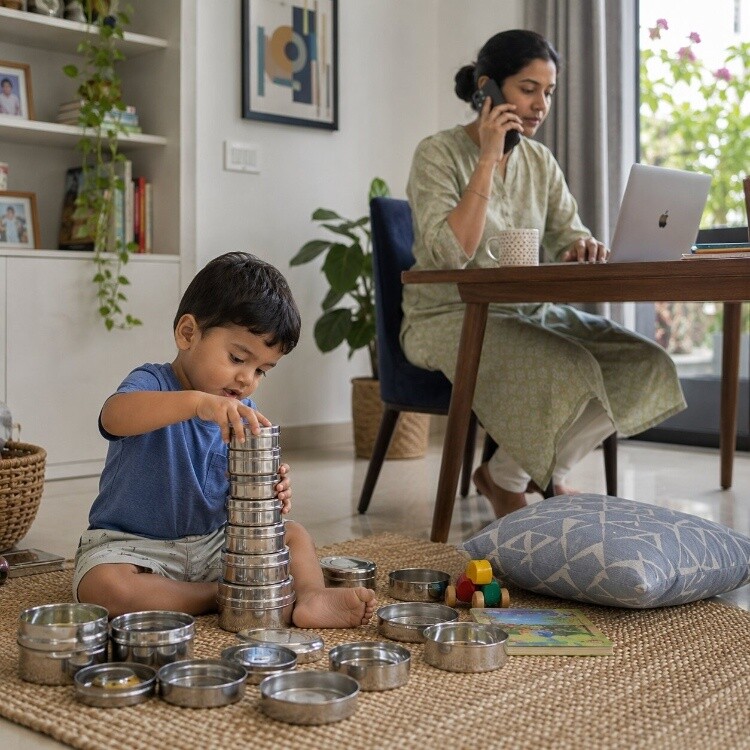
The zero-screen ideal assumes caregiving capacity that many households — two working parents, help with mixed engagement levels, no nearby family — don't consistently have. A parent handing over a phone during a critical work call, or a long car journey, is managing reality, not failing. The useful question isn't "did screens happen?" but "what's the default pattern?"
A workable framework for real households
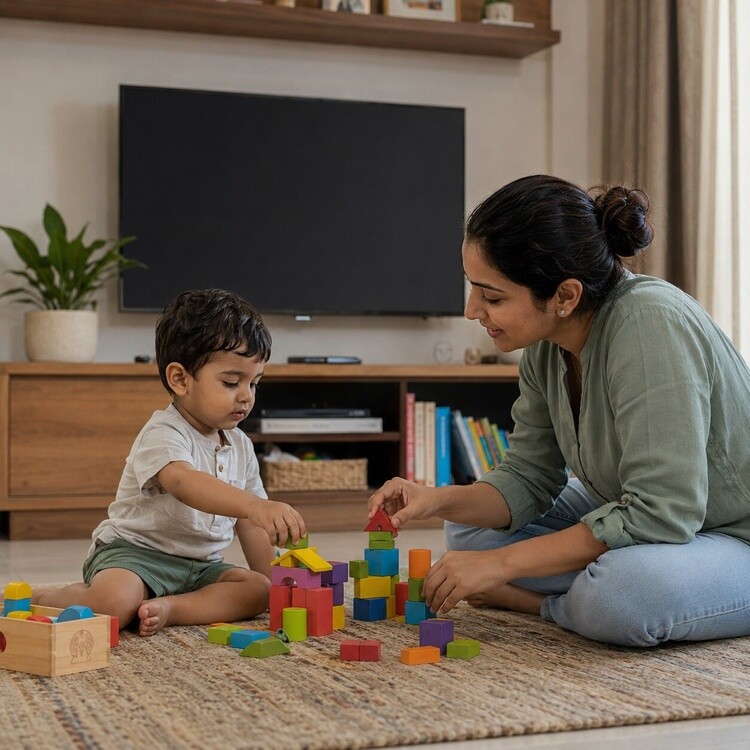
Keep screens exceptional rather than routine — a deliberate tool for specific moments, not ambient background. When screens happen, choose slow-paced, simple content over frenetic stimulation, and co-view when remotely possible — narrating and responding transforms passive watching into something closer to interaction. Protect the non-negotiable zones: meals and the hour before sleep. And address the background TV habit — a television running for adults all evening affects the toddler in the room more than most families realise.
The caregiver alignment problem
The hardest screen battles are often not with the toddler but with the household: a helper who keeps the child quiet with a phone, or grandparents whose TV runs all day. Framing matters — a request to "play with her instead, she loves the blocks" lands better than a screen-time lecture, and the activity menu approach (leaving specific easy play setups ready) gives everyone a genuine alternative.
A long-game perspective
Habits formed now set defaults for the years ahead, but nothing about toddler screen exposure is irreversible. A family that resets its patterns at any point gets most of the benefit. The goal is a childhood where screens are one small, bounded thing among many bigger things — play, people, boredom, books — not a purity contest.