
 Summer Camp
 Reading Writing
 Book Club
 Calligraphy
 Creative Writing
 English Speaking
 Handwriting
 Library
 Phonics
 Story Telling
 Art and Craft
 Clay Moulding
 Drawing
 Painting
 Pottery
 Sketching
 Drama Theatre
 Personality Development
 Public Speaking
 Languages
 Arabic
 Chinese
 French
 German
 Hindi
Hindi Italian
 Japanese
 Korean
 Persian
 Portuguese
 Russian
 Spanish
 Turkish
 Uzbek
Uzbek Sports and Fitness
 Aerobics
 Athletics
 Badminton
 Basket Ball
 Chess
Chess Cricket
 Football
 Golf
Golf Gymnastics
 Hulahoop
 Karate
 Martial Arts
 Pickleball
 Rugby
Rugby Skating
 Swimming
 Taekwondo
 Tennis
 Volleyball
 Yoga
Yoga Zumba
Zumba Tuition Classes
 Accounts
 Biology
 Business Studies
 CBSE
CBSE Chemistry
 Commerce
 Economics
 Homework Classes
 IB Board
 IGCSE
IGCSE Mathematics
 Physics
 Psychology
 Science
 Social Studies
 Vedic Maths
 Dance and Music
 Ballet
 Bhangra
 Bharatnatyam
 Bollywood Dance
 Casio
Casio Dandiya and Garba
 Drums
Drums Flute
Flute Guitar
 Harmonium
 Hip Hop
 Jazz
Jazz Kathak
 Keyboard
 Piano
Piano Salsa
Salsa Shlokas
 Sitar
Sitar Tabla
Tabla Ukulele
 Violin
 Vocal
Vocal Play School
 STEM
STEM
 Abacus
 App Development
 Artificial intelligence
 Basic Computer Courses
 Canva
Canva Coding
 Graphic Design
 Lego
Lego Python
 Robotics
 Rubiks Cube
 Scrabble
 Scratch
 Website Development
 Winter Camp
 Workshops
 Diwali Workshop
 Easter
 Ganesh Mahotsav
 Guru Nanak Jayanti Workshop
 Holi
Holi Independence day workshop
 Janmashtami Workshop
 Mothers day
 Navratri Workshops
 Raksha Bandhan workshop
 Ramayana Workshop
 Spring Camp
 Valentines Day Workshops
 Festive
 Daycare
 Cooking and Food
 Spring Camp
 Contests and Competitions
 Special abled
 Republic Day Workshops
 Mela
Mela
 Mela
Mela Cognitive Development
 Mother-Toddler Program
-Jul-03-2026-06-59-25-1926-AM.webp?width=30&height=30&name=Smart_20Skills_20(2)-Jul-03-2026-06-59-25-1926-AM.webp) Smart Skills
Smart Skills
 Financial Literacy
 Mental Wellbeing
 Meditation
 Reiki
Reiki





Potty training succeeds on readiness signs, not age targets or family pressure. Here's a calm, signs-based approach — with the accidents, regressions, and dadi-timeline management included.
Few toddler milestones attract as much comparison pressure as potty training — the neighbour's child trained at 18 months, dadi trained all her children "before they walked," and the preschool admission form asks about it. Amid the noise, the research is calm: training started on readiness signs goes faster and gentler than training started on external timelines.
The readiness signs that matter
Staying dry for longer stretches (signalling bladder maturity); awareness of going — pausing, hiding behind the curtain, announcing after the fact; discomfort with a dirty nappy; interest in the bathroom and in others' toilet habits; ability to follow simple instructions and manage simple clothing; and — underrated — willingness. Most children show this cluster somewhere between 2 and 3, with wide, normal variation. A child showing none of these signs isn't ready regardless of age; a training attempt then teaches only frustration.
A workable approach once signs appear
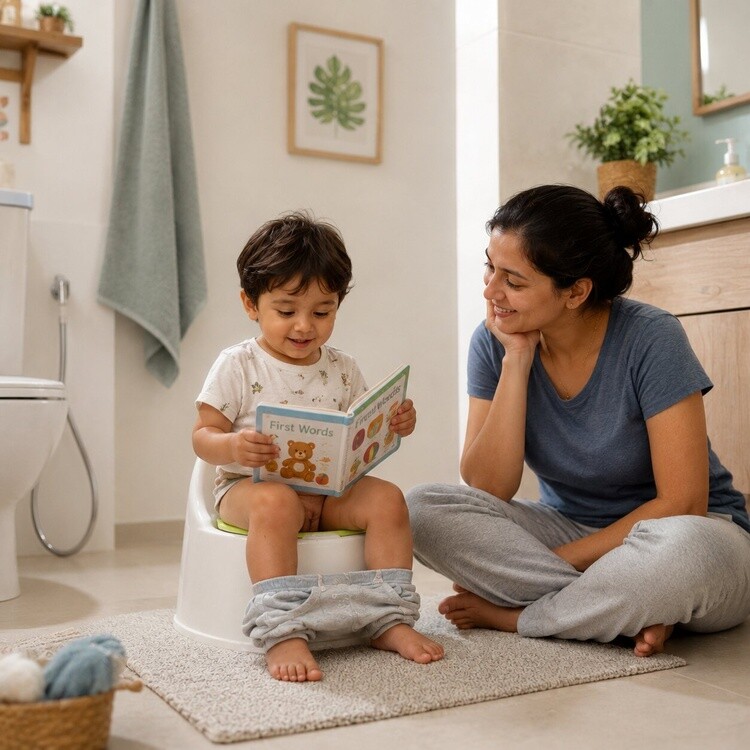
Equipment - A floor potty or a toilet seat-reducer with a footstool — feet supported, body stable. Indian bathrooms with floor access often make this transition practically easier.
Introduce before expecting — the potty sits around, gets talked about, hosts a teddy, features in a picture book or two, all before any performance is requested.
Routine sits at high-probability times — after waking, after meals — brief, pressure-free, ended cheerfully regardless of outcome.
Celebrate matter-of-factly — acknowledgment over festivals; the goal is normalcy, not performance anxiety.
Dress for success — elastic waists and quick access; this is not the season for complicated fastenings.
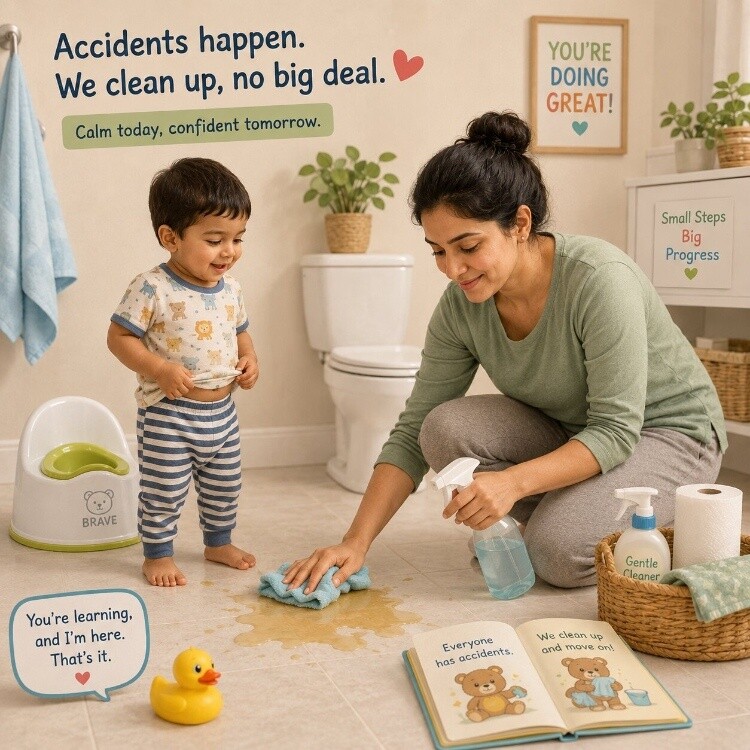
Accidents get boring responses — "Oops, let's clean up" — zero scolding, zero drama. Shame demonstrably slows training.
The parts nobody advertises
Daytime training and night dryness are separate physiological developments — night nappies often continue months or years after confident daytime training, completely normally. Regressions accompany disruptions (new sibling, illness, school start, travel) and resolve with calm consistency. And poo often lags wee — some fully wee-trained children request a nappy for poo for a while; accommodating briefly beats forcing a standoff.
Managing the family timeline commentary
The generational gap is real: earlier eras started conditioning much younger, with a very different definition of "trained" (a caregiver catching timing versus a child self-managing). The gracious frame for family: "The doctor suggested waiting for her signs — it goes much faster that way." It invokes authority, closes debate, and happens to be true.
When to mention it to a paediatrician
No interest or readiness signs well past three and a half; pain, constipation, or fear around toileting (constipation quietly sabotages many training efforts and is very treatable); or training that's become a genuine battle — all worth a routine-visit conversation rather than escalating pressure at home.