
 Summer Camp
 Reading Writing
 Book Club
 Calligraphy
 Creative Writing
 English Speaking
 Handwriting
 Library
 Phonics
 Story Telling
 Art and Craft
 Clay Moulding
 Drawing
 Painting
 Pottery
 Sketching
 Drama Theatre
 Personality Development
 Public Speaking
 Languages
 Arabic
 Chinese
 French
 German
 Hindi
Hindi Italian
 Japanese
 Korean
 Persian
 Portuguese
 Russian
 Spanish
 Turkish
 Uzbek
Uzbek Sports and Fitness
 Aerobics
 Athletics
 Badminton
 Basket Ball
 Chess
Chess Cricket
 Football
 Golf
Golf Gymnastics
 Hulahoop
 Karate
 Martial Arts
 Pickleball
 Rugby
Rugby Skating
 Swimming
 Taekwondo
 Tennis
 Volleyball
 Yoga
Yoga Zumba
Zumba Tuition Classes
 Accounts
 Biology
 Business Studies
 CBSE
CBSE Chemistry
 Commerce
 Economics
 Homework Classes
 IB Board
 IGCSE
IGCSE Mathematics
 Physics
 Psychology
 Science
 Social Studies
 Vedic Maths
 Dance and Music
 Ballet
 Bhangra
 Bharatnatyam
 Bollywood Dance
 Casio
Casio Dandiya and Garba
 Drums
Drums Flute
Flute Guitar
 Harmonium
 Hip Hop
 Jazz
Jazz Kathak
 Keyboard
 Piano
Piano Salsa
Salsa Shlokas
 Sitar
Sitar Tabla
Tabla Ukulele
 Violin
 Vocal
Vocal Play School
 STEM
STEM
 Abacus
 App Development
 Artificial intelligence
 Basic Computer Courses
 Canva
Canva Coding
 Graphic Design
 Lego
Lego Python
 Robotics
 Rubiks Cube
 Scrabble
 Scratch
 Website Development
 Winter Camp
 Workshops
 Diwali Workshop
 Easter
 Ganesh Mahotsav
 Guru Nanak Jayanti Workshop
 Holi
Holi Independence day workshop
 Janmashtami Workshop
 Mothers day
 Navratri Workshops
 Raksha Bandhan workshop
 Ramayana Workshop
 Spring Camp
 Valentines Day Workshops
 Festive
 Daycare
 Cooking and Food
 Spring Camp
 Contests and Competitions
 Special abled
 Republic Day Workshops
 Mela
Mela
 Mela
Mela Cognitive Development
 Mother-Toddler Program
-Jul-03-2026-06-59-25-1926-AM.webp?width=30&height=30&name=Smart_20Skills_20(2)-Jul-03-2026-06-59-25-1926-AM.webp) Smart Skills
Smart Skills
 Financial Literacy
 Mental Wellbeing
 Meditation
 Reiki
Reiki





Toddlers don't need destination outings — the colony park, society garden, and ordinary streets deliver rich outdoor learning. These activities turn everyday outdoor access into curiosity fuel.
For a two-year-old, the walk to the park is as valuable as the park. Outdoor time at this age isn't about activities in the structured sense — it's about giving curiosity room, with an adult who moves at toddler pace.
The toddler-pace walk
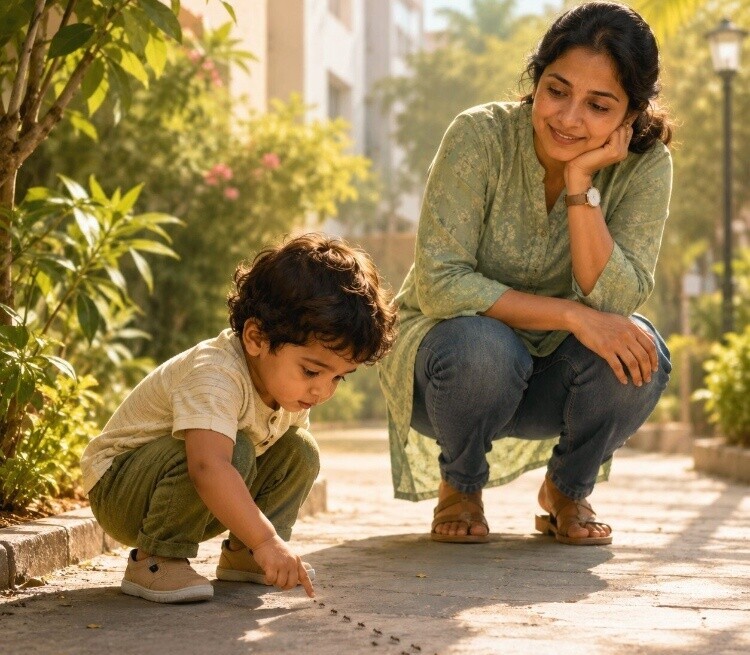
The single most underrated outdoor activity: a walk with no destination and no hurry, where stopping to watch ants, touch tree bark, and point at autos is the agenda. Twenty minutes of toddler-paced walking contains more learning than an hour of adult-paced transit.
Park and garden activities
Collecting walks — leaves, sticks, stones, fallen flowers — a collection bag turns any walk into a treasure hunt (with a wash-hands ritual after).
Barefoot grass time — sensory input through the feet, in safe clean patches.
Ball games with maximum chasing — kicking and throwing where running after the ball is the real activity.
Bubble chasing — outdoors, bubbles plus wind equals sustained delighted running.
Slide and swing time — playground equipment builds vestibular and motor development alongside courage.
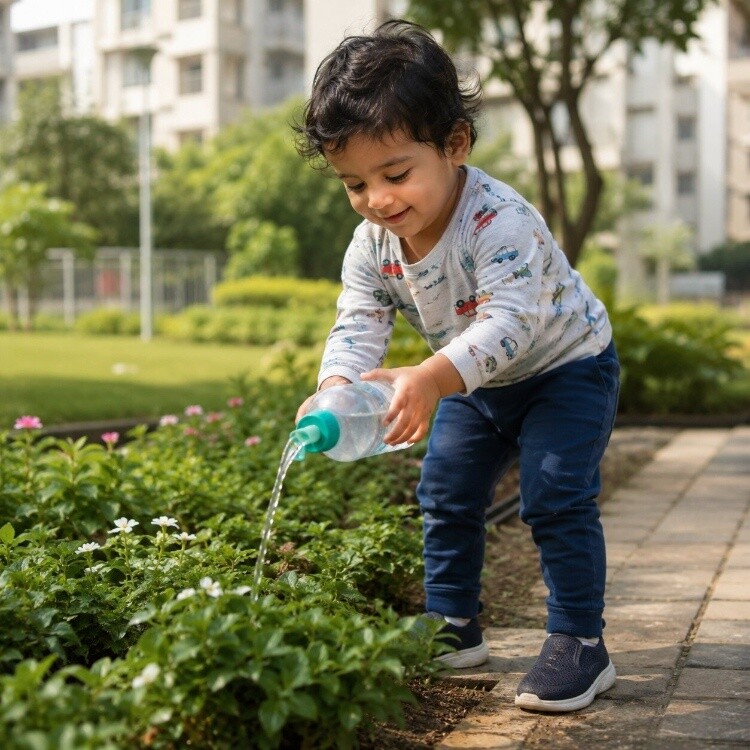
Watering plants — a small bottle for "helping" water society plants; responsibility in miniature.
Puddle and mud windows — post-monsoon-shower puddle stomping, dressed for it, is peak toddler joy and genuine sensory play; the laundry is the fee.
Observation games for streets and balconies
Vehicle spotting — autos, buses, bikes, cycles — naming and counting from a gate or balcony.
Bird and animal watching — pigeons, squirrels, street dogs (from respectful distance), the sabziwala's cart — the daily street offers a full nature documentary.
Sound mapping — "What can we hear?" — horns, birds, the pressure cooker from a neighbour's window.
Timing around Delhi's climate - Summer pushes outdoor time to early morning (before 9) and post-sunset; monsoon offers between-shower windows; winter's pollution spikes genuinely warrant checking AQI before longer outdoor stretches, and favouring late-morning sun in the cold months. Working with the climate rather than fighting it keeps outdoor time consistent across the year.

The social dimension of park time
Regular visits to the same park at the same time mean the same children — and while two-year-olds mostly play alongside rather than with each other, this repeated parallel exposure is exactly how early social comfort builds. The park bench parent network is also, not incidentally, where Delhi NCR parents exchange most of their activity and class intelligence — the original discovery platform.