
 Summer Camp
 Reading Writing
 Book Club
 Calligraphy
 Creative Writing
 English Speaking
 Handwriting
 Library
 Phonics
 Story Telling
 Art and Craft
 Clay Moulding
 Drawing
 Painting
 Pottery
 Sketching
 Drama Theatre
 Personality Development
 Public Speaking
 Languages
 Arabic
 Chinese
 French
 German
 Hindi
Hindi Italian
 Japanese
 Korean
 Persian
 Portuguese
 Russian
 Spanish
 Turkish
 Uzbek
Uzbek Sports and Fitness
 Aerobics
 Athletics
 Badminton
 Basket Ball
 Chess
Chess Cricket
 Football
 Golf
Golf Gymnastics
 Hulahoop
 Karate
 Martial Arts
 Pickleball
 Rugby
Rugby Skating
 Swimming
 Taekwondo
 Tennis
 Volleyball
 Yoga
Yoga Zumba
Zumba Tuition Classes
 Accounts
 Biology
 Business Studies
 CBSE
CBSE Chemistry
 Commerce
 Economics
 Homework Classes
 IB Board
 IGCSE
IGCSE Mathematics
 Physics
 Psychology
 Science
 Social Studies
 Vedic Maths
 Dance and Music
 Ballet
 Bhangra
 Bharatnatyam
 Bollywood Dance
 Casio
Casio Dandiya and Garba
 Drums
Drums Flute
Flute Guitar
 Harmonium
 Hip Hop
 Jazz
Jazz Kathak
 Keyboard
 Piano
Piano Salsa
Salsa Shlokas
 Sitar
Sitar Tabla
Tabla Ukulele
 Violin
 Vocal
Vocal Play School
 STEM
STEM
 Abacus
 App Development
 Artificial intelligence
 Basic Computer Courses
 Canva
Canva Coding
 Graphic Design
 Lego
Lego Python
 Robotics
 Rubiks Cube
 Scrabble
 Scratch
 Website Development
 Winter Camp
 Workshops
 Diwali Workshop
 Easter
 Ganesh Mahotsav
 Guru Nanak Jayanti Workshop
 Holi
Holi Independence day workshop
 Janmashtami Workshop
 Mothers day
 Navratri Workshops
 Raksha Bandhan workshop
 Ramayana Workshop
 Spring Camp
 Valentines Day Workshops
 Festive
 Daycare
 Cooking and Food
 Spring Camp
 Contests and Competitions
 Special abled
 Republic Day Workshops
 Mela
Mela
 Mela
Mela Cognitive Development
 Mother-Toddler Program
-Jul-03-2026-06-59-25-1926-AM.webp?width=30&height=30&name=Smart_20Skills_20(2)-Jul-03-2026-06-59-25-1926-AM.webp) Smart Skills
Smart Skills
 Financial Literacy
 Mental Wellbeing
 Meditation
 Reiki
Reiki




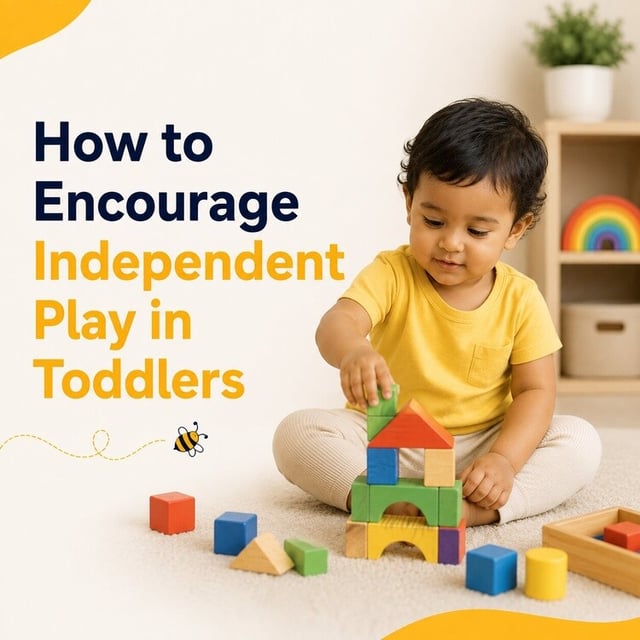
Independent play is a buildable skill, not a temperament lottery — and it's genuinely valuable for both toddler development and parent sanity. Here's how to grow it from ninety seconds to half an hour.
The toddler who plays alone contentedly while a parent cooks or works isn't a unicorn — independent play is trainable, growing from moments to stretches with the right setup. And it's not a parenting convenience dressed up as development: self-directed play genuinely builds concentration, creativity, and self-sufficiency.
Why it matters beyond the free half-hour
In self-directed play, a toddler makes every decision — what to play, how, what happens next — the purest available exercise for attention, planning, and imagination. Constantly entertained children outsource this; independently playing children build it. The parent's free stretch is the bonus, not the point (though it is a very good bonus).
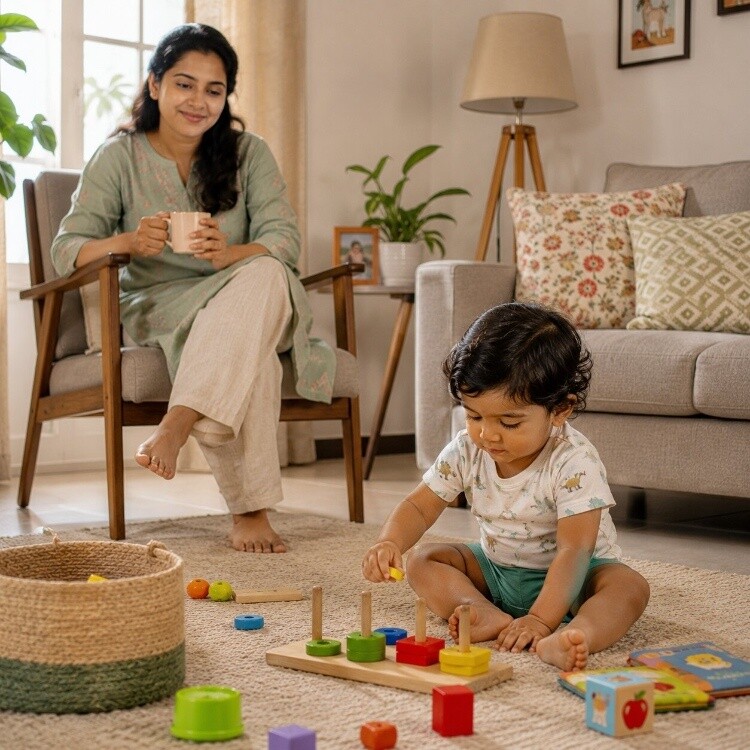
How to build it, step by step
Start with connection, not departure — a tank filled with ten minutes of full engaged attention separates far more willingly than one running on empty. Play together first; step back second.
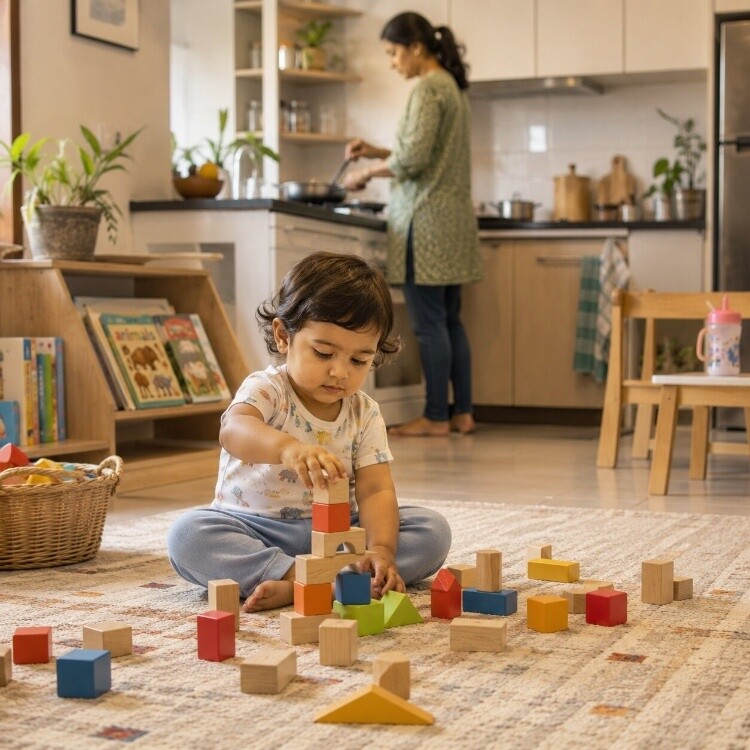
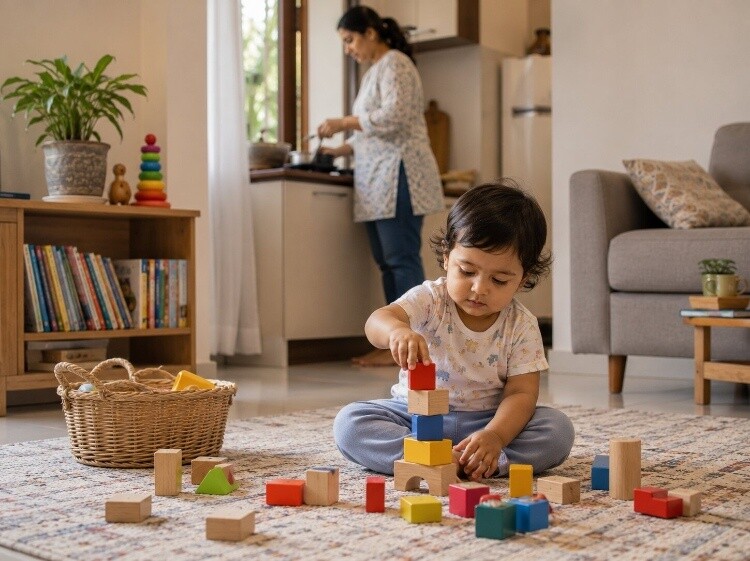
Step back within sight — the early stage isn't leaving the room; it's sitting nearby doing something else. Presence without participation is the bridge.
Resist re-entry — the toddler absorbed in stacking doesn't need commentary, praise, or improvement suggestions; every well-meant interruption resets the concentration you're trying to grow.
Curate the environment — a few open-ended options visible and reachable (blocks, the pretend-kitchen shelf, animals, books) beats a toy avalanche; abundance fragments attention.
Use the rotation — familiar toys returning after a resting week play like new; novelty on a budget.
Accept boredom's job — the whiny "nothing to do" gap before self-directed play begins is the runway, not a problem requiring adult rescue; ride it out and play usually ignites.
Grow the stretch gradually — ninety seconds this month, five minutes next, fifteen after that. Expecting a half-hour immediately produces failure and abandonment of the whole project.
Timing and rhythm
Independent play has prime hours — typically post-breakfast and post-nap, when rest and food are onboard. Attempting it against hunger, tiredness, or a day of separation (straight after daycare pickup, when connection hunger peaks) fights biology. Anchoring a daily independent-play window to the same slot builds it into the toddler's expected rhythm.
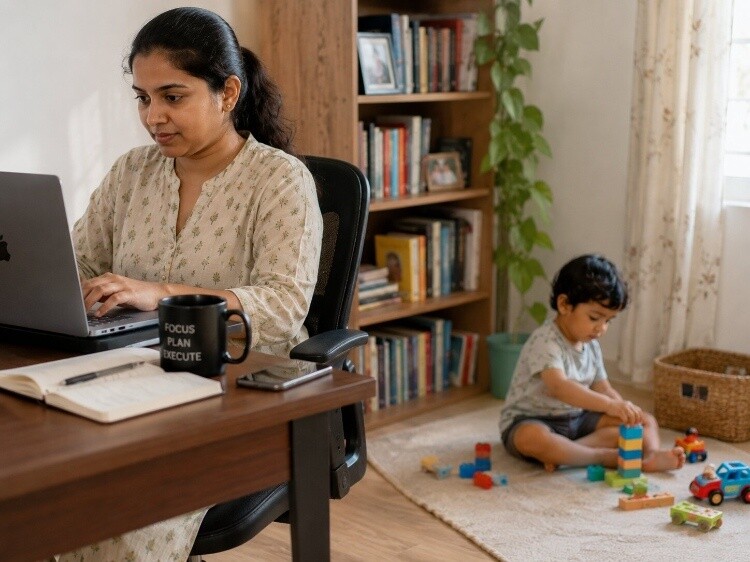
What realistic looks like
At two: five to fifteen minutes of genuinely absorbed solo play, built gradually, is excellent. Some temperaments run longer, some shorter — the direction of growth matters more than the number. Parents working from home deserve honesty here: independent play buys focused stretches, not childcare; the toddler will still surface, and the setup that works pairs the play window with the parent's least-interruptible task, not a critical call.
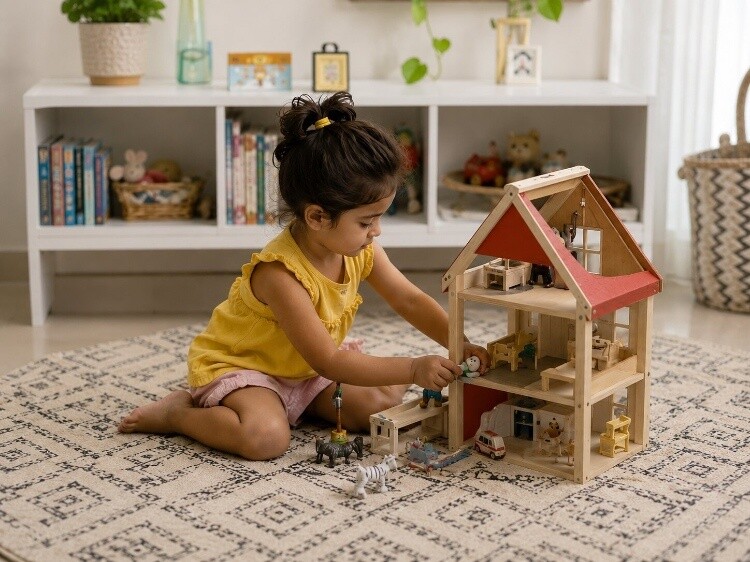
The screen distinction
A toddler watching a screen is occupied; a toddler deep in pretend play is developing. Both produce parental free minutes, only one builds attention and imagination — which is why growing independent play, effortful as it is, pays compound interest that the easier option never does.
When solo play seems genuinely absent
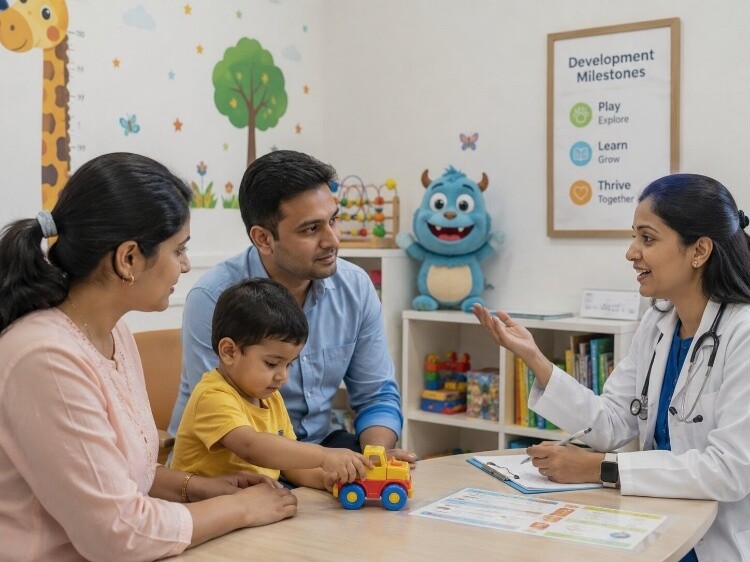
Most toddlers build independent play with consistent setup; if a child seems unable to engage with any self-directed play, needs constant adult direction, or this sits alongside other social-communication differences, it's worth raising at a paediatric visit — usually it's temperament and habit, occasionally it's a flag worth checking early.