
 Summer Camp
 Reading Writing
 Book Club
 Calligraphy
 Creative Writing
 English Speaking
 Handwriting
 Library
 Phonics
 Story Telling
 Art and Craft
 Clay Moulding
 Drawing
 Painting
 Pottery
 Sketching
 Drama Theatre
 Personality Development
 Public Speaking
 Languages
 Arabic
 Chinese
 French
 German
 Hindi
Hindi Italian
 Japanese
 Korean
 Persian
 Portuguese
 Russian
 Spanish
 Turkish
 Uzbek
Uzbek Sports and Fitness
 Aerobics
 Athletics
 Badminton
 Basket Ball
 Chess
Chess Cricket
 Football
 Golf
Golf Gymnastics
 Hulahoop
 Karate
 Martial Arts
 Pickleball
 Rugby
Rugby Skating
 Swimming
 Taekwondo
 Tennis
 Volleyball
 Yoga
Yoga Zumba
Zumba Tuition Classes
 Accounts
 Biology
 Business Studies
 CBSE
CBSE Chemistry
 Commerce
 Economics
 Homework Classes
 IB Board
 IGCSE
IGCSE Mathematics
 Physics
 Psychology
 Science
 Social Studies
 Vedic Maths
 Dance and Music
 Ballet
 Bhangra
 Bharatnatyam
 Bollywood Dance
 Casio
Casio Dandiya and Garba
 Drums
Drums Flute
Flute Guitar
 Harmonium
 Hip Hop
 Jazz
Jazz Kathak
 Keyboard
 Piano
Piano Salsa
Salsa Shlokas
 Sitar
Sitar Tabla
Tabla Ukulele
 Violin
 Vocal
Vocal Play School
 STEM
STEM
 Abacus
 App Development
 Artificial intelligence
 Basic Computer Courses
 Canva
Canva Coding
 Graphic Design
 Lego
Lego Python
 Robotics
 Rubiks Cube
 Scrabble
 Scratch
 Website Development
 Winter Camp
 Workshops
 Diwali Workshop
 Easter
 Ganesh Mahotsav
 Guru Nanak Jayanti Workshop
 Holi
Holi Independence day workshop
 Janmashtami Workshop
 Mothers day
 Navratri Workshops
 Raksha Bandhan workshop
 Ramayana Workshop
 Spring Camp
 Valentines Day Workshops
 Festive
 Daycare
 Cooking and Food
 Spring Camp
 Contests and Competitions
 Special abled
 Republic Day Workshops
 Mela
Mela
 Mela
Mela Cognitive Development
 Mother-Toddler Program
-Jul-03-2026-06-59-25-1926-AM.webp?width=30&height=30&name=Smart_20Skills_20(2)-Jul-03-2026-06-59-25-1926-AM.webp) Smart Skills
Smart Skills
 Financial Literacy
 Mental Wellbeing
 Meditation
 Reiki
Reiki




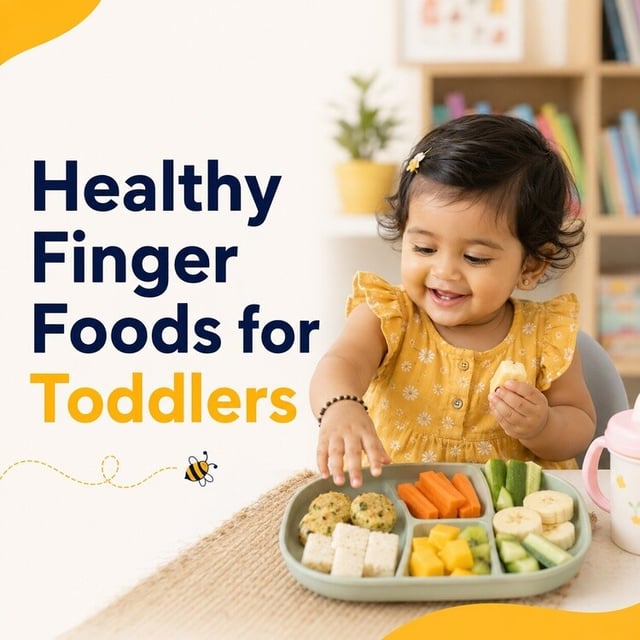
Finger foods build self-feeding skills, fine motor control, and healthy food relationships simultaneously. Indian home cooking offers abundant toddler-appropriate options — here's a practical list with safety guidelines.
Somewhere between 9 and 15 months, most toddlers begin insisting on feeding themselves — a messy, slow, gloriously important developmental push toward independence that Indian home kitchens are exceptionally well-equipped to support.
Why self-feeding matters beyond nutrition
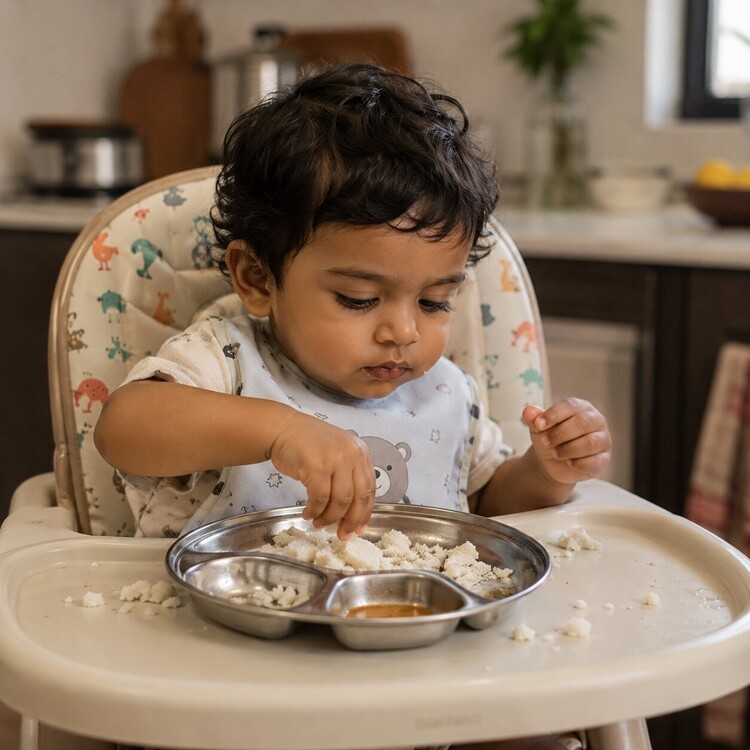
Every self-fed bite practices the pincer grasp, hand-eye coordination, and self-regulation — a toddler who controls their own eating pace learns fullness cues that spoon-feeding can override. The mess is the tuition fee.
Indian kitchen finger foods that work
Soft roti or paratha strips — the daily staple, torn into grippable pieces; ghee-soft versions work best.
Idli pieces — soft, mild, and perfectly sized when quartered; among the most toddler-friendly foods in any cuisine.
Steamed vegetable pieces — soft-steamed carrot, beans, lauki, and pumpkin cubes.
Paneer cubes — soft protein that holds its shape for gripping.
Banana, chikoo, mango, papaya — soft fruits in graspable pieces; slightly firm banana grips better than fully ripe.
Cheela strips — besan or moong dal cheela cut into strips; protein-rich and easy to hold.
Soft-cooked rice pressed into small balls — slightly sticky rice holds together for self-feeding practice.
Dhokla pieces — soft, spongy, and naturally grippable.
Well-cooked pasta shapes — spirals and tubes offer grip practice with a food most toddlers accept.
Scrambled egg pieces — soft protein clusters, if eggs are part of the family diet.
Safety rules that aren't optional
Always seated, always supervised. No whole grapes, whole nuts, popcorn, hard raw vegetables, or anything round and firm — these are the classic choking foods; grapes and similar items get quartered lengthwise. No honey before age one. Salt kept minimal — toddler kidneys aren't ready for adult-level Indian seasoning, so pulling the toddler's portion before final salting works well.
Managing the family food environment
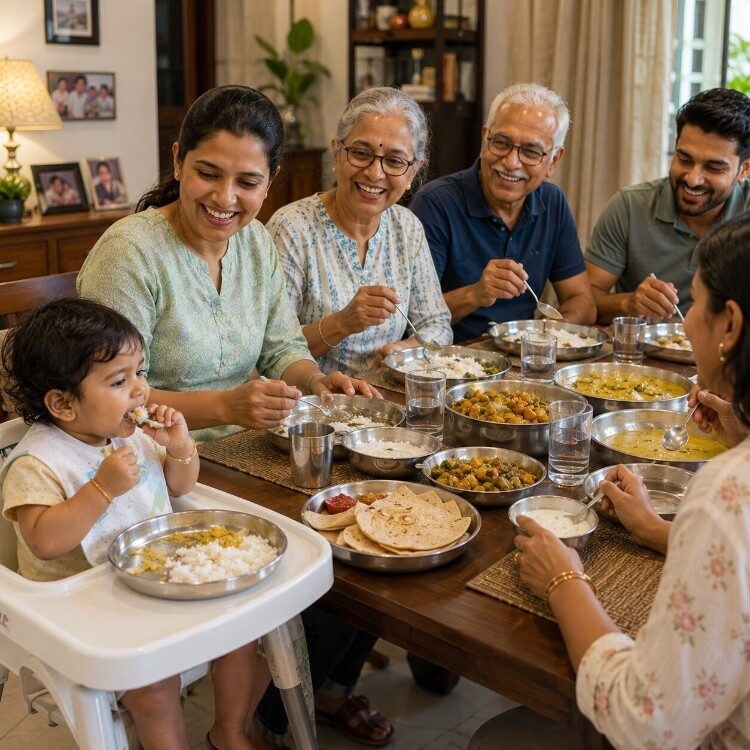
Toddlers in Indian joint families eat surrounded by opinions. The two worth defending: letting the child self-feed even though dadi could spoon-feed faster and cleaner, and tolerating the mess as developmental rather than disciplinary. A plastic sheet under the high chair resolves most practical objections.
When rejection is just the day's weather
Toddler appetite varies wildly day to day, and rejecting a food ten times before accepting it is documented, normal behaviour. The job is offering variety without pressure; their job is deciding what and how much. That division of labour, held calmly, prevents most feeding battles before they start.