
 Summer Camp
 Reading Writing
 Book Club
 Calligraphy
 Creative Writing
 English Speaking
 Handwriting
 Library
 Phonics
 Story Telling
 Art and Craft
 Clay Moulding
 Drawing
 Painting
 Pottery
 Sketching
 Drama Theatre
 Personality Development
 Public Speaking
 Languages
 Arabic
 Chinese
 French
 German
 Hindi
Hindi Italian
 Japanese
 Korean
 Persian
 Portuguese
 Russian
 Spanish
 Turkish
 Uzbek
Uzbek Sports and Fitness
 Aerobics
 Athletics
 Badminton
 Basket Ball
 Chess
Chess Cricket
 Football
 Golf
Golf Gymnastics
 Hulahoop
 Karate
 Martial Arts
 Pickleball
 Rugby
Rugby Skating
 Swimming
 Taekwondo
 Tennis
 Volleyball
 Yoga
Yoga Zumba
Zumba Tuition Classes
 Accounts
 Biology
 Business Studies
 CBSE
CBSE Chemistry
 Commerce
 Economics
 Homework Classes
 IB Board
 IGCSE
IGCSE Mathematics
 Physics
 Psychology
 Science
 Social Studies
 Vedic Maths
 Dance and Music
 Ballet
 Bhangra
 Bharatnatyam
 Bollywood Dance
 Casio
Casio Dandiya and Garba
 Drums
Drums Flute
Flute Guitar
 Harmonium
 Hip Hop
 Jazz
Jazz Kathak
 Keyboard
 Piano
Piano Salsa
Salsa Shlokas
 Sitar
Sitar Tabla
Tabla Ukulele
 Violin
 Vocal
Vocal Play School
 STEM
STEM
 Abacus
 App Development
 Artificial intelligence
 Basic Computer Courses
 Canva
Canva Coding
 Graphic Design
 Lego
Lego Python
 Robotics
 Rubiks Cube
 Scrabble
 Scratch
 Website Development
 Winter Camp
 Workshops
 Diwali Workshop
 Easter
 Ganesh Mahotsav
 Guru Nanak Jayanti Workshop
 Holi
Holi Independence day workshop
 Janmashtami Workshop
 Mothers day
 Navratri Workshops
 Raksha Bandhan workshop
 Ramayana Workshop
 Spring Camp
 Valentines Day Workshops
 Festive
 Daycare
 Cooking and Food
 Spring Camp
 Contests and Competitions
 Special abled
 Republic Day Workshops
 Mela
Mela
 Mela
Mela Cognitive Development
 Mother-Toddler Program
-Jul-03-2026-06-59-25-1926-AM.webp?width=30&height=30&name=Smart_20Skills_20(2)-Jul-03-2026-06-59-25-1926-AM.webp) Smart Skills
Smart Skills
 Financial Literacy
 Mental Wellbeing
 Meditation
 Reiki
Reiki




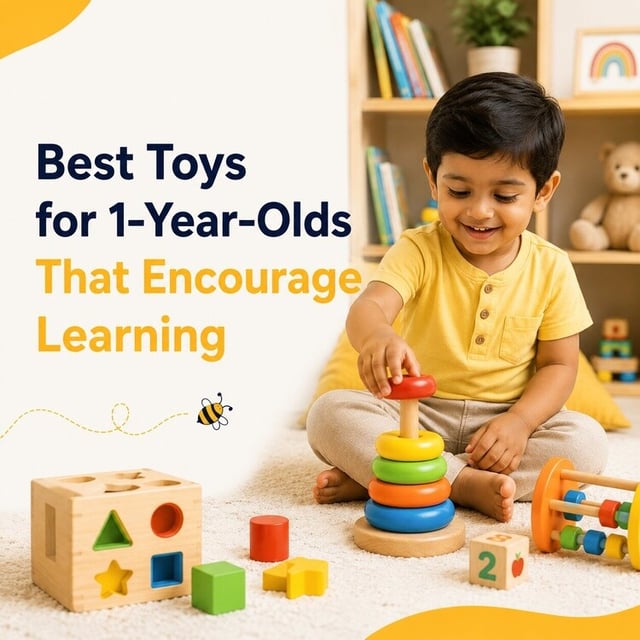
The best toys for one-year-olds are simple, open-ended, and durable — and several of the highest-value options cost very little. Here's what genuinely supports learning at this age, and what the toy industry oversells.
Toy shopping for a one-year-old is a masterclass in marketing pressure — everything claims to be "educational," "brain-boosting," or "Montessori-inspired." The genuine science of play at this age points somewhere much simpler.
What makes a toy genuinely good at this age
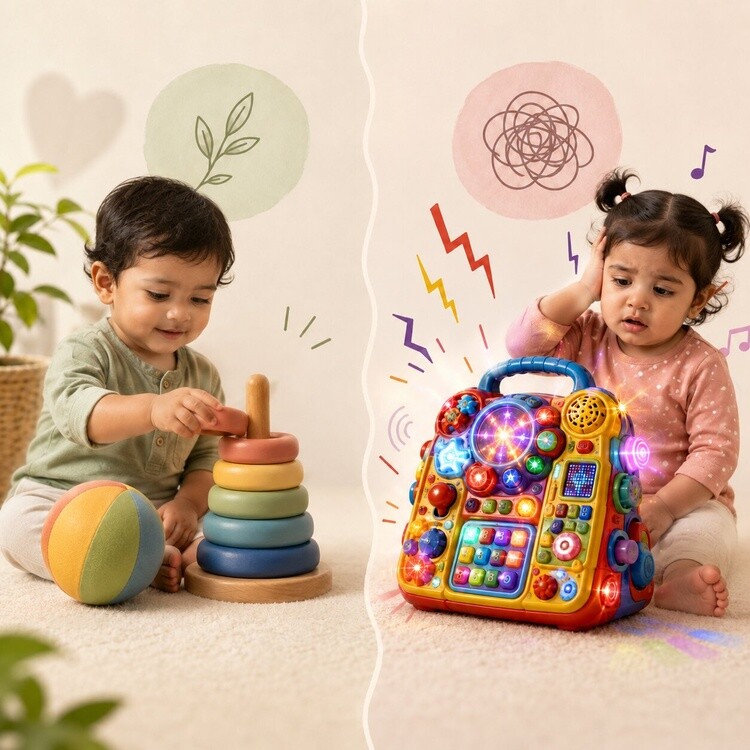
The 90/10 rule: a good toy is 90% child and 10% toy. Simple objects that respond to what the child does (stacking, banging, filling, dumping) beat elaborate toys that perform while the child watches. If the toy does all the singing, flashing, and moving, the child's brain is doing less, not more.
Genuinely worthwhile toy categories
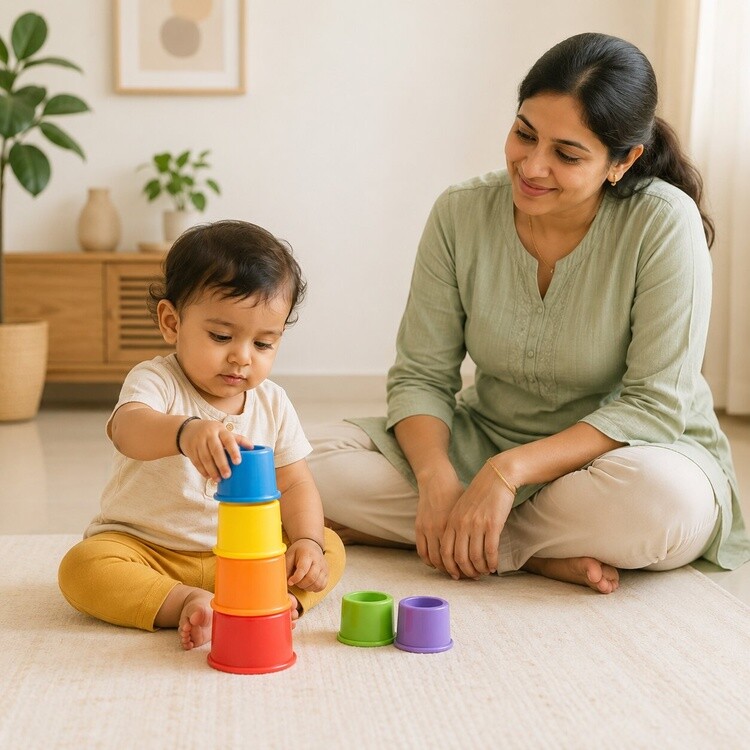
Stacking and nesting toys — stacking cups or rings build spatial reasoning and motor control, and survive being thrown repeatedly.
Shape sorters — a classic for genuine reason; early problem-solving in its purest form.
Push toys and walkers (the push-along kind, not seated wheeled walkers) — support new walkers safely; paediatricians consistently recommend against seated wheeled walkers.
Simple vehicles with wheels — anything that rolls invites pushing, chasing, and cause-and-effect exploration.
Soft balls in a few sizes — rolling, throwing, and chasing; possibly the highest play-value-per-rupee item available.
Board books — toys in their own right at this age; sturdy pages for independent handling.
Musical instruments — simple shakers, a small drum — cause-and-effect plus rhythm, and Indian households often have suitable substitutes already (a dholak someone's cousin left behind works fine).
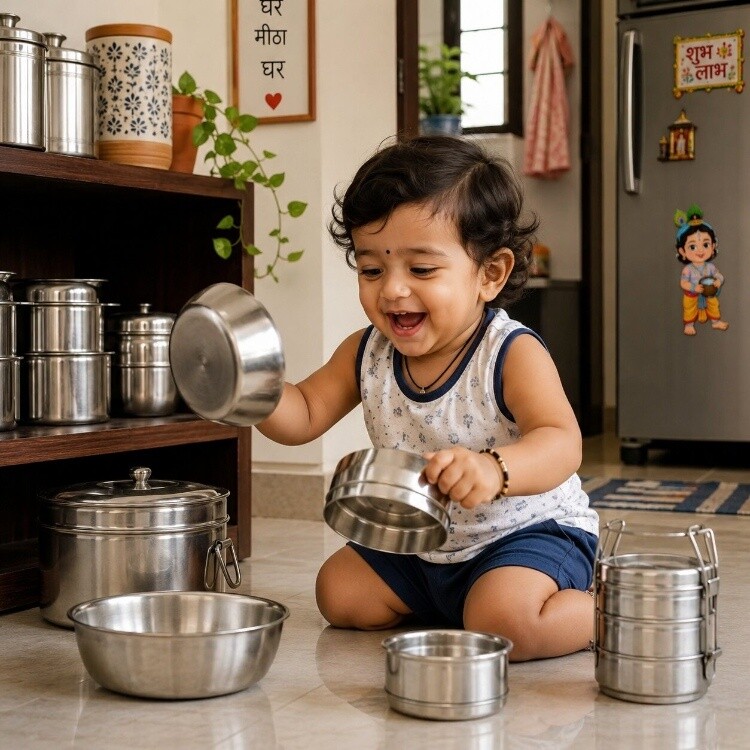
Household items reborn — steel bowls, dabbas with lids, wooden spoons, empty (cleaned) containers. Genuinely equal in developmental value to most purchased toys.
What the toy industry oversells for this age
Electronic "learning" toys with letters and numbers — a one-year-old pressing a button that recites "A!" is learning button-pressing, not letters. Screen-adjacent toys and tablets marketed for babies. Anything promising academic acceleration — no evidence supports academic toys providing lasting advantage at this age, and the claim itself misunderstands how one-year-olds learn.
Buying less, rotating more
Toddlers engage more deeply with fewer toys available at once. Keeping most toys stored and rotating a small set weekly makes "old" toys repeatedly novel — cheaper and more effective than continuous buying. Grandparent gifting enthusiasm (a loving constant in most Indian families) can be gently channelled toward books and quality basics rather than the loudest plastic option in the shop.
A quality-over-quantity note for Indian shoppers
Well-made wooden and quality plastic basics from reputable brands cost more upfront but survive multiple children, cousin hand-me-downs, and years of throwing. The market's cheapest options often shed small parts — a genuine hazard at the mouthing age.