
 Summer Camp
 Reading Writing
 Book Club
 Calligraphy
 Creative Writing
 English Speaking
 Handwriting
 Library
 Phonics
 Story Telling
 Art and Craft
 Clay Moulding
 Drawing
 Painting
 Pottery
 Sketching
 Drama Theatre
 Personality Development
 Public Speaking
 Languages
 Arabic
 Chinese
 French
 German
 Hindi
Hindi Italian
 Japanese
 Korean
 Persian
 Portuguese
 Russian
 Spanish
 Turkish
 Uzbek
Uzbek Sports and Fitness
 Aerobics
 Athletics
 Badminton
 Basket Ball
 Chess
Chess Cricket
 Football
 Golf
Golf Gymnastics
 Hulahoop
 Karate
 Martial Arts
 Pickleball
 Rugby
Rugby Skating
 Swimming
 Taekwondo
 Tennis
 Volleyball
 Yoga
Yoga Zumba
Zumba Tuition Classes
 Accounts
 Biology
 Business Studies
 CBSE
CBSE Chemistry
 Commerce
 Economics
 Homework Classes
 IB Board
 IGCSE
IGCSE Mathematics
 Physics
 Psychology
 Science
 Social Studies
 Vedic Maths
 Dance and Music
 Ballet
 Bhangra
 Bharatnatyam
 Bollywood Dance
 Casio
Casio Dandiya and Garba
 Drums
Drums Flute
Flute Guitar
 Harmonium
 Hip Hop
 Jazz
Jazz Kathak
 Keyboard
 Piano
Piano Salsa
Salsa Shlokas
 Sitar
Sitar Tabla
Tabla Ukulele
 Violin
 Vocal
Vocal Play School
 STEM
STEM
 Abacus
 App Development
 Artificial intelligence
 Basic Computer Courses
 Canva
Canva Coding
 Graphic Design
 Lego
Lego Python
 Robotics
 Rubiks Cube
 Scrabble
 Scratch
 Website Development
 Winter Camp
 Workshops
 Diwali Workshop
 Easter
 Ganesh Mahotsav
 Guru Nanak Jayanti Workshop
 Holi
Holi Independence day workshop
 Janmashtami Workshop
 Mothers day
 Navratri Workshops
 Raksha Bandhan workshop
 Ramayana Workshop
 Spring Camp
 Valentines Day Workshops
 Festive
 Daycare
 Cooking and Food
 Spring Camp
 Contests and Competitions
 Special abled
 Republic Day Workshops
 Mela
Mela
 Mela
Mela Cognitive Development
 Mother-Toddler Program
-Jul-03-2026-06-59-25-1926-AM.webp?width=30&height=30&name=Smart_20Skills_20(2)-Jul-03-2026-06-59-25-1926-AM.webp) Smart Skills
Smart Skills
 Financial Literacy
 Mental Wellbeing
 Meditation
 Reiki
Reiki





Two-year-olds graduate from board-book handling to genuine story engagement — simple plots, repetition, and characters they recognise. Here's what works now, and how reading together evolves.
Somewhere in the third year, books stop being objects and start being stories. A two-year-old follows simple plots, anticipates familiar pages, protests skipped words, and demands the favourite again — reading has become real.
What two-year-olds want from books now
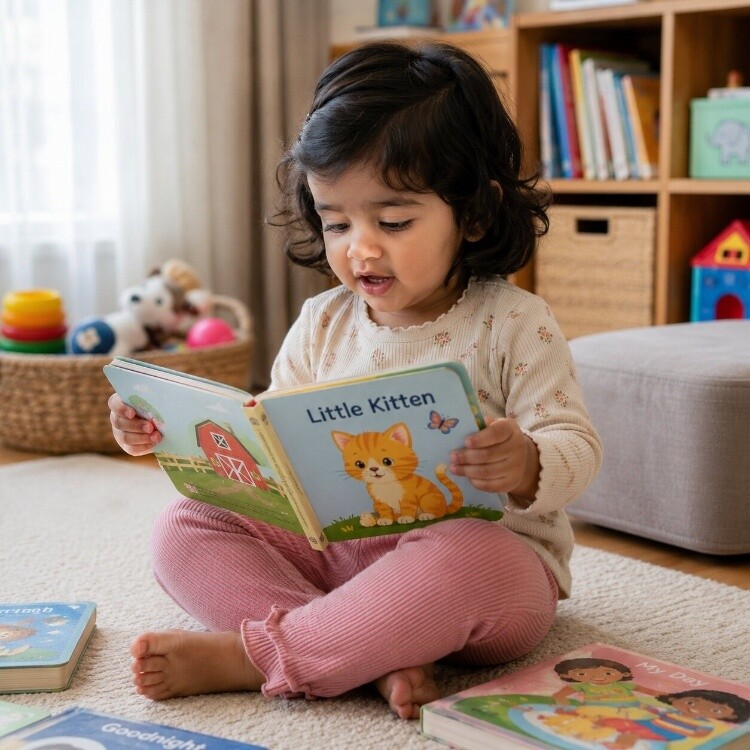
Simple, linear stories — one clear thread, no subplots. Repetitive and cumulative structures — refrains they can join, patterns they can predict. Familiar-world content — food, animals, vehicles, bedtime, park visits — their own life reflected and slightly stretched. Rhythm and rhyme — musical language holds them even when meaning wobbles. Bold, readable illustrations — pictures carrying the story visibly, since they're "reading" the pictures while you read the words.
Categories to stock
Repetition and refrain books — stories with a repeated line the child joins in on; participation is the engagement engine at two.
Daily-routine stories — books about eating, bathing, potty, and sleeping do double duty as routine-supporters.
Animal stories — the universal two-year-old passion, from realistic to fully anthropomorphic.
Vehicle books — for the truck-and-auto obsessed, meeting the obsession is meeting the reader.
Gentle-humour books — two-year-olds get simple visual jokes now, and a book that makes them laugh gets requested forever.
Indian-context picture books — Tulika, Karadi Tales, Pratham, and Eklavya publish stories where the food is roti, the streets have autos, and the grandmothers look like theirs — recognition that deepens engagement, alongside international classics.
How reading together evolves at this age
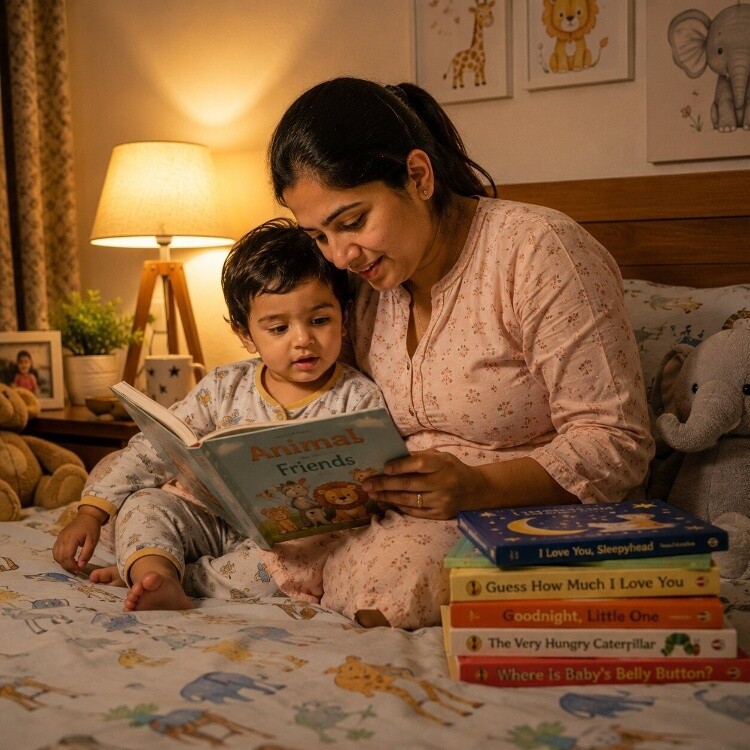
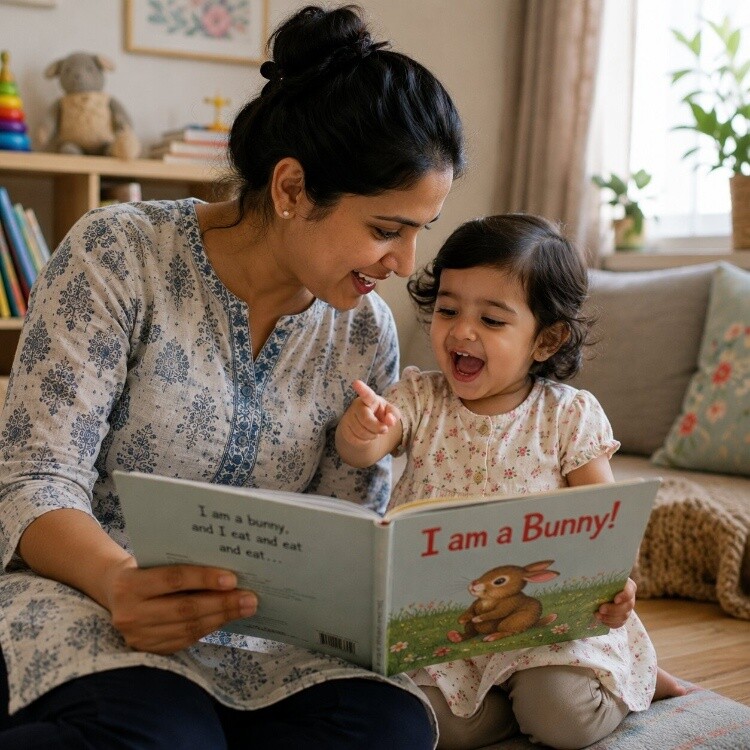
Dialogic reading begins: pausing to ask "What's that? What will happen?" turns reading into conversation. Letting them "read" familiar books back to you — reciting from memory — is genuine pre-literacy, not cheating. The favourite-book loop (the same story, weeks on end) continues serving language development; endure it warmly. And attention spans remain elastic — some sessions run twenty minutes, some ninety seconds, and both count.
Building the library affordably
Board-book prices accumulate; the mix that works: a modest owned collection of proven favourites, library memberships where available, the parent hand-me-down circuit (toddler books outlive their readers), and Pratham's famously low-cost titles for collection-building on a budget.
The bedtime anchor
If one reading ritual survives busy family life, bedtime reading earns the slot — the day's wind-down, the language input, and the association of books with warmth and closeness, compounding nightly for years. Fifteen minutes, most nights, is the entire program.