
 Summer Camp
 Reading Writing
 Book Club
 Calligraphy
 Creative Writing
 English Speaking
 Handwriting
 Library
 Phonics
 Story Telling
 Art and Craft
 Clay Moulding
 Drawing
 Painting
 Pottery
 Sketching
 Drama Theatre
 Personality Development
 Public Speaking
 Languages
 Arabic
 Chinese
 French
 German
 Hindi
Hindi Italian
 Japanese
 Korean
 Persian
 Portuguese
 Russian
 Spanish
 Turkish
 Uzbek
Uzbek Sports and Fitness
 Aerobics
 Athletics
 Badminton
 Basket Ball
 Chess
Chess Cricket
 Football
 Golf
Golf Gymnastics
 Hulahoop
 Karate
 Martial Arts
 Pickleball
 Rugby
Rugby Skating
 Swimming
 Taekwondo
 Tennis
 Volleyball
 Yoga
Yoga Zumba
Zumba Tuition Classes
 Accounts
 Biology
 Business Studies
 CBSE
CBSE Chemistry
 Commerce
 Economics
 Homework Classes
 IB Board
 IGCSE
IGCSE Mathematics
 Physics
 Psychology
 Science
 Social Studies
 Vedic Maths
 Dance and Music
 Ballet
 Bhangra
 Bharatnatyam
 Bollywood Dance
 Casio
Casio Dandiya and Garba
 Drums
Drums Flute
Flute Guitar
 Harmonium
 Hip Hop
 Jazz
Jazz Kathak
 Keyboard
 Piano
Piano Salsa
Salsa Shlokas
 Sitar
Sitar Tabla
Tabla Ukulele
 Violin
 Vocal
Vocal Play School
 STEM
STEM
 Abacus
 App Development
 Artificial intelligence
 Basic Computer Courses
 Canva
Canva Coding
 Graphic Design
 Lego
Lego Python
 Robotics
 Rubiks Cube
 Scrabble
 Scratch
 Website Development
 Winter Camp
 Workshops
 Diwali Workshop
 Easter
 Ganesh Mahotsav
 Guru Nanak Jayanti Workshop
 Holi
Holi Independence day workshop
 Janmashtami Workshop
 Mothers day
 Navratri Workshops
 Raksha Bandhan workshop
 Ramayana Workshop
 Spring Camp
 Valentines Day Workshops
 Festive
 Daycare
 Cooking and Food
 Spring Camp
 Contests and Competitions
 Special abled
 Republic Day Workshops
 Mela
Mela
 Mela
Mela Cognitive Development
 Mother-Toddler Program
-Jul-03-2026-06-59-25-1926-AM.webp?width=30&height=30&name=Smart_20Skills_20(2)-Jul-03-2026-06-59-25-1926-AM.webp) Smart Skills
Smart Skills
 Financial Literacy
 Mental Wellbeing
 Meditation
 Reiki
Reiki



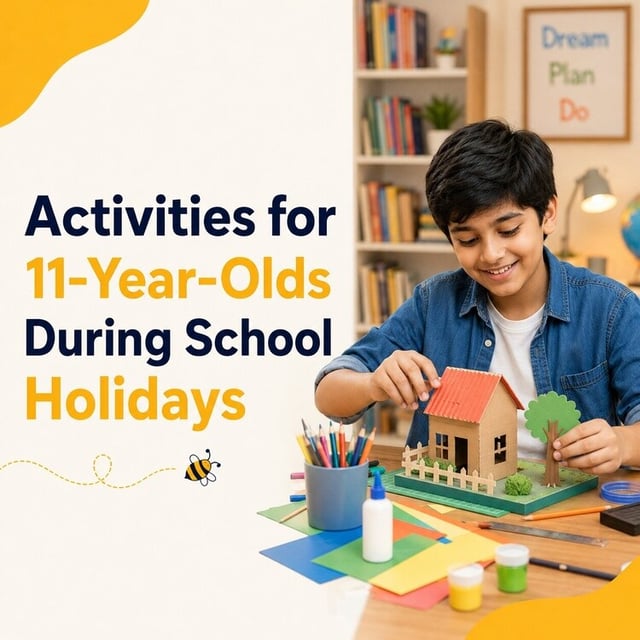
Long school holidays at eleven need structure without regimentation — a loose framework leaving room for both planned activities and genuine unstructured time, avoiding both chaos and over-programming.
Eleven-year-olds facing weeks of holiday need enough structure to avoid drift into all-day screens, and enough freedom to avoid holiday-as-second-school. The framework, not the schedule, matters.
Building the holiday framework
A loose weekly rhythm — one or two anchor commitments (a camp, a class, a family activity day) with the rest of the week open — prevents total drift without over-programming.
Morning structure, afternoon freedom — mornings with some purposeful activity tend to produce better-behaved, less-conflict-prone afternoons of free time than fully unstructured days.
Sibling and peer coordination — holiday activities planned with cousins or friends multiply engagement and reduce the "nothing to do" refrain significantly.
Specific holiday activity ideas
Skill deep-dives — using holiday time for genuine progress on an existing interest rather than starting something new casually.
Holiday camps — sports, art, drama, or STEM camps offering structured peer time and skill-building in concentrated bursts, widely available across Delhi NCR in summer and winter breaks.
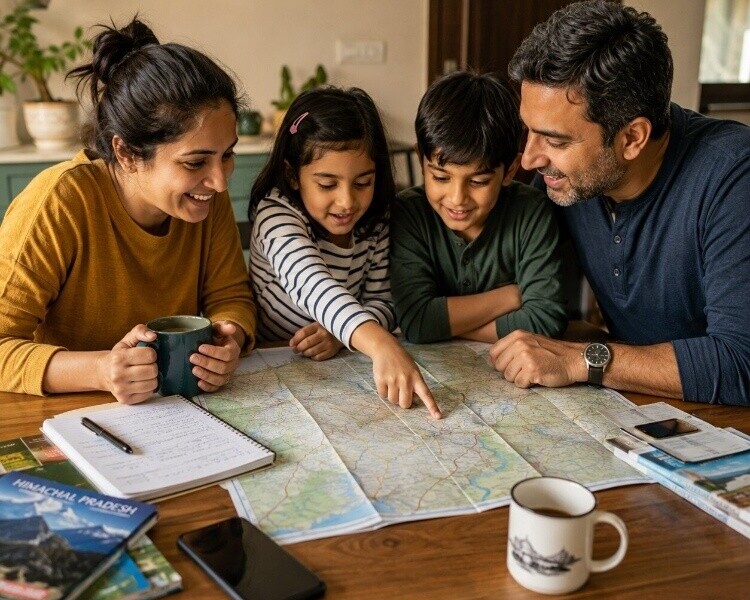
Travel and family trips — even short ones, offering novelty, navigation practice, and family connection outside routine.
Reading challenges — a self-set or family-set book count for the holiday, with genuine choice in titles.
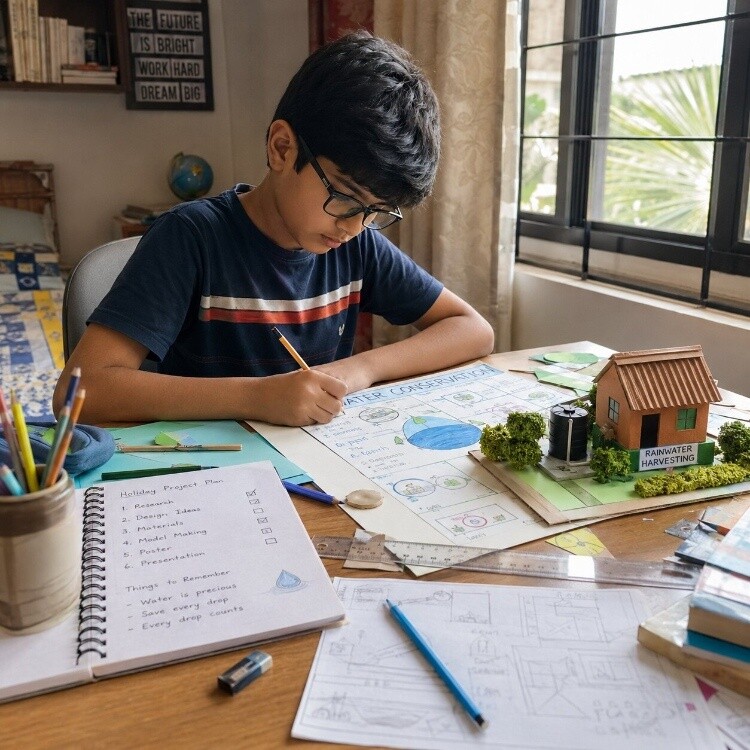
Independent projects — a self-directed project with real autonomy and a loose deadline.
Household contribution projects — a genuine responsibility taken on for the holiday duration.
Volunteering or community involvement — age-appropriate options building purpose alongside the holiday.
The screen-time holiday reality
Holidays reliably see screen time spike, and rigid limits often become the holiday's central battle. A more workable approach: negotiated boundaries co-created with the child, tied to other holiday activities happening rather than purely time-capped.
Avoiding the two failure modes
Over-programmed holidays produce exhaustion and resentment; under-programmed holidays produce boredom-turned-conflict and screen defaults. The framework above sits between both failure modes deliberately.