
 Summer Camp
 Reading Writing
 Book Club
 Calligraphy
 Creative Writing
 English Speaking
 Handwriting
 Library
 Phonics
 Story Telling
 Art and Craft
 Clay Moulding
 Drawing
 Painting
 Pottery
 Sketching
 Drama Theatre
 Personality Development
 Public Speaking
 Languages
 Arabic
 Chinese
 French
 German
 Hindi
Hindi Italian
 Japanese
 Korean
 Persian
 Portuguese
 Russian
 Spanish
 Turkish
 Uzbek
Uzbek Sports and Fitness
 Aerobics
 Athletics
 Badminton
 Basket Ball
 Chess
Chess Cricket
 Football
 Golf
Golf Gymnastics
 Hulahoop
 Karate
 Martial Arts
 Pickleball
 Rugby
Rugby Skating
 Swimming
 Taekwondo
 Tennis
 Volleyball
 Yoga
Yoga Zumba
Zumba Tuition Classes
 Accounts
 Biology
 Business Studies
 CBSE
CBSE Chemistry
 Commerce
 Economics
 Homework Classes
 IB Board
 IGCSE
IGCSE Mathematics
 Physics
 Psychology
 Science
 Social Studies
 Vedic Maths
 Dance and Music
 Ballet
 Bhangra
 Bharatnatyam
 Bollywood Dance
 Casio
Casio Dandiya and Garba
 Drums
Drums Flute
Flute Guitar
 Harmonium
 Hip Hop
 Jazz
Jazz Kathak
 Keyboard
 Piano
Piano Salsa
Salsa Shlokas
 Sitar
Sitar Tabla
Tabla Ukulele
 Violin
 Vocal
Vocal Play School
 STEM
STEM
 Abacus
 App Development
 Artificial intelligence
 Basic Computer Courses
 Canva
Canva Coding
 Graphic Design
 Lego
Lego Python
 Robotics
 Rubiks Cube
 Scrabble
 Scratch
 Website Development
 Winter Camp
 Workshops
 Diwali Workshop
 Easter
 Ganesh Mahotsav
 Guru Nanak Jayanti Workshop
 Holi
Holi Independence day workshop
 Janmashtami Workshop
 Mothers day
 Navratri Workshops
 Raksha Bandhan workshop
 Ramayana Workshop
 Spring Camp
 Valentines Day Workshops
 Festive
 Daycare
 Cooking and Food
 Spring Camp
 Contests and Competitions
 Special abled
 Republic Day Workshops
 Mela
Mela
 Mela
Mela Cognitive Development
 Mother-Toddler Program
-Jul-03-2026-06-59-25-1926-AM.webp?width=30&height=30&name=Smart_20Skills_20(2)-Jul-03-2026-06-59-25-1926-AM.webp) Smart Skills
Smart Skills
 Financial Literacy
 Mental Wellbeing
 Meditation
 Reiki
Reiki




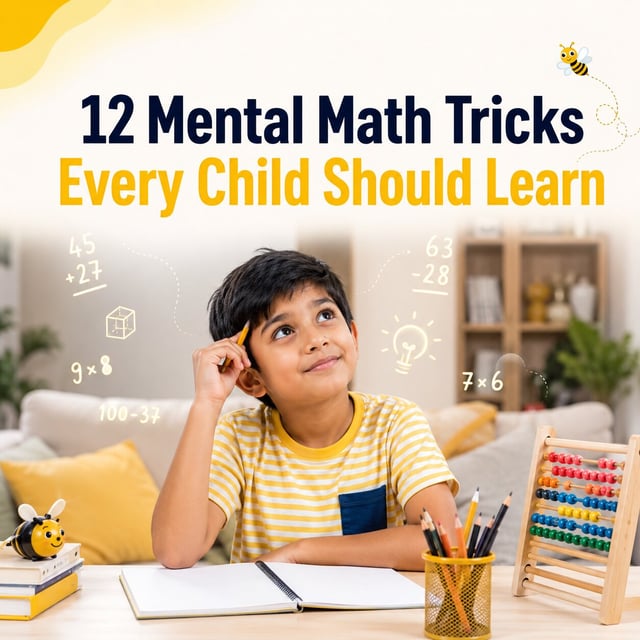
Mental math builds number confidence far beyond the specific tricks themselves — and several of these techniques connect naturally to Vedic maths concepts already familiar in Indian classrooms. These tricks work for everyday situations kids actually encounter, like shopping and sharing.
Mental math isn't about calculating faster than a calculator — it's about building genuine number sense, the kind that makes a child comfortable estimating a bill at a shop or splitting a snack fairly among friends without anxiety. These tricks are chosen for being immediately useful, not just clever party tricks.
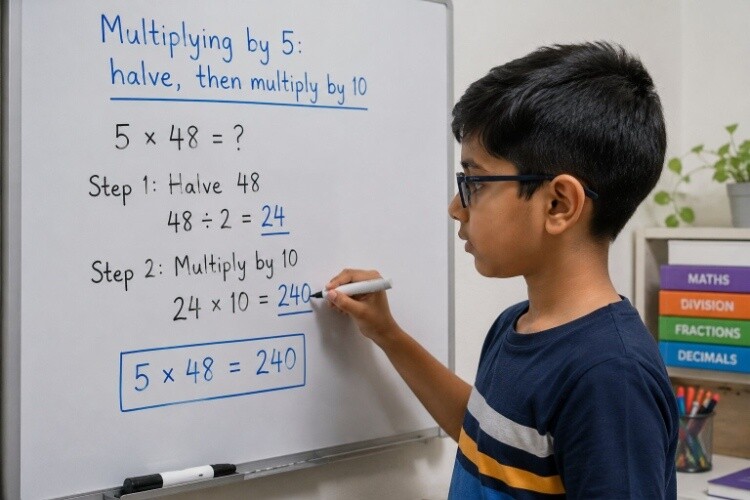
Multiplying by 5: halve, then multiply by 10
For 5 × 48, halve 48 to get 24, then multiply by 10 to get 240. Far easier than direct multiplication for most kids.
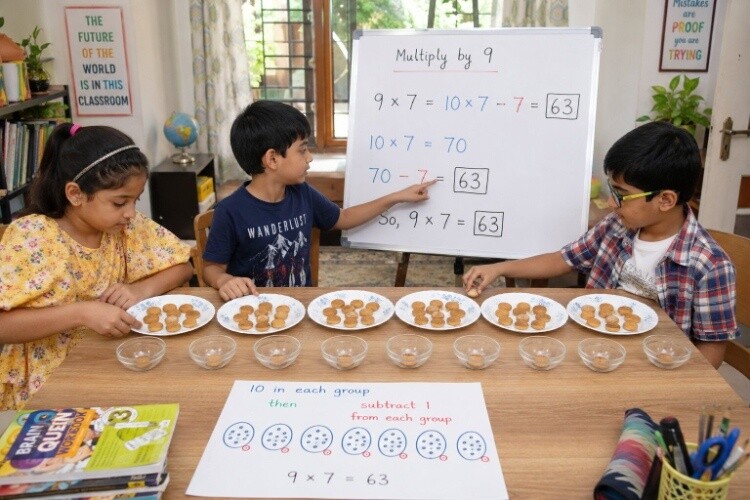
Multiplying by 9: multiply by 10, then subtract the number
For 9 × 7, calculate 10 × 7 = 70, then subtract 7 to get 63. Works reliably for any number.
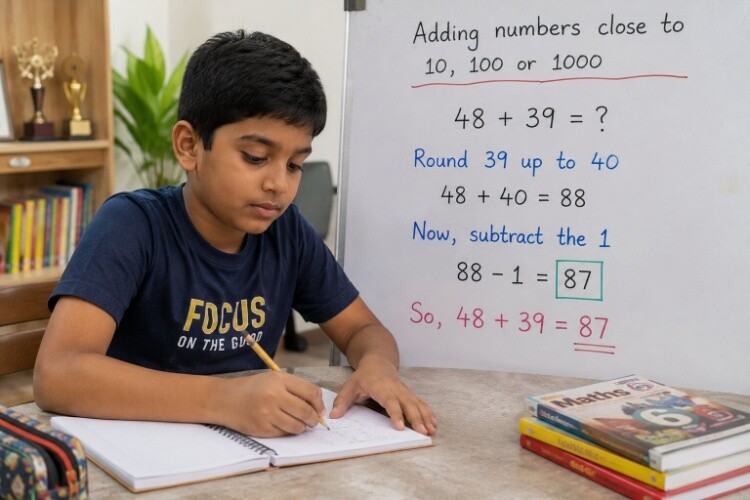
Adding numbers close to 10, 100, or 1000
For 48 + 39, round 39 up to 40 (48 + 40 = 88), then subtract the 1 you added (88 - 1 = 87). Rounding-and-adjusting is one of the most broadly useful mental math skills.
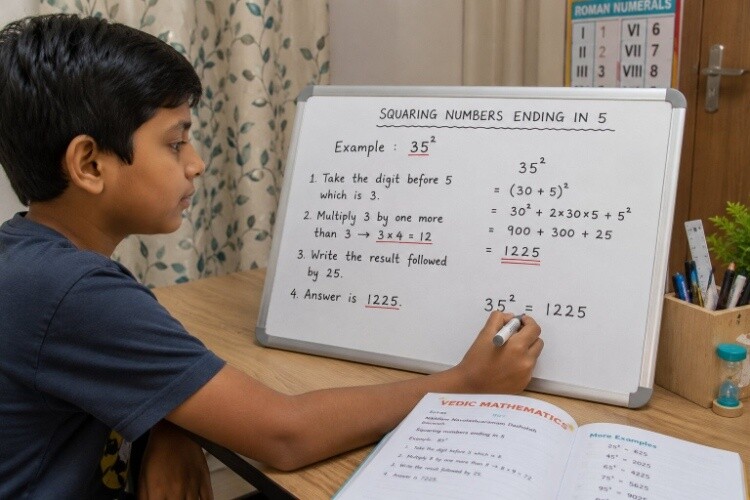
Squaring numbers ending in 5
For 35², multiply 3 × 4 (the digit before 5, times one more) to get 12, then append 25: answer is 1225. This connects directly to Vedic maths techniques many Indian schools already introduce.
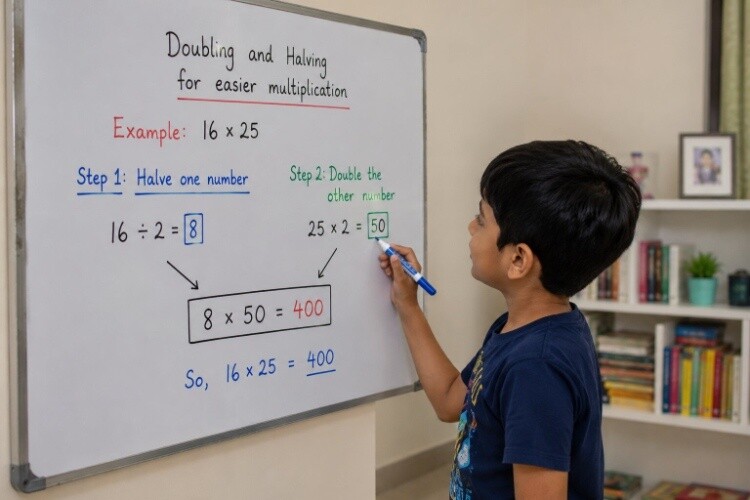
Doubling and halving for easier multiplication
For 16 × 25, halve 16 to 8 and double 25 to 50: 8 × 50 = 400. Restructuring the problem is often easier than solving it directly.
The "friends of 10" trick for quick addition
Recognising number pairs that make 10 (1+9, 2+8, 3+7) speeds up multi-number addition significantly, especially useful for adding shopping bills.
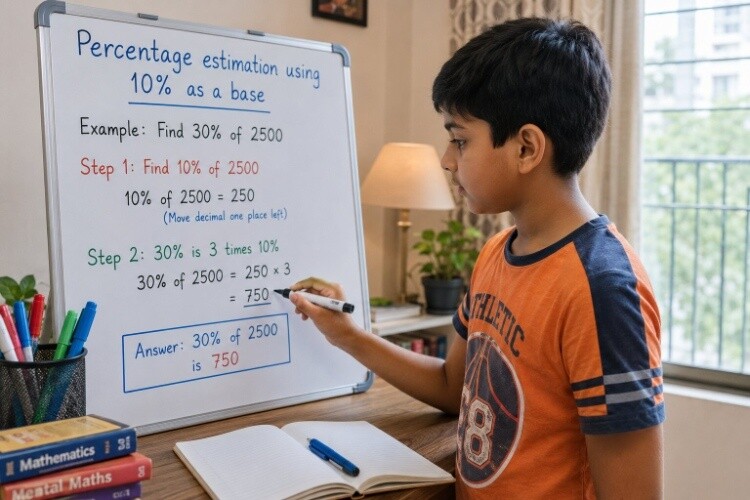
Percentage estimation using 10% as a base
To estimate 30% of a number, find 10% (move the decimal) and triple it. Genuinely useful for discount calculations while shopping — a real-world application kids notice immediately.
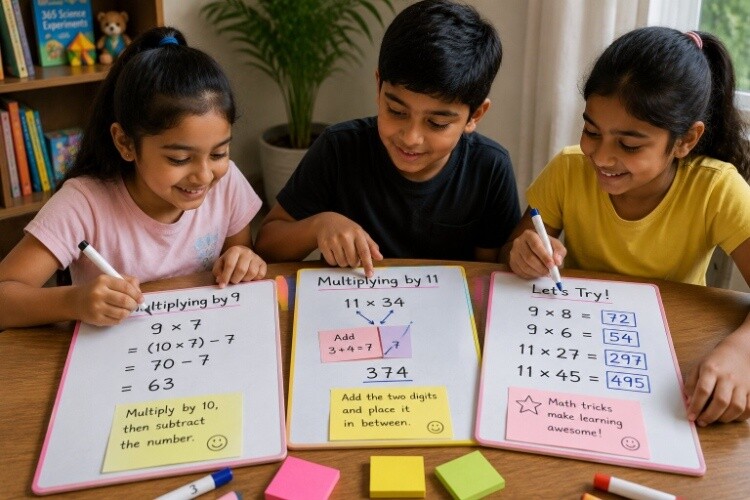
Multiplying two-digit numbers by 11
For 11 × 34, add the two digits (3+4=7) and place it between them: 374. A satisfying trick that builds enthusiasm for mental math generally.
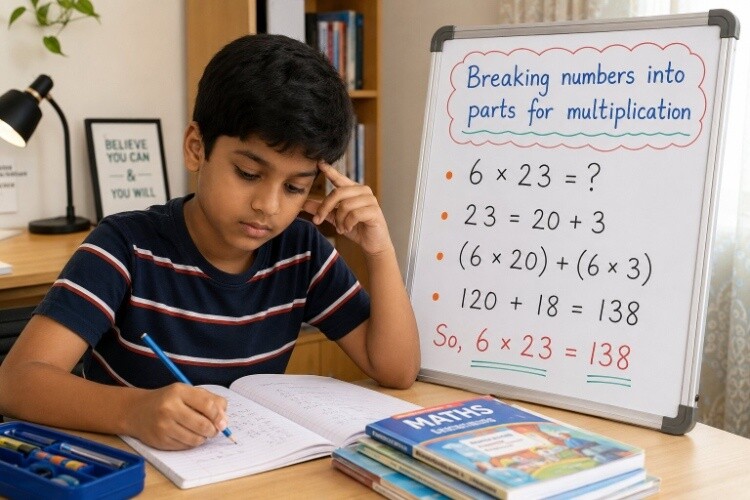
Breaking numbers into parts for multiplication
For 6 × 23, break 23 into 20 + 3: (6×20) + (6×3) = 120 + 18 = 138. This distributive thinking underlies most efficient mental math.
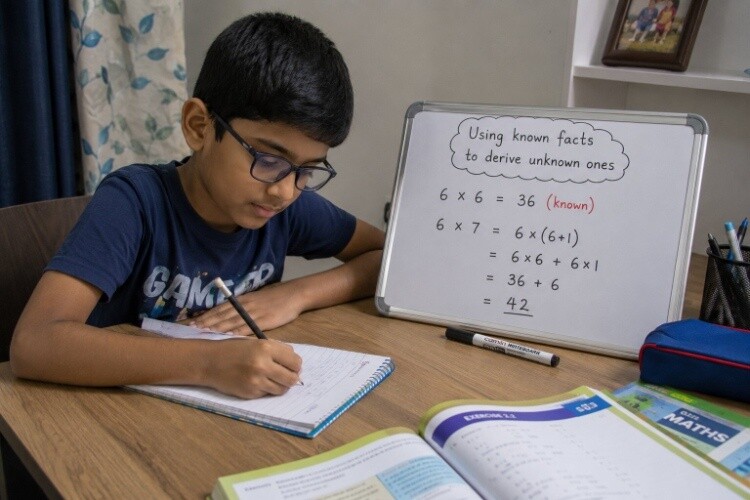
Using known facts to derive unknown ones
If a child knows 6 × 6 = 36, they can derive 6 × 7 by simply adding one more 6 (36 + 6 = 42), rather than recalculating from scratch.
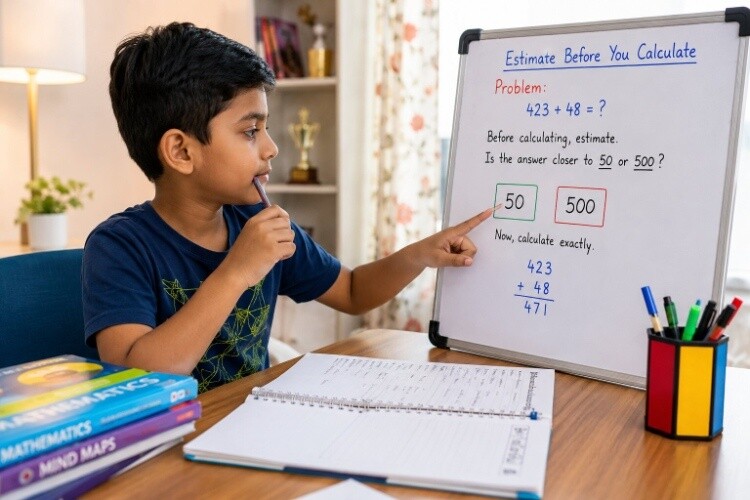
Estimating before calculating exactly
Teaching a child to first estimate an answer (is it closer to 50 or 500?) before calculating builds number sense and catches careless errors.
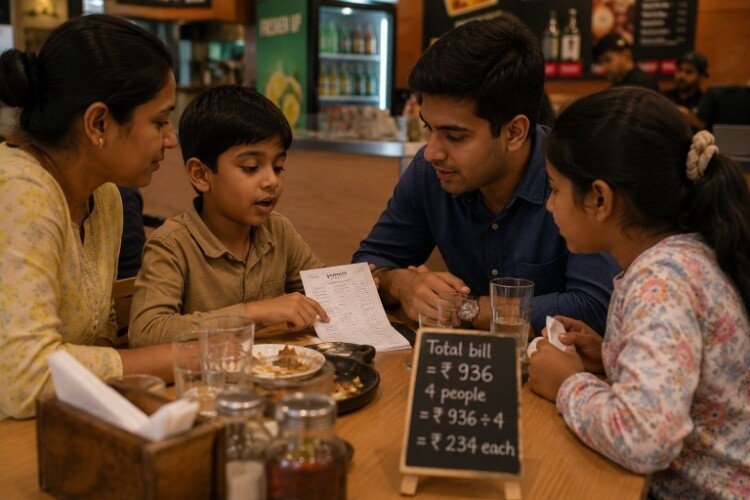
Splitting bills and sharing snacks as real practice
When dividing a bill at a family outing or splitting a packet of biscuits among cousins, involve your child in the actual calculation out loud — real stakes make mental math genuinely engaging.
Why this matters beyond exam scores
Children who develop strong mental math early tend to approach all math with more confidence, because numbers stop feeling abstract and start feeling manageable. This confidence often matters more long-term than any single technique.
Making practice a natural habit, not a drill
The techniques above work best woven into real moments — market trips, dividing sweets, calculating how many overs are left in a cricket match — rather than isolated worksheet drilling. A child who's comfortable estimating a vegetable vendor's bill has absorbed more genuine number sense than one who's memorised times tables under pressure.