
 Reading Writing
 Book Club
 Calligraphy
 Creative Writing
 English Speaking
 Handwriting
 Library
 Phonics
 Story Telling
 Art and Craft
 Clay Moulding
 Drawing
 Painting
 Pottery
 Sketching
 Drama Theatre
 Personality Development
 Public Speaking
 Languages
 Arabic
 Chinese
 French
 German
 Hindi
Hindi Italian
 Japanese
 Korean
 Persian
 Portuguese
 Russian
 Spanish
 Turkish
 Uzbek
Uzbek Sports and Fitness
 Aerobics
 Athletics
 Badminton
 Basket Ball
 Chess
Chess Cricket
 Football
 Golf
Golf Gymnastics
 Hulahoop
 Karate
 Martial Arts
 Pickleball
 Rugby
Rugby Skating
 Swimming
 Taekwondo
 Tennis
 Volleyball
 Yoga
Yoga Zumba
Zumba Tuition Classes
 Accounts
 Biology
 Business Studies
 CBSE
CBSE Chemistry
 Commerce
 Economics
 Homework Classes
 IB Board
 IGCSE
IGCSE Mathematics
 Physics
 Psychology
 Science
 Social Studies
 Vedic Maths
 Dance and Music
 Ballet
 Bhangra
 Bharatnatyam
 Bollywood Dance
 Casio
Casio Dandiya and Garba
 Drums
Drums Flute
Flute Guitar
 Harmonium
 Hip Hop
 Jazz
Jazz Kathak
 Keyboard
 Piano
Piano Salsa
Salsa Shlokas
 Sitar
Sitar Tabla
Tabla Ukulele
 Violin
 Vocal
Vocal Play School
 STEM
STEM
 Abacus
 App Development
 Artificial intelligence
 Basic Computer Courses
 Canva
Canva Coding
 Graphic Design
 Lego
Lego Python
 Robotics
 Rubiks Cube
 Scrabble
 Scratch
 Website Development
 Workshops
 Diwali Workshops
 Guru Nanak Jayanti Workshop
 Halloween
 Independence day workshop
 Navratri Workshops
 Raksha Bandhan workshop
 Ramayana Workshop
 Spring Camp
 Valentines Day Workshops
 Festive
 Daycare
 Cooking and Food
 Spring Camp
 Contests and Competitions
 Special abled
 Republic Day Workshops
 Mela
Mela
 Mela
Mela Cognitive Development
 Mother-Toddler Program
 Music
Music
 Dance
Dance
-Jul-03-2026-06-59-25-1926-AM.webp?width=30&height=30&name=Smart_20Skills_20(2)-Jul-03-2026-06-59-25-1926-AM.webp) Smart Skills
Smart Skills
 Financial Literacy
 Mental Wellbeing
 Meditation
 Reiki
Reiki




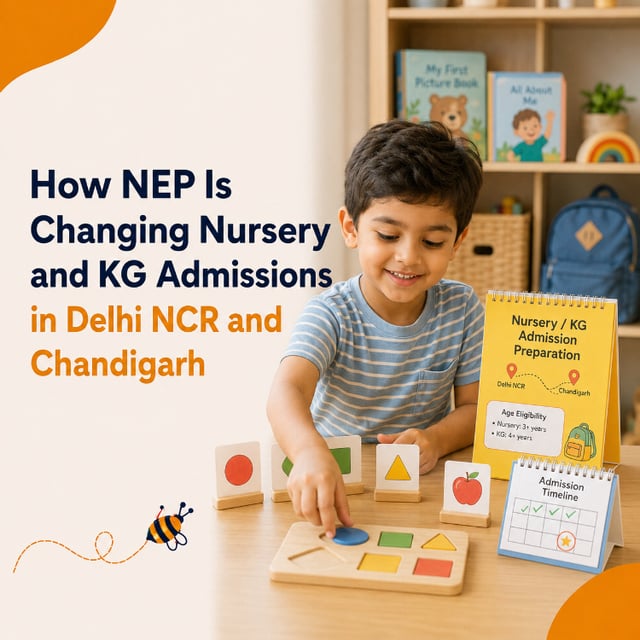
NEP's early childhood care and education (ECCE) provisions are gradually reshaping nursery and KG admissions — age criteria, curriculum expectations, and even which institutions count as "formal" pre-schooling. Here's the current picture for both cities.
Nursery and KG admissions have always been a source of significant Delhi NCR parental anxiety, and NEP's early childhood provisions are adding a genuine layer of change on top of an already complex process — worth untangling specifically for families currently navigating or approaching this stage.
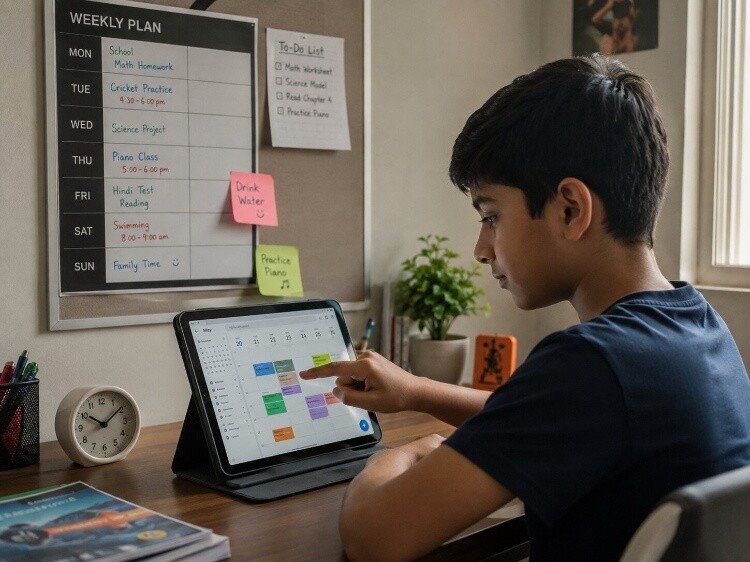
NEP's core early childhood position
NEP formally recognises Early Childhood Care and Education (ages 3-6, corresponding to the first part of the Foundational Stage) as integral to formal schooling for the first time at a national policy level — previously, pre-primary education existed in a somewhat unregulated space, with wide variation in quality, curriculum, and even basic oversight across private nurseries and preschools.
What's changing as a result
Increasing move toward standardised, play-based ECCE curriculum guidelines (NCERT has developed specific frameworks for this age group), growing emphasis on qualified early-years teacher training rather than assuming any teacher can effectively run a nursery classroom, and gradual integration of anganwadi-based early education with formal school pipelines in some contexts, though this is more relevant to government and rural contexts than typical urban Delhi NCR or Chandigarh private nursery admissions.
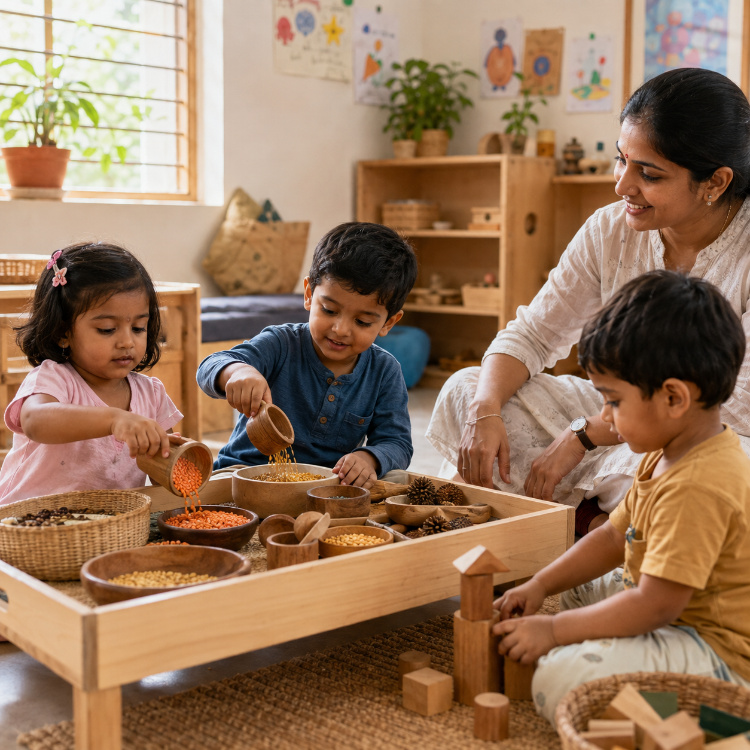
The Delhi NCR nursery admission reality, current specifics
Delhi's nursery admission process (particularly for private schools under the Directorate of Education's guidelines) involves point-based criteria, defined age cutoffs, and increasingly standardised timelines — worth checking the current academic year's specific Delhi DoE nursery admission guidelines directly, since criteria and calendar dates are revised regularly and vary between Delhi NCT proper and neighbouring Gurugram/Noida/Faridabad, which fall under different state administrations with their own rules.
The Chandigarh nursery admission reality, current specifics
Chandigarh's admission process, given its Union Territory administration, follows its own defined guidelines, generally simpler in structure than Delhi's often-criticised point system, but still worth verifying current-year specifics directly with target schools and the UT education department given periodic revisions.
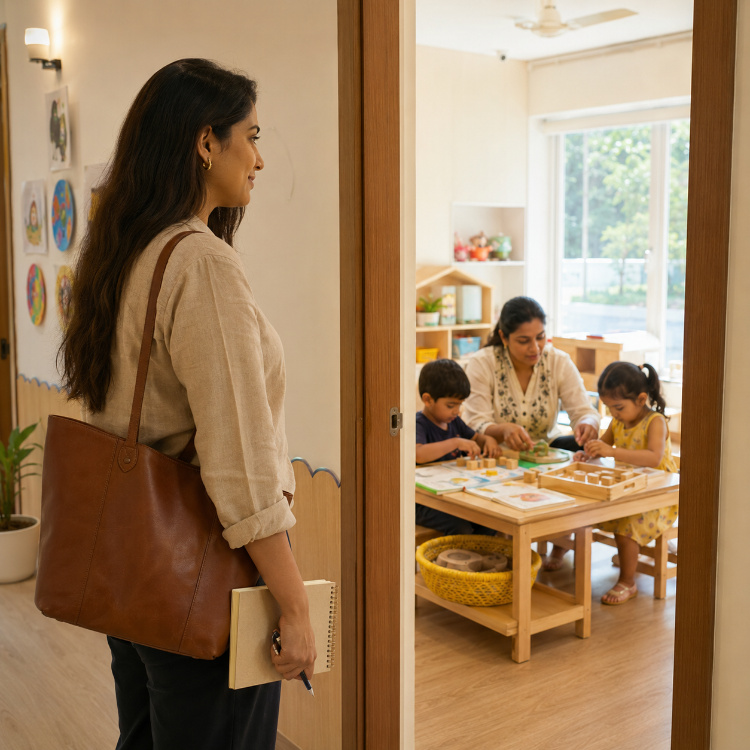
What NEP-aligned nursery education should genuinely look like, regardless of admission process specifics
Significant unstructured and semi-structured play, minimal to no formal academic instruction (writing worksheets, formal reading drills) at nursery/LKG level specifically, strong emphasis on social-emotional development and language exposure through natural interaction rather than instruction, and physical development through movement and outdoor time as a core, not supplementary, part of the day.
Red flags worth watching for during nursery visits
A nursery heavily marketing "advanced curriculum" or early formal academics (reading and writing instruction well before typical developmental readiness) is often working against, not with, current early-years developmental understanding and NEP's stated direction — genuinely well-aligned early years programs tend to look less "academically impressive" on a first tour and more genuinely play-rich, which can feel counterintuitive to parents anxious about early preparation but reflects better-supported developmental practice.

Practical navigation advice given the ongoing transition
Since implementation varies significantly by individual institution regardless of official guidelines, direct school visits and specific questions about daily schedule and pedagogy remain more useful than assuming any given nursery's marketing materials or NEP-aligned language reflects genuine classroom practice — the same verification principle that applies across most NEP-related claims covered throughout this series.