

 Summer Camp
 Reading Writing
 Book Club
 Calligraphy
 Creative Writing
 English Speaking
 Handwriting
 Library
 Phonics
 Story Telling
 Art and Craft
 Clay Moulding
 Drawing
 Painting
 Pottery
 Sketching
 Drama Theatre
 Personality Development
 Public Speaking
 Languages
 Arabic
 Chinese
 French
 German
 Hindi
Hindi Italian
 Japanese
 Korean
 Persian
 Portuguese
 Russian
 Spanish
 Turkish
 Uzbek
Uzbek Sports and Fitness
 Aerobics
 Athletics
 Badminton
 Basket Ball
 Chess
Chess Cricket
 Football
 Golf
Golf Gymnastics
 Hulahoop
 Karate
 Martial Arts
 Pickleball
 Rugby
Rugby Skating
 Swimming
 Taekwondo
 Tennis
 Volleyball
 Yoga
Yoga Zumba
Zumba Tuition Classes
 Accounts
 Biology
 Business Studies
 CBSE
CBSE Chemistry
 Commerce
 Economics
 Homework Classes
 IB Board
 IGCSE
IGCSE Mathematics
 Physics
 Psychology
 Science
 Social Studies
 Vedic Maths
 Dance and Music
 Ballet
 Bhangra
 Bharatnatyam
 Bollywood Dance
 Casio
Casio Dandiya and Garba
 Drums
Drums Flute
Flute Guitar
 Harmonium
 Hip Hop
 Jazz
Jazz Kathak
 Keyboard
 Piano
Piano Salsa
Salsa Shlokas
 Sitar
Sitar Tabla
Tabla Ukulele
 Violin
 Vocal
Vocal Play School
 STEM
STEM
 Abacus
 App Development
 Artificial intelligence
 Basic Computer Courses
 Canva
Canva Coding
 Graphic Design
 Lego
Lego Python
 Robotics
 Rubiks Cube
 Scrabble
 Scratch
 Website Development
 Winter Camp
 Workshops
 Diwali Workshop
 Easter
 Ganesh Mahotsav
 Guru Nanak Jayanti Workshop
 Holi
Holi Independence day workshop
 Janmashtami Workshop
 Mothers day
 Navratri Workshops
 Raksha Bandhan workshop
 Ramayana Workshop
 Spring Camp
 Valentines Day Workshops
 Festive
 Daycare
 Cooking and Food
 Spring Camp
 Contests and Competitions
 Special abled
 Republic Day Workshops
 Mela
Mela
 Mela
Mela Cognitive Development
 Mother-Toddler Program
-Jul-03-2026-06-59-25-1926-AM.webp?width=30&height=30&name=Smart_20Skills_20(2)-Jul-03-2026-06-59-25-1926-AM.webp) Smart Skills
Smart Skills
 Financial Literacy





Homework time can quickly become one of the most stressful parts of the day.
The child is tired after school. The parent is tired after managing work, home, meals, classes, and everything else. One small worksheet can suddenly turn into a full drama — “I’m hungry,” “I’m sleepy,” “My pencil fell,” “I don’t know this,” “I’ll do it later,” “Why do I have to do homework?”
And before you know it, homework has become less about learning and more about power struggle.
The good news is that homework resistance can be handled with routine, patience, and a little creativity. The goal is not to force the child to sit for hours. The goal is to make homework feel predictable, manageable, and less emotionally heavy.
Here are some practical things parents can try.
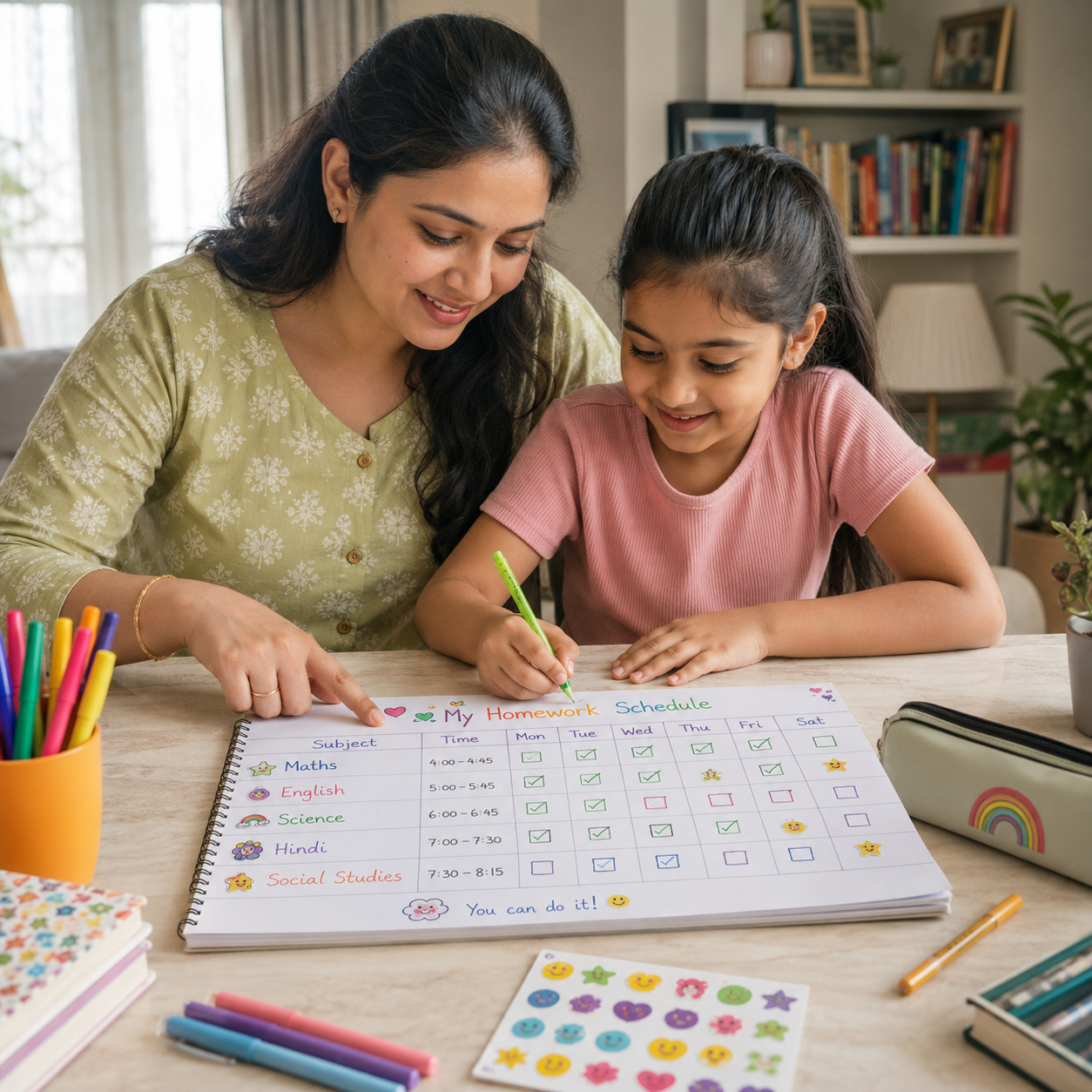
1. Make a written homework schedule
Children often resist homework more when it comes as a sudden announcement.
“Come on, sit now. Finish your homework.”
For a child, this can feel like their playtime has been attacked without warning. A written schedule helps reduce that resistance because the child knows what to expect.
Make a simple daily routine and put it somewhere visible — on the fridge, study table, or bedroom wall.
For example:
4:00 pm – Snack and rest
4:30 pm – Outdoor play / activity
6:00 pm – Homework time
6:45 pm – Break
7:00 pm – Reading / revision
7:30 pm – Free time
You can adjust this based on your child’s age, school load, and activities. The important thing is that homework should have a fixed place in the day.
When the schedule is written, it is no longer “Mumma suddenly said so.” It becomes “This is our routine.”
You can also let your child help decorate the schedule. Use stickers, checkboxes, smileys, or colour coding. When children help create the routine, they are more likely to follow it.
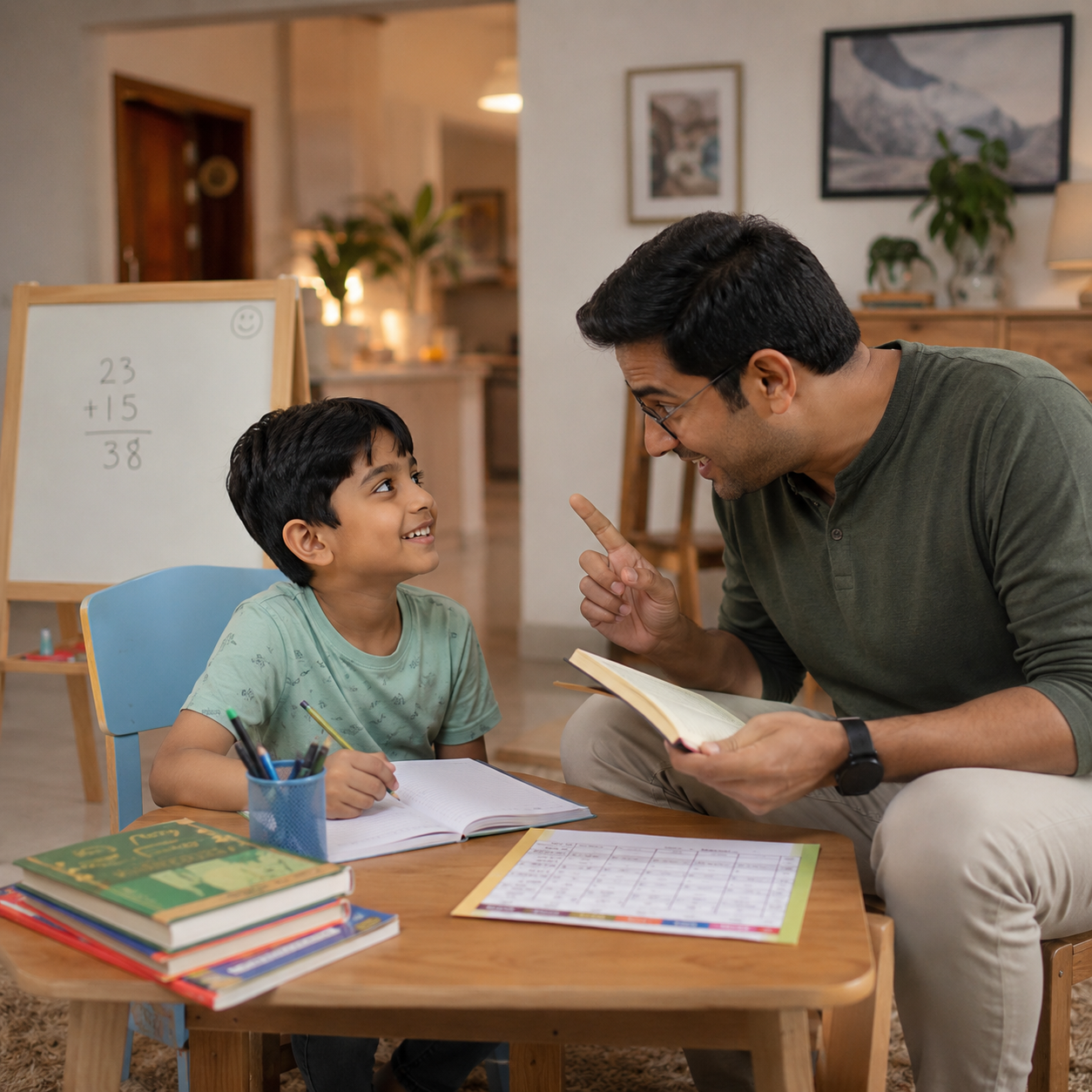
2. Turn homework into a school game
Sometimes children resist homework because it feels boring and lonely. A simple way to make it more interesting is to turn it into a pretend school game.
You become the teacher. Your child becomes the student. You can say things like:
“Good morning, class!”
“Today we are doing Maths period first.”
“Please open your notebook.”
“Very good answer. One star for neat work.”
“Now it’s English period.”
You can even make a small “class timetable” for the homework session:
Period 1: Maths
Period 2: English
Short break
Period 3: Hindi / EVS
This makes homework feel more playful and familiar. Many children enjoy role play, especially younger ones.
There is also a hidden benefit: you may get small insights into what happens in school. The child may copy their teacher’s tone, repeat classroom phrases, or tell you how things are done in class. You may learn whether they are scared of a subject, whether they enjoy a particular teacher, or whether they feel confused in class.
The idea is not to overact or make it complicated. Just make the homework environment a little lighter. Sometimes a child who refuses to “do homework” may happily “play school.”

3. Add physical exercises between subjects
Children are not machines. After school, classes, travel, noise, and screen exposure, their brains may be genuinely tired.
Sitting still for long periods can be especially hard for some children. Instead of forcing them to sit continuously, add short movement breaks between subjects or topics.
For example, after Maths, ask them to do:
Hanging from a bar for 20 seconds
10 monkey jumps
20 skips
Jumping on one leg till you count to 20
Wall push-ups
Animal walks
Stretching arms and legs
Running once around the room
Balancing on one foot
You can make it fun by giving small targets:
“I’ll count to 20. Let’s see if you can keep jumping till then.”
“Do 10 monkey jumps and then we start English.”
“Hang from the bar while I count slowly.”
“Balance on one leg like a flamingo.”
These short exercises give the tired brain a break. Movement helps release restlessness, improves alertness, and gives the child something to look forward to between subjects.
The break should be short and clear. It should not become a 30-minute play session. You can say:
“Two-minute body break, then we come back.”
This works especially well for children who get irritated, sleepy, or mentally blocked during homework.
4. Be persistent, even when there are tantrums
This is one of the hardest parts.
If a child learns that crying, shouting, arguing, or delaying can make homework disappear, they may repeat the same behaviour again and again.
This does not mean you should be harsh. It means you need to be calm and consistent.
For example, instead of saying:
“Fine, leave it. I can’t deal with this today.”
Try saying:
“I can see you’re upset. We can take two minutes to calm down, but homework will still happen.”
Or:
“You don’t have to do everything at once. But we will finish the first part.”
Children test boundaries. That is normal. If the routine changes every time they resist, they learn that resistance works. But if they see that homework still happens, even in a smaller or calmer way, the drama slowly reduces.
Persistence does not mean forcing a child for hours. It means not making homework optional because of tantrums.
You can reduce the task, break it into parts, give a movement break, sit closer, or change the order of subjects. But try not to completely skip it every time there is drama.
The message should be: “I will help you, but we will still do it.”
5. Be prepared with stationery
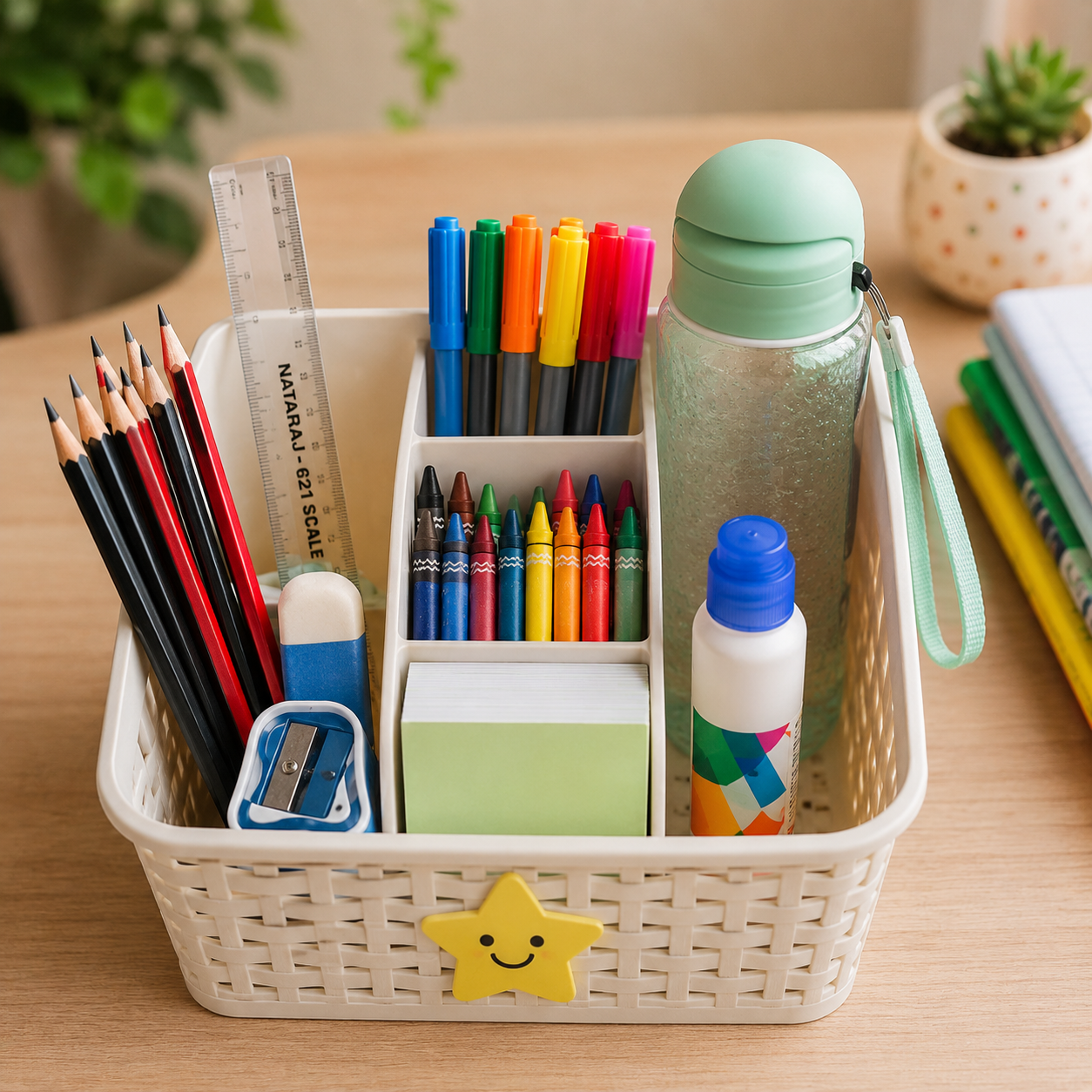 This may sound small, but it makes a big difference.
During homework, every small interruption can become an excuse to escape.
“My pencil broke.”
“I can’t find my eraser.”
“The sharpener is missing.”
“My scale is not here.”
“I need another notebook.”
By the time everything is found, the child has lost focus and the parent has lost patience.
Before homework starts, keep a small homework basket ready.
It can include:
- Sharpened pencils
- Eraser
- Sharpener
- Scale
- Crayons or colour pencils
- Glue stick
- Scissors, if needed
- Extra sheets
- Water bottle
- Rough notebook
If the pencil drops, quietly give another one. If the eraser is missing, hand over the spare. Try not to turn every small issue into a lecture.
The smoother the environment, the fewer chances the child gets to escape the task.
A prepared homework space tells the child: “We are ready. Let’s begin.”
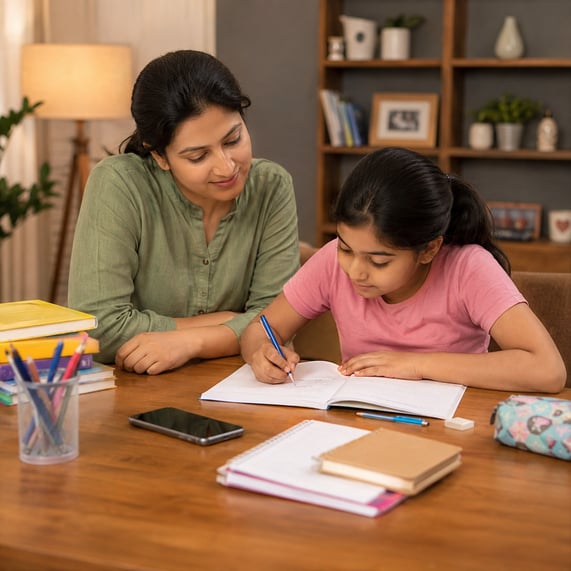
6. Sit with them without your phone
Children can sense when we are only half-present.
If you are sitting next to your child but scrolling your phone, checking messages, or replying to emails, the child may also lose seriousness. They may feel, “Mumma is busy anyway,” or “Homework is not important enough for full attention.”
For younger children especially, your presence matters.
Sit with them properly. Keep your phone away for that homework window. Even 30–40 minutes of focused attention can be more useful than two hours of distracted sitting.
This does not mean you have to do the homework for them. Your role is to guide, encourage, and keep them anchored.
You can say:
“Read the question aloud.”
“Try the first one. I’m sitting right here.”
“Show me how your teacher explained this.”
“Let’s do one line neatly, then the next.”
When you are fully present, children often settle faster. They feel supported, not abandoned with a pile of work.
This also helps you notice where the actual struggle is. Is the child avoiding work because they don’t understand? Are they tired? Are they careless? Are they scared of making mistakes? You can only notice these things when you are truly present.
7. Don’t lose patience
This is easier said than done.
Homework drama can test every bit of patience. But when the parent gets angry, the child’s brain often shuts down further. What started as homework resistance becomes a fear, anger, or crying cycle.
Try to keep your voice steady. If you feel yourself getting too angry, pause for a minute.
You can say:
“I need one minute. Then we’ll continue.”
“Let’s both take a deep breath.”
“We are not fighting. We are just finishing homework.”
Avoid using homework as a threat:
“Do it or I’ll cancel your playtime forever.”
“If you don’t finish, I won’t talk to you.”
“You are so lazy.”
These lines may get short-term obedience, but they create long-term negativity around learning.
Instead, focus on calm firmness.
“You are upset, but shouting will not help.”
“We will do one question at a time.”
“First finish this page, then you can take a break.”
“I know you can do this. I’m here.”
Children do not need a perfect parent during homework. They need a steady parent.
A simple homework routine that may work
Here is a sample structure you can try:
Step 1: Snack, water, and 15–20 minutes of rest after school
Step 2: Look at the written homework schedule together
Step 3: Start with the easiest or shortest subject
Step 4: Add a 2-minute physical break
Step 5: Move to the next subject
Step 6: Give encouragement for effort, not just correct answers
Step 7: End with packing the school bag for the next day
The routine should feel predictable. Children resist less when they know the beginning, middle, and end.
Final thought
Making a child sit for homework is not only about discipline. It is also about routine, connection, energy, and consistency.
A written schedule reduces surprises.
A school game makes it playful.
Movement breaks refresh the brain.
Persistence teaches that homework cannot be avoided through tantrums.
Prepared stationery reduces excuses.
Your phone-free presence makes the child feel supported.
Your patience keeps the environment safe.
Some days will still be difficult. That is normal. But when you keep the routine steady, homework slowly becomes less dramatic and more manageable.
The goal is not a perfect homework session every day.
The goal is a calmer one.



Leave a Reply