

 Summer Camp
 Reading Writing
 Book Club
 Calligraphy
 Creative Writing
 English Speaking
 Handwriting
 Library
 Phonics
 Story Telling
 Art and Craft
 Clay Moulding
 Drawing
 Painting
 Pottery
 Sketching
 Drama Theatre
 Personality Development
 Public Speaking
 Languages
 Arabic
 Chinese
 French
 German
 Hindi
Hindi Italian
 Japanese
 Korean
 Persian
 Portuguese
 Russian
 Spanish
 Turkish
 Uzbek
Uzbek Sports and Fitness
 Aerobics
 Athletics
 Badminton
 Basket Ball
 Chess
Chess Cricket
 Football
 Golf
Golf Gymnastics
 Hulahoop
 Karate
 Martial Arts
 Pickleball
 Rugby
Rugby Skating
 Swimming
 Taekwondo
 Tennis
 Volleyball
 Yoga
Yoga Zumba
Zumba Tuition Classes
 Accounts
 Biology
 Business Studies
 CBSE
CBSE Chemistry
 Commerce
 Economics
 Homework Classes
 IB Board
 IGCSE
IGCSE Mathematics
 Physics
 Psychology
 Science
 Social Studies
 Vedic Maths
 Dance and Music
 Ballet
 Bhangra
 Bharatnatyam
 Bollywood Dance
 Casio
Casio Dandiya and Garba
 Drums
Drums Flute
Flute Guitar
 Harmonium
 Hip Hop
 Jazz
Jazz Kathak
 Keyboard
 Piano
Piano Salsa
Salsa Shlokas
 Sitar
Sitar Tabla
Tabla Ukulele
 Violin
 Vocal
Vocal Play School
 STEM
STEM
 Abacus
 App Development
 Artificial intelligence
 Basic Computer Courses
 Canva
Canva Coding
 Graphic Design
 Lego
Lego Python
 Robotics
 Rubiks Cube
 Scrabble
 Scratch
 Website Development
 Winter Camp
 Workshops
 Diwali Workshop
 Easter
 Ganesh Mahotsav
 Guru Nanak Jayanti Workshop
 Holi
Holi Independence day workshop
 Janmashtami Workshop
 Mothers day
 Navratri Workshops
 Raksha Bandhan workshop
 Ramayana Workshop
 Spring Camp
 Valentines Day Workshops
 Festive
 Daycare
 Cooking and Food
 Spring Camp
 Contests and Competitions
 Special abled
 Republic Day Workshops
 Mela
Mela
 Mela
Mela Cognitive Development
 Mother-Toddler Program
-Jul-03-2026-06-59-25-1926-AM.webp?width=30&height=30&name=Smart_20Skills_20(2)-Jul-03-2026-06-59-25-1926-AM.webp) Smart Skills
Smart Skills
 Financial Literacy




Why After-School Activities Matter
From boosting confidence to building lifelong skills, after-school programs play a crucial role in your child’s development. Not only do these activities offer valuable opportunities for socialization, teamwork, and discovering new interests, but they also provide a structured environment that supports emotional and academic growth. However, if you're a working parent or juggling multiple commitments, fitting these activities into your family’s schedule can feel overwhelming. The good news? With a bit of planning, clear communication, and flexibility, it’s entirely possible to make after-school programs work for your family and ensure your child reaps all the benefits they have to offer.
Smart tips for busy parents to strike the right balance:
1. Choose What Truly Interests Your Child
Rather than signing up for multiple activities, focus on 1–2 that your child genuinely enjoys. By narrowing the choices, you help prevent overwhelm and create space for deeper engagement. This approach not only reduces stress but also allows your child to develop stronger skills and more meaningful connections within those activities. Additionally, concentrating on just a couple of interests makes it much easier to maintain a consistent routine, so neither you nor your child feels stretched thin or overcommitted.
Pro tip: Involve your child in the decision—it creates excitement and ownership.
2. Look for Nearby Classes or Online Options
- Conveniently located near your home or your child’s school, so getting there is quick and hassle-free
- Held right on your child’s school campus, making participation simple without extra commuting
- Accessible online, which is especially ideal for unique interests or niche hobbies like coding, chess, or languages, offering flexibility and a wider variety of options
BeeBuddy can help you find classes by location, age, and type—making shortlisting easy.
3. Plan for Downtime Too
Kids need breathing space after a structured school day. Transitioning from the classroom to a new activity can be overwhelming without time to pause and decompress. If the activity is immediately after school, make sure there’s a snack break or a chance for your child to unwind—this could be as simple as a few minutes of quiet time or a fun chat with friends. Giving kids a moment to recharge helps them show up with more energy and engagement. By prioritizing these buffers, you support your child’s well-being and set them up for a positive after-school experience.
4. Choose Fixed Days, Not Every Day
Try to pick fixed weekdays for activities instead of signing up for something every day, which can be exhausting and hard to keep up with. For instance,
- Tuesday/Thursday for dance
- Saturday for robotics or sports
This routine helps avoid last-minute schedule clashes with unexpected events or heavy homework nights, and ensures your child has a healthy balance between activities, schoolwork, and rest.
5. Coordinate With Other Parents
If your child’s friend is in the same class, carpooling becomes a game-changer. Sharing rides with another family not only saves you time and driving effort, but also gives your child a built-in buddy for the journey. This can make getting to and from activities feel less like a chore and more like a part of the fun. This system lightens the load for everyone involved, creates consistency, and even gives parents a chance to connect and coordinate together.
Bonus: It strengthens your child’s social circle too.
6. Talk to the Instructor or Organizers
Many classes are designed to accommodate busy family schedules, offering options like flexible batch timings, the ability to attend make-up sessions if your child misses a class, or even shorter trial versions so you can see if the activity is a good fit before committing long-term. Most organizers are happy to help families find a solution that fits their unique schedule.
7. Use Visual Planners at Home
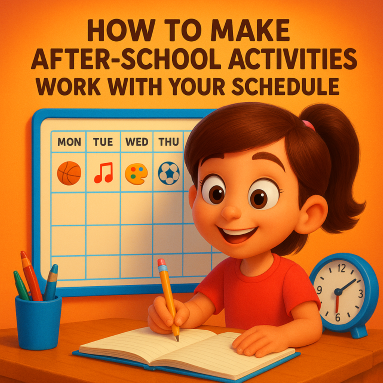
Create a weekly chart that clearly lays out school hours, activity slots, and dedicated time for play or rest. Display this chart somewhere visible—such as on the fridge or a family pinboard—so everyone at home knows the plan for the week. This kind of visual schedule not only cuts down on last-minute confusion but also empowers your child by letting them see and anticipate what’s coming up each day. When children are part of creating and following the weekly plan, they feel more in control and invested in their routines, making the whole family’s week run smoother.
Final Thoughts
After-school activities don’t have to be an added stress—they can fit beautifully into your child’s (and your!) weekly rhythm when chosen wisely. Prioritize what brings genuine joy and creates opportunities for learning and growth, not just what seems popular or what other families are doing. With a smart plan—like using a visual family schedule or thoughtfully coordinating logistics—you can seamlessly weave these activities into daily life. This balanced approach lets your child grow, explore new passions, and stay active, all while keeping family life harmonious and avoiding the burnout that can come from trying to do too much. The right activities, at the right pace, make for happier kids and a happier family.





Leave a Reply