

 Summer Camp
 Reading Writing
 Book Club
 Calligraphy
 Creative Writing
 English Speaking
 Handwriting
 Library
 Phonics
 Story Telling
 Art and Craft
 Clay Moulding
 Drawing
 Painting
 Pottery
 Sketching
 Drama Theatre
 Personality Development
 Public Speaking
 Languages
 Arabic
 Chinese
 French
 German
 Hindi
Hindi Italian
 Japanese
 Korean
 Persian
 Portuguese
 Russian
 Spanish
 Turkish
 Uzbek
Uzbek Sports and Fitness
 Aerobics
 Athletics
 Badminton
 Basket Ball
 Chess
Chess Cricket
 Football
 Golf
Golf Gymnastics
 Hulahoop
 Karate
 Martial Arts
 Pickleball
 Rugby
Rugby Skating
 Swimming
 Taekwondo
 Tennis
 Volleyball
 Yoga
Yoga Zumba
Zumba Tuition Classes
 Accounts
 Biology
 Business Studies
 CBSE
CBSE Chemistry
 Commerce
 Economics
 Homework Classes
 IB Board
 IGCSE
IGCSE Mathematics
 Physics
 Psychology
 Science
 Social Studies
 Vedic Maths
 Dance and Music
 Ballet
 Bhangra
 Bharatnatyam
 Bollywood Dance
 Casio
Casio Dandiya and Garba
 Drums
Drums Flute
Flute Guitar
 Harmonium
 Hip Hop
 Jazz
Jazz Kathak
 Keyboard
 Piano
Piano Salsa
Salsa Shlokas
 Sitar
Sitar Tabla
Tabla Ukulele
 Violin
 Vocal
Vocal Play School
 STEM
STEM
 Abacus
 App Development
 Artificial intelligence
 Basic Computer Courses
 Canva
Canva Coding
 Graphic Design
 Lego
Lego Python
 Robotics
 Rubiks Cube
 Scrabble
 Scratch
 Website Development
 Winter Camp
 Workshops
 Diwali Workshop
 Easter
 Ganesh Mahotsav
 Guru Nanak Jayanti Workshop
 Holi
Holi Independence day workshop
 Janmashtami Workshop
 Mothers day
 Navratri Workshops
 Raksha Bandhan workshop
 Ramayana Workshop
 Spring Camp
 Valentines Day Workshops
 Festive
 Daycare
 Cooking and Food
 Spring Camp
 Contests and Competitions
 Special abled
 Republic Day Workshops
 Mela
Mela
 Mela
Mela Cognitive Development
 Mother-Toddler Program
-Jul-03-2026-06-59-25-1926-AM.webp?width=30&height=30&name=Smart_20Skills_20(2)-Jul-03-2026-06-59-25-1926-AM.webp) Smart Skills
Smart Skills
 Financial Literacy




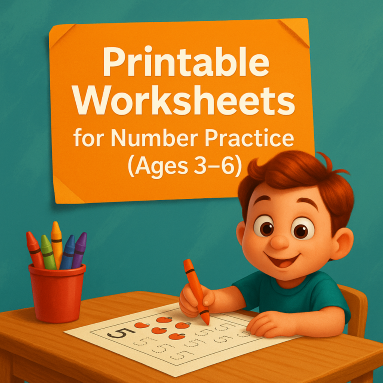
When it comes to early math learning, number practice is one of the first building blocks for children aged 3 to 6. At this stage, children are developing foundational numeracy skills that will set the tone for their future understanding of mathematics. Whether your child is just beginning to count aloud, recognizing numbers in everyday life, or starting to hold a pencil and trace digits, engaging, hands-on practice is key. Printable worksheets are a simple and effective way to reinforce these skills in a fun, screen-free format. These resources offer a variety of activities—such as tracing numbers, connecting dots, matching quantities to numerals, and simple counting exercises—that not only help solidify number recognition and counting but also build fine motor skills and boost confidence as children see their own progress.
Why Number Practice Matters in Early Years
Children between the ages of 3 and 6 are in a developmental stage where they begin understanding a variety of foundational concepts. During these formative years, children start developing:
- Counting and number recognition
- Basic comparisons like more vs. less
- Simple patterns and sequencing
- Number writing and fine motor skills
Regular exposure to numbers through playful practice and real-life situations helps build familiarity, confidence, and curiosity—all crucial traits for future math success.
Benefits of Using Worksheets
Printable worksheets are:
- Structured – Give clear direction and purpose, making it easy for children to understand what they are supposed to do
- Flexible – Can be used anytime, anywhere
- Repeatable – Easy to print again for practice, so children can revisit the same skills as often as needed
- Engaging – Include drawings, tracing paths, and coloring activities
- Customizable – You can adjust difficulty based on your child’s level
What to Look for in a Good Number Worksheet
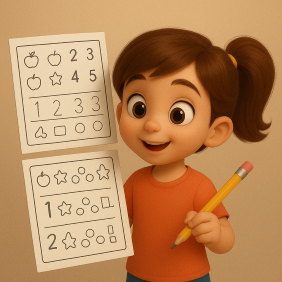
- Number Tracing – Practice writing 1–10 (and later, up to 20 or 50)
- Counting Objects – Visuals like apples, stars, or toys to count and color
- Matching Numbers to Quantities – Helps build number sense
- Dot-to-Dot Activities – Reinforces order of numbers while being fun
- Simple Mazes and Paths – Incorporate numbers into problem-solving
How to Use These Worksheets Effectively
- Make It a Routine: Set aside 10–15 minutes daily for number practice
- Mix and Match: Use a variety of formats to prevent boredom
- Add Physical Play: Pair worksheets with toys like number blocks or counting beads
- Praise Progress: Celebrate small wins like correctly writing a number, etc.
- Stick It on the Fridge: Let kids showcase their completed worksheets proudly!
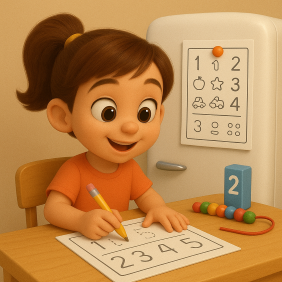
You’ll be able to download a complete set tailored for each age group—3–4, 4–5, and 5–6 years old. Each set is thoughtfully designed to support foundational number skills and early math development, making them perfect for use at home or in school. All worksheets are printable, easy to follow, and ready for immediate use. Download your free Number Practice Printables from here:



Leave a Reply