
 Summer Camp
 Reading Writing
 Book Club
 Calligraphy
 Creative Writing
 English Speaking
 Handwriting
 Library
 Phonics
 Story Telling
 Art and Craft
 Clay Moulding
 Drawing
 Painting
 Pottery
 Sketching
 Drama Theatre
 Personality Development
 Public Speaking
 Languages
 Arabic
 Chinese
 French
 German
 Hindi
Hindi Italian
 Japanese
 Korean
 Persian
 Portuguese
 Russian
 Spanish
 Turkish
 Uzbek
Uzbek Sports and Fitness
 Aerobics
 Athletics
 Badminton
 Basket Ball
 Chess
Chess Cricket
 Football
 Golf
Golf Gymnastics
 Hulahoop
 Karate
 Martial Arts
 Pickleball
 Rugby
Rugby Skating
 Swimming
 Taekwondo
 Tennis
 Volleyball
 Yoga
Yoga Zumba
Zumba Tuition Classes
 Accounts
 Biology
 Business Studies
 CBSE
CBSE Chemistry
 Commerce
 Economics
 Homework Classes
 IB Board
 IGCSE
IGCSE Mathematics
 Physics
 Psychology
 Science
 Social Studies
 Vedic Maths
 Dance and Music
 Ballet
 Bhangra
 Bharatnatyam
 Bollywood Dance
 Casio
Casio Dandiya and Garba
 Drums
Drums Flute
Flute Guitar
 Harmonium
 Hip Hop
 Jazz
Jazz Kathak
 Keyboard
 Piano
Piano Salsa
Salsa Shlokas
 Sitar
Sitar Tabla
Tabla Ukulele
 Violin
 Vocal
Vocal Play School
 STEM
STEM
 Abacus
 App Development
 Artificial intelligence
 Basic Computer Courses
 Canva
Canva Coding
 Graphic Design
 Lego
Lego Python
 Robotics
 Rubiks Cube
 Scrabble
 Scratch
 Website Development
 Winter Camp
 Workshops
 Diwali Workshop
 Easter
 Ganesh Mahotsav
 Guru Nanak Jayanti Workshop
 Holi
Holi Independence day workshop
 Janmashtami Workshop
 Mothers day
 Navratri Workshops
 Raksha Bandhan workshop
 Ramayana Workshop
 Spring Camp
 Valentines Day Workshops
 Festive
 Daycare
 Cooking and Food
 Spring Camp
 Contests and Competitions
 Special abled
 Republic Day Workshops
 Mela
Mela
 Mela
Mela Cognitive Development
 Mother-Toddler Program
-Jul-03-2026-06-59-25-1926-AM.webp?width=30&height=30&name=Smart_20Skills_20(2)-Jul-03-2026-06-59-25-1926-AM.webp) Smart Skills
Smart Skills
 Financial Literacy
 Mental Wellbeing
 Meditation
 Reiki
Reiki




The nursery admission season for the academic year 2026–27 is around the corner, and parents are gearing up for one of the most important milestones in their child’s early education journey. With increased competition and several key deadlines to keep in mind, it’s essential to stay well-informed and organized throughout the process. Being proactive will ensure you don’t miss out on any critical steps, from gathering necessary documents to tracking important dates. To help you stay ahead, here’s a detailed look at the tentative admission timeline:
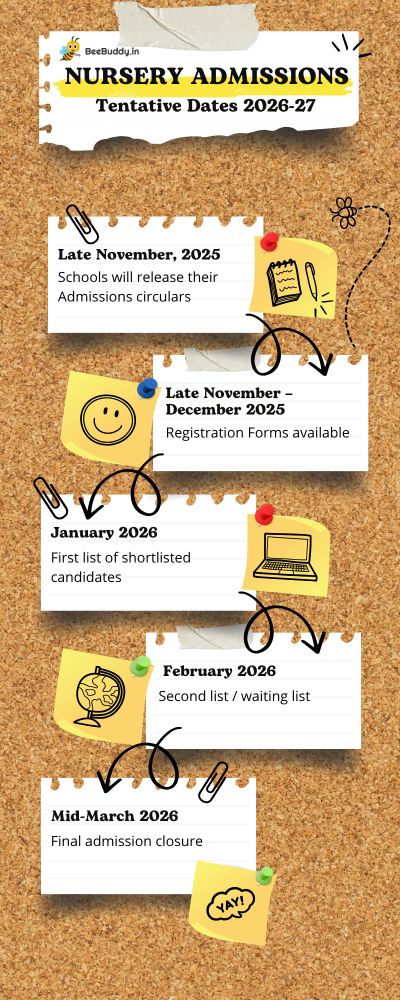
Tentative Timeline for Nursery Admissions 2026–27
- Late November 2025 : Schools will begin releasing their admission circulars. These documents outline eligibility criteria, age cut-offs, and other important details for parents.
- Late November – December 2025 : Registration forms will be made available by schools. Parents can begin filling out and submitting forms during this period.
- January 2026 : Schools will publish the first list of shortlisted candidates based on their selection criteria.
- February 2026 : A second list or waiting list will be released for any remaining seats.
- Mid-March 2026 : The final admission process will conclude, and schools will close the admission window for the session 2026–27
Stay tuned to BeeBuddy.in for verified updates, and expert guidance throughout the Nursery Admissions 2026–27 season.
Guidelines & Required Documents
Applying for your child’s nursery admission can be smoother when you have everything ready in advance. To help parents through the process, here’s a complete checklist of the required documents and an overview of the guidelines issued by the Directorate of Education (DoE) for Delhi schools.
Documents Required for Nursery Admissions
Before starting the application process, make sure you have clear, valid copies of the following documents:
- Birth Certificate – Issued by a municipal authority or equivalent as proof of age.
- Address Proof – Any one of the following:
Ration card issued in parents’ name (child’s name must be mentioned)
Domicile certificate of the child or of the parents
Voter ID / Aadhaar card / Electricity bill / Water bill / Passport (any one valid address proof)
- Photographs – Passport-sized photos of the child, father, and mother/guardian.
- Proof of Sibling (if applicable) – If a real sibling is studying in the same school, submit the school ID card or fee receipt.
- Proof of Alumni (if applicable) – School certificate or mark sheet showing that one of the parents is an alumnus of the same school.
- Proof of Firstborn Child (if applicable) – For schools giving points under this criterion, a self-declaration may be required
- First/Girl child affidavit : Most of the schools were fine with a common affidavit attested by a Notary. There were some exceptions here e.g. one school had their own format for the affidavit. Another schools needed this signed and attested by a Magistrate or higher authority.
You can download a sample of this affidavit by clicking here.
The Application Process for Nursery Admissions 2026–27
The Nursery Admission process for the academic session 2026–27 in Delhi is set to begin late November , 2025, as per the schedule announced by the Directorate of Education (DoE). Parents can choose to apply online or offline, depending on the school’s application system.
Online Application:
Many private unaided schools in Delhi offer online application forms on their official websites. Parents can:
-
Visit the school’s website and navigate to the Admissions/Nursery Admissions 2026–27 section.
-
Fill out the registration form carefully, ensuring all details match the supporting documents.
-
Upload required documents, such as the child’s birth certificate, address proof, and photographs.
-
Pay the registration fee online (if applicable) through the school’s payment gateway.
-
Download and save a copy of the submitted application form and payment receipt for future reference.
Offline Application:
For schools accepting offline applications:
-
Parents can collect the admission form directly from the school office during working hours starting Late November, 2025.
-
Fill in the form manually and attach self-attested photocopies of all required documents.
-
Submit the completed form to the school along with the registration fee (if applicable).
-
Keep the acknowledgment slip or receipt as proof of submission.
Admission Selection Process
The selection process for nursery admissions in Delhi’s private unaided schools follows a points-based system set by each individual school. While the specific criteria and weightage may differ, all schools must ensure transparency and compliance with the guidelines issued by the Directorate of Education (DoE) for the 2026–27 academic session.
- Distance from the School : Priority is often given to children living close to the school. Higher points are awarded to applicants residing within a specific distance range (for example, within 0–3 km).
- Sibling Studying in the School : Additional points are granted if an older sibling is already enrolled in the same school, promoting family continuity.
- Alumni Connection : Some schools provide extra points if one or both parents are alumni of the institution.
- Girl Child / Firstborn (if applicable) : Certain schools may include additional parameters such as the girl child or firstborn criteria as part of their point system.
BeeBuddy Tip : Before applying, review your shortlisted schools’ admission criteria and point allocation carefully. This helps you understand where your child stands and increases your chances of selection.
Reserved Seats for Nursery Admissions 2026–27
In accordance with the Right to Education (RTE) Act, 2009 and the Directorate of Education (DoE), Delhi, every private unaided school is required to reserve 25% of total nursery seats for specific categories of children. This ensures equal access to quality education for all sections of society.
Categories Under Reserved Seats:- Economically Weaker Section (EWS) : Children belonging to families with an annual income of up to ₹1 lakh (as per the latest DoE norms) are eligible under this category.
- Disadvantaged Group (DG) : This includes children belonging to Scheduled Castes (SC), Scheduled Tribes (ST), Other Backward Classes (OBC Non-Creamy Layer), and other recognized disadvantaged communities.
- Children with Disabilities (CwD) : As defined under the Rights of Persons with Disabilities Act, 2016, this category includes children with benchmark disabilities who are entitled to admission under the reserved quota.
- A minimum of 25% of total entry-level seats (Nursery, KG, or Class 1) in each private unaided school are set aside for EWS/DG/CwD categories.
- The admission process for these categories is conducted centrally through the DoE’s online portal, not directly by individual schools.
- Schools cannot charge any application or admission fee for these reserved category seats.
Key Timeline (Tentative for 2026–27)
The EWS/DG/CwD online admission process is expected to start around December 2025, shortly after general admissions open. Parents can apply through the official DoE website by filling out the registration form and uploading the required documents.
BeeBuddy Tip : If you’re applying under the EWS, DG, or CwD categories, keep your income, caste, or disability certificates ready and valid before the admission window opens.
Prohibited Criteria for Nursery Admissions 2026–27
To ensure transparency and equal opportunity in the nursery admission process, the Delhi Directorate of Education (DoE) has clearly defined a set of criteria that schools are strictly prohibited from considering when selecting applicants. These exclusions are designed to prevent any form of bias or discrimination during the admissions process and to uphold the principle of fairness for all children. Since 2016, the Delhi government has actively reformed the admission guidelines by eliminating parameters that were viewed as discriminatory or irrelevant, such as interviews with parents or children, parents’ educational backgrounds, professions, or income levels, and other subjective or non-merit-based factors. By enforcing these restrictions, the DoE aims to create a level playing field, ensuring that every child has an equal chance of gaining admission, regardless of their background.
Schools are strictly prohibited from considering the following factors while assigning points or shortlisting candidates:
- Parents’ Educational Qualifications : Schools cannot give preference to applicants based on the academic background or degrees of the parents.
- Parents’ Employment Status or Occupation : Employment type or professional position of either parent cannot be used as a criterion for admission.
- Food Habits, Cultural, or Religious Background : Any criteria related to a family’s food habits (e.g., vegetarian/non-vegetarian), cultural practices, or religious affiliation are not permitted.
Make the Admission Process Stress-Free!
With these resources and tips at your disposal, you can confidently navigate each stage of the nursery admission process. Whether it’s preparing documents, understanding admission criteria, or keeping up with deadlines, everything you need is right here for quick reference. Make sure to bookmark this guide so you can easily access important information whenever you need it during your child’s nursery admission journey. Remember, we’re committed to supporting you at every step—if you have any questions or need further assistance, you can always reach out. Together, we’ll help you make the admission process smooth and stress-free!